Skip to content
You can now search across every topic, entity and event.What's new
European Energy Markets
31JUL

Iran hits US bases in Kuwait, Bahrain

3 min read
09:44UTC

The IRGC fired ballistic missiles and drones at US bases in Kuwait and Bahrain on 28 June, the first such strike since the 16 June ceasefire and the first to kill a Gulf civilian.

EconomicDeveloping
Key takeaway

Iran returned to striking US bases in Kuwait and Bahrain, the first such blow since the 16 June truce.

Iran fired ballistic missiles and drones at two US bases in two Gulf states on Sunday 28 June, and Washington's answer was to stand down 1. The IRGC (Islamic Revolutionary Guard Corps), Iran's ideological military force, hit Ali Al Salem air base in Kuwait and the US Fifth Fleet headquarters at Port Salman in Bahrain 2. The IRGC had struck these same two bases once before, a seven-missile salvo on 5-6 June ; the truce signed on 16 June then pushed Iran's pressure offshore onto tankers. Returning to the bases, now with drones added to the missiles, is the hardest test of that truce since it was signed.

The IRGC released video of its launches, with anti-Trump messages written on the missiles, and claimed eight US sites were hit 3. US officials denied any damage or casualties at their facilities 4. No independent battle-damage assessment has settled the two accounts. A Qatari citizen was killed by shrapnel amid the strikes; Qatar attributed the death to "military operations in the area" and did not name Iran 5.

Kuwait condemned the attack as "repeated heinous Iranian aggressions" and a violation of its sovereignty; Bahrain said it had undermined de-escalation 6. The strikes capped a four-day ladder that ran from the drone attack on the tanker Ever Lovely to ballistic missiles landing near a Gulf capital's airport. Each earlier rung had drawn a measured US reply, which left Washington choosing between the devastation Trump has promised and the de-escalation he keeps reaching for.


Deep Analysis

In plain English

Iran's military wing, called the Islamic Revolutionary Guard Corps or IRGC, fired missiles and attack drones at two US military bases on 28 June 2026. One base, called Ali Al Salem, sits in Kuwait, a small country at the top of the Persian Gulf. The other target was the headquarters of the US Navy's Fifth Fleet in Bahrain, a tiny island nation nearby. Both Kuwait and Bahrain are independent countries that have agreed to host American forces. A Qatari citizen (from Qatar, another Gulf country) was killed by metal debris from the explosions. Qatar, which is trying to stay in position as a peace negotiator, said the death was caused by 'military operations in the area' without naming Iran directly. CENTCOM, the US military command for the Middle East, said no personnel were harmed at either base. Iran's military claimed to have hit eight locations and released videos showing missiles with anti-Trump slogans on them, a detail that tells you part of the strike was designed as a political message inside Iran, not purely a military operation. The attack happened on the same day Iran was supposed to attend peace talks, which it skipped.

Deep Analysis
Root Causes

Iran's IRGC Khatam al-Anbia Central Headquarters reports directly to the Supreme Leader's office and does not require civilian foreign ministry authorisation for strike decisions. This dual command structure means military escalation and civilian diplomacy can run simultaneously without internal contradiction: Araghchi's representatives were absent from the scheduled technical session on 28 June while the IRGC was launching ballistic missiles at US facilities in two countries.

The 16 June MOU's absence of a published text provides no constraint the IRGC must visibly violate before acting, because each side holds its own interpretation of what constitutes a breach.

The anti-Trump inscriptions on IRGC missiles reflect a structural domestic pressure that operates independently of the external conflict. Revolutionary legitimacy inside Iran requires visible confrontation with the United States, particularly as economic conditions have deteriorated since February 2026.

Striking symbolic targets while stopping short of US casualties is the IRGC's historically consistent method for satisfying that domestic requirement without triggering maximum American retaliation.

What could happen next?
  • Consequence

    Kuwait and Bahrain publicly condemned the strikes, indicating both Gulf host states will not stay silent through repeat IRGC base attacks, raising the diplomatic cost for any further salvo.

    Immediate · Reported
  • Risk

    The first Qatari civilian death attributable to the conflict creates a humanitarian record that could complicate Qatar's mediating neutrality if attributed to Iran by independent investigation.

    Short term · Assessed
  • Precedent

    The IRGC's anti-Trump missile inscriptions establish a domestic legitimacy framing that constrains any Iranian government from de-escalating without being seen to capitulate to the same president it publicly mocked.

    Medium term · Assessed
First Reported In

Update #141 · Iran hits two US bases; Trump pulls back

Al Jazeera· 30 Jun 2026
Read original
Causes and effects
This Event
Iran hits US bases in Kuwait, Bahrain
Iran's return to striking US bases on allied Gulf soil, with a Gulf civilian dead, is the hardest test the 16 June truce has faced.
Different Perspectives
Spain's LNG terminal operators
Spain's 9,145 GWh terminal inventory is the largest single stock in the EU LNG network, an option value that can reroute cargoes wherever the winter strip pays best rather than a cavern gas obligation tied to a fixed date. That flexibility matters more as Germany's cavern shortfall pushes more of the winter security question onto import infrastructure.
European Commission
European Commission
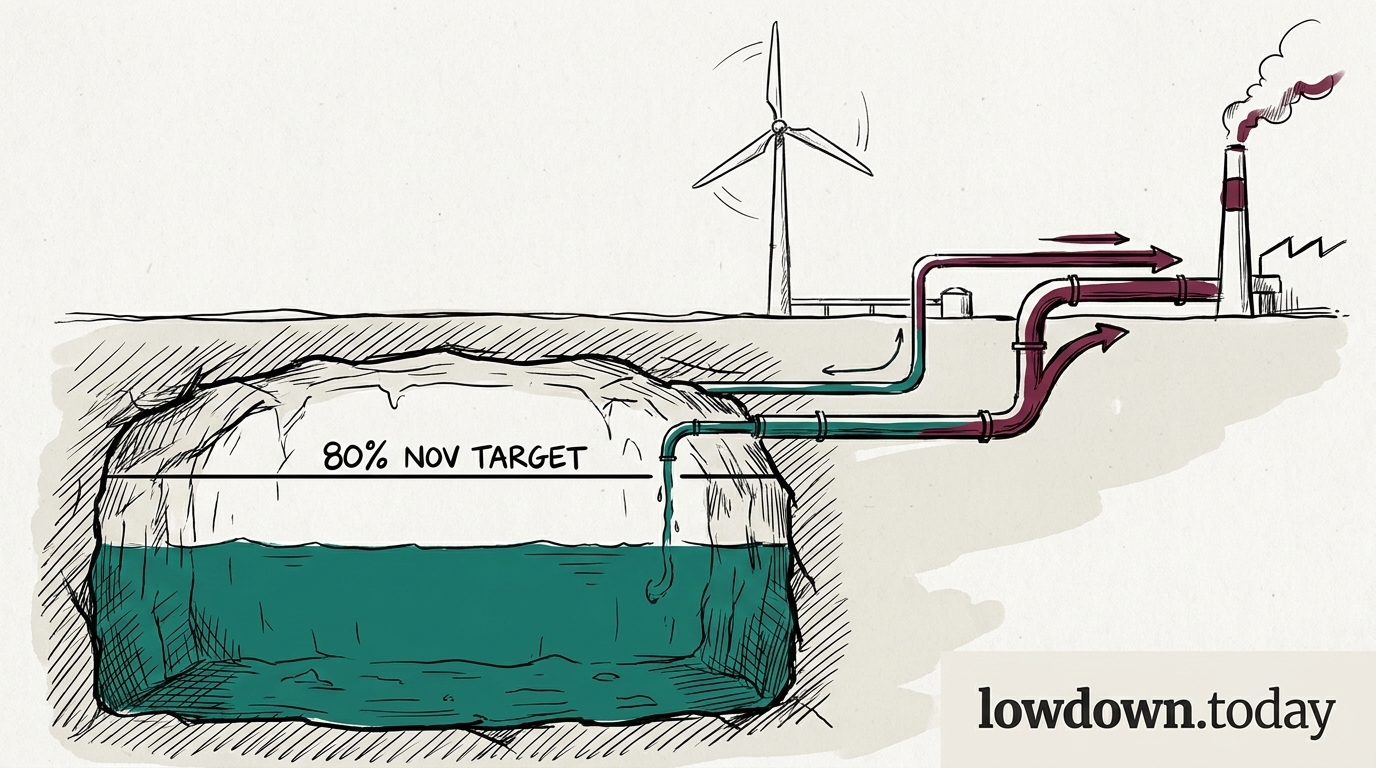
Brussels holds the bloc to 90% on a flexible window while Germany, holding roughly a quarter of EU storage capacity, tracks toward missing its own lower 80% figure by 21 points. A national shortfall this size in the anchor market matters more to bloc security than the flexible timetable alone can absorb.
French power exporters and CRE
French day-ahead rose in step with Germany but by less, reopening a EUR 7-17 premium that makes northward export flows commercially attractive again after the EUR 43.09 discount evaporated in days. CRE separately authorised RTE and Enedis to buy flexibility locally, betting the coming winter's binding constraint is grid congestion rather than a shortage of firm capacity.
TTF trading desk
TTF trading desk
A visible national shortfall like Germany's 21-point gap is a directional signal, not noise, for a desk holding the summer-winter spread. TTF's flat EUR 58-60 range through this week's German price swings says the market has not yet chosen to reprice refill risk into the front of the curve.
German cavern and CCGT operators
German caverns kept buying prompt gas at TTF near EUR 58-60 through the inversion; the wind collapse to 2.4 GW then flipped the spark spread to plus EUR 29 and put turbines back in the same queue. Every day turbines win that bid, injection at a third of the 877 GWh/day pace needed falls further behind.
Slovakia
Slovakia
Slovakia says it dropped its hold-out on the 21st sanctions package only after Ursula von der Leyen personally signed written gas-price and supply guarantees. The Council of the European Union's own 17,238-character release on the package names neither Slovakia nor any guarantee, leaving Bratislava's account unconfirmed by the institutional record.



