Skip to content
You can now search across every topic, entity and event.What's new
European Energy Markets
31JUL

IRGC salvo hits two Gulf states at once

3 min read
09:44UTC

The IRGC fired seven ballistic missiles at US bases in Kuwait and Bahrain overnight 5-6 June, the largest simultaneous two-country launch of the war. CENTCOM reported intercepting six; the seventh missed.

EconomicDeveloping
Key takeaway

Iran's first two-country missile salvo widens the war as Gulf interceptor stocks run low.

The IRGC (Islamic Revolutionary Guard Corps) fired seven ballistic missiles at US bases in Kuwait and Bahrain in a single salvo overnight 5-6 June, the largest simultaneous two-country launch of the war, according to Iranian state media corroborated by The National and RFE/RL 1. CENTCOM (US Central Command) reportedly intercepted six; the seventh is said to have missed its target. Neither side confirmed casualties, and CENTCOM published no statement Lowdown could independently retrieve, so the count rests on Iranian-origin reporting.

The exchange ran in sequence. The IRGC first warned four tankers transiting Hormuz without coordination; CENTCOM then struck Iranian coastal radar at Goruk and on Qeshm Island and downed four one-way attack drones over the strait; the missile salvo followed.

This breaks the pattern of earlier strikes. The 3 June airport drone and the 31 May two-missile attack on Kuwait each hit a single state. Saturday's salvo hit two, and Bahrain hosts the US Fifth Fleet headquarters. The widening drains munitions as much as it sends a message: Bahrain is defending Fifth Fleet HQ on a PAC-3 (Patriot Advanced Capability-3) magazine reported at 87 per cent depletion with an 18-month resupply gap . Each larger salvo leaves fewer rounds for the next.


Deep Analysis

In plain English

In a single overnight operation, Iran's Revolutionary Guard (IRGC) fired seven ballistic missiles at US military bases in two separate Gulf countries simultaneously, Kuwait and Bahrain, while also warning four oil tankers in the Strait of Hormuz to get out and attacking radar stations on the ground. It is the most ambitious single military operation the IRGC has attempted since the war began. US forces, known as CENTCOM (US Central Command), intercepted six of the seven missiles. One missed its target without confirmed casualties. CENTCOM had also struck two Iranian radar stations beforehand, which appears to have been what triggered the salvo. No deaths from the missiles were confirmed by either side, but this does not mean the situation is under control: Bahrain's missile interceptors (PAC-3) are nearly exhausted, and resupply takes 18 months.

Deep Analysis
Root Causes

The IRGC's Decentralised Mosaic Defence, activated on 28 February 2026, devolves launch authority to 31 autonomous provincial units. This structural decentralisation means the Iranian Foreign Ministry's negotiating posture and the IRGC's operational tempo are institutionally decoupled. Araghchi can signal flexibility on the nuclear file while provincial IRGC commanders independently escalate the salvo count.

Bahrain's PAC-3 depletion and its exclusion from the 2 May emergency resupply authorisation created an identified target gap. The IRGC's intelligence on Gulf air-defence magazine levels has been consistent throughout the conflict; the timing of the two-country salvo, coming three days after the single-target airport drone, reflects deliberate magazine-exhaustion strategy.

Escalation

The seven-missile, two-country simultaneous salvo represents a step-change from the sequential attacks documented since 31 May . Each prior attack targeted a single state or single facility; this attack split the defensive problem.

The next escalatory threshold would be a salvo that exhausts Bahrain's remaining eight PAC-3 rounds or targets a facility where US personnel are present in numbers that preclude a no-casualty outcome. The combination of Bahrain's magazine depletion and the 18-month resupply lag means that threshold is reachable within weeks at the current salvo tempo.

What could happen next?
  • Risk

    Bahrain's PAC-3 magazine is near exhaustion; a second simultaneous two-country salvo within weeks could break through defences before resupply arrives.

    Immediate · Assessed
  • Consequence

    The two-country simultaneous format demonstrates the IRGC's Decentralised Mosaic Defence has recovered enough coordination to deliver complex multi-vector operations despite command attrition.

    Short term · Assessed
  • Risk

    IRGC provincial commanders operating under devolved launch authority may continue escalating independently of Tehran's negotiating track, making the deal timeline and the military timeline structurally uncoupled.

    Short term · Reported
First Reported In

Update #119 · Trump's Iran deal: 95% done, 0% signed

Press TV· 6 Jun 2026
Read original
Causes and effects
This Event
IRGC salvo hits two Gulf states at once
Iran has dropped the limit it had observed of retaliating only against the state that provoked it. Striking two Gulf states at once widens the war and drains thinning interceptor stocks faster than they can be refilled.
Different Perspectives
Spain's LNG terminal operators
Spain's 9,145 GWh terminal inventory is the largest single stock in the EU LNG network, an option value that can reroute cargoes wherever the winter strip pays best rather than a cavern gas obligation tied to a fixed date. That flexibility matters more as Germany's cavern shortfall pushes more of the winter security question onto import infrastructure.
European Commission
European Commission
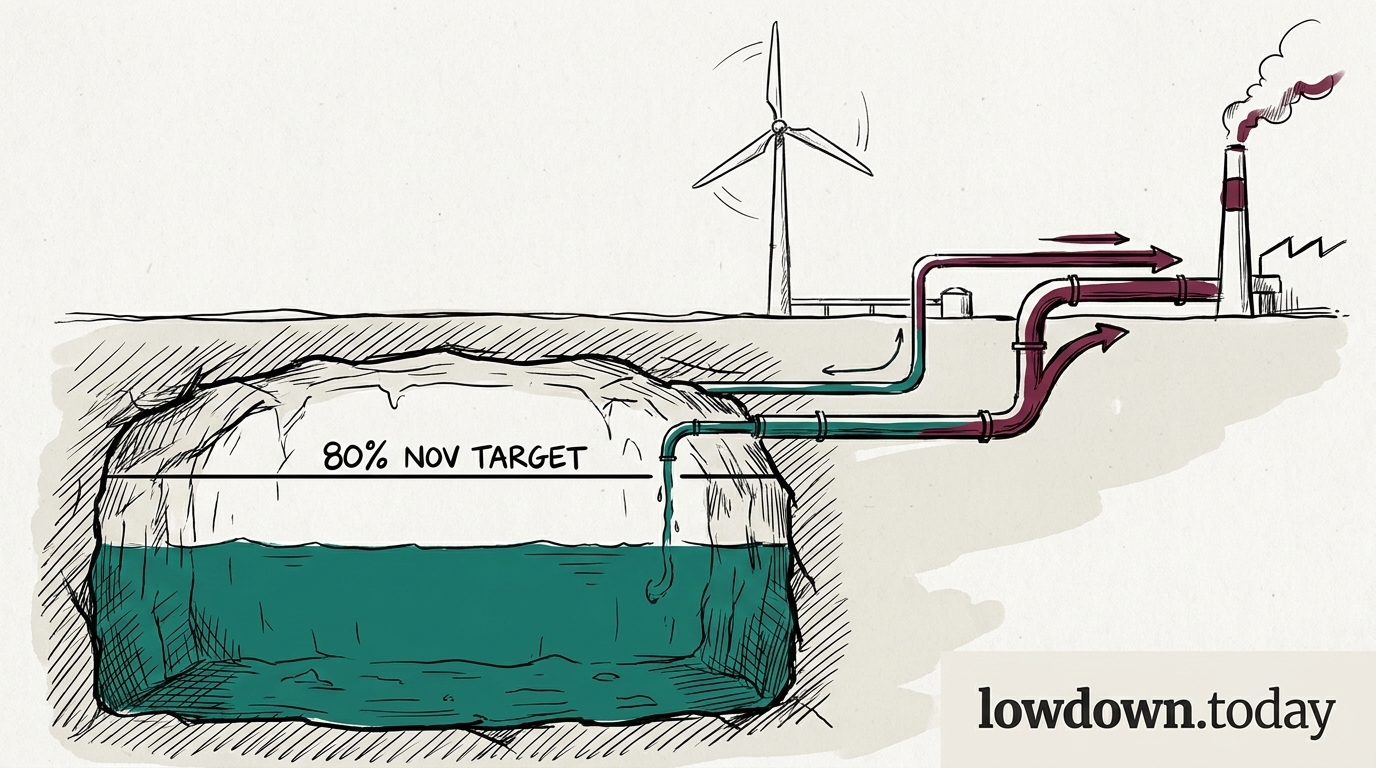
Brussels holds the bloc to 90% on a flexible window while Germany, holding roughly a quarter of EU storage capacity, tracks toward missing its own lower 80% figure by 21 points. A national shortfall this size in the anchor market matters more to bloc security than the flexible timetable alone can absorb.
French power exporters and CRE
French day-ahead rose in step with Germany but by less, reopening a EUR 7-17 premium that makes northward export flows commercially attractive again after the EUR 43.09 discount evaporated in days. CRE separately authorised RTE and Enedis to buy flexibility locally, betting the coming winter's binding constraint is grid congestion rather than a shortage of firm capacity.
TTF trading desk
TTF trading desk
A visible national shortfall like Germany's 21-point gap is a directional signal, not noise, for a desk holding the summer-winter spread. TTF's flat EUR 58-60 range through this week's German price swings says the market has not yet chosen to reprice refill risk into the front of the curve.
German cavern and CCGT operators
German caverns kept buying prompt gas at TTF near EUR 58-60 through the inversion; the wind collapse to 2.4 GW then flipped the spark spread to plus EUR 29 and put turbines back in the same queue. Every day turbines win that bid, injection at a third of the 877 GWh/day pace needed falls further behind.
Slovakia
Slovakia
Slovakia says it dropped its hold-out on the 21st sanctions package only after Ursula von der Leyen personally signed written gas-price and supply guarantees. The Council of the European Union's own 17,238-character release on the package names neither Slovakia nor any guarantee, leaving Bratislava's account unconfirmed by the institutional record.



