Skip to content
You can now search across every topic, entity and event.What's new
European Energy Markets
31JUL

India faces three Iran tracks, speaks on one

3 min read
09:44UTC

India's Ministry of External Affairs engaged Tehran at high level on 23 April after the Epaminondas was seized carrying cargo bound for Mundra port in Gujarat. The MEA has held public silence for eight days on the 15 April OFAC designations naming Indian nationals and India-registered firms in the Shamkhani network.

EconomicDeveloping
Key takeaway

Delhi is handling three Iran tracks but has chosen to speak on only the one with Indian crews at sea.

India's Ministry of External Affairs engaged Tehran at high level on 23 April after the Epaminondas was seized carrying cargo bound for Mundra port in Gujarat 1. The engagement routed through the same ministry that has now held public silence for eight days on the 15 April OFAC designations of the Shamkhani network , which named Chetan Prakash Balhotra, Navi Mumbai-registered Fleet Tanqo Private Limited and other Indian firms .

Foreign Secretary Vikram Misri demarched Iran's ambassador Fathali on 18 April after the IRGC fired on the Indian tankers Sanmar Herald and Jag Arnav . Three Iran tracks now converge on Misri's office inside a week: tanker firings producing a demarche, OFAC sanctions producing silence and the Epaminondas producing quiet diplomacy.

Delhi cannot publicly demand the corps stop firing on Indian-bound vessels while staying silent on Treasury sanctions targeting Indian firms that help Iran evade the same sanctions those vessels operate inside. India is the largest non-Chinese user of Iranian-routed crude, so every week the MEA holds the line leaves Mumbai and Chennai operators unable to price their next cargo. Misri's office has chosen the shipping file over the sanctions file because Indian crews are at sea and Indian firms are on paper.


Deep Analysis

In plain English

India faces three separate problems from the Iran conflict, all landing at once on 23 April. First, an Indian-bound cargo ship was seized by Iran's military in the Strait of Hormuz. Second, the US Treasury named Indian companies and individuals as part of an Iranian oil-smuggling network called the Shamkhani network. Third, the US government's waiver that allowed Indian refineries to legally buy Iranian oil expired with no renewal. India is one of the world's largest oil importers and has historically bought cheap Iranian crude despite US sanctions. It has also been developing a major port at Chabahar in Iran, which India views as its gateway to Central Asia and Afghanistan. New Delhi has been trying to stay on good terms with both the US and Iran, but these three simultaneous developments make that balancing act harder. It is now publicly engaged on the first problem (the ship seizure) while publicly silent on the other two, which carry greater long-term legal and economic risk.

What could happen next?
  • Risk

    Indian banks processing transactions for OFAC-designated Indian firms in the Shamkhani network face US correspondent banking sanctions after a 60-day wind-down period, creating systemic risk for India's banking sector connectivity to the dollar system.

First Reported In

Update #77 · Pentagon: six months to clear Hormuz mines

UK Foreign, Commonwealth and Development Office· 23 Apr 2026
Read original
Different Perspectives
Spain's LNG terminal operators
Spain's 9,145 GWh terminal inventory is the largest single stock in the EU LNG network, an option value that can reroute cargoes wherever the winter strip pays best rather than a cavern gas obligation tied to a fixed date. That flexibility matters more as Germany's cavern shortfall pushes more of the winter security question onto import infrastructure.
European Commission
European Commission
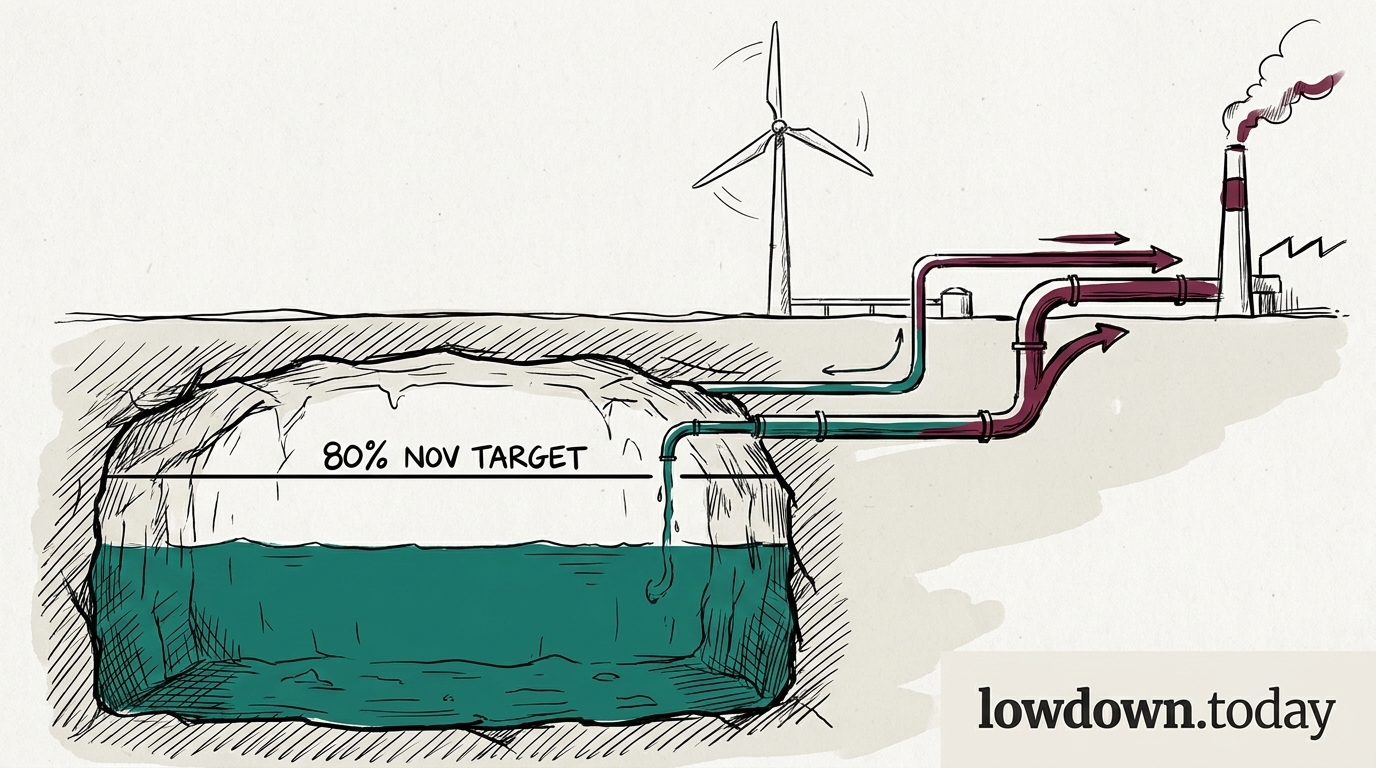
Brussels holds the bloc to 90% on a flexible window while Germany, holding roughly a quarter of EU storage capacity, tracks toward missing its own lower 80% figure by 21 points. A national shortfall this size in the anchor market matters more to bloc security than the flexible timetable alone can absorb.
French power exporters and CRE
French day-ahead rose in step with Germany but by less, reopening a EUR 7-17 premium that makes northward export flows commercially attractive again after the EUR 43.09 discount evaporated in days. CRE separately authorised RTE and Enedis to buy flexibility locally, betting the coming winter's binding constraint is grid congestion rather than a shortage of firm capacity.
TTF trading desk
TTF trading desk
A visible national shortfall like Germany's 21-point gap is a directional signal, not noise, for a desk holding the summer-winter spread. TTF's flat EUR 58-60 range through this week's German price swings says the market has not yet chosen to reprice refill risk into the front of the curve.
German cavern and CCGT operators
German caverns kept buying prompt gas at TTF near EUR 58-60 through the inversion; the wind collapse to 2.4 GW then flipped the spark spread to plus EUR 29 and put turbines back in the same queue. Every day turbines win that bid, injection at a third of the 877 GWh/day pace needed falls further behind.
Slovakia
Slovakia
Slovakia says it dropped its hold-out on the 21st sanctions package only after Ursula von der Leyen personally signed written gas-price and supply guarantees. The Council of the European Union's own 17,238-character release on the package names neither Slovakia nor any guarantee, leaving Bratislava's account unconfirmed by the institutional record.



