Skip to content
You can now search across every topic, entity and event.What's new
European Energy Markets
31JUL

Delhi stays silent seven days on OFAC designations

2 min read
09:44UTC

Lowdown Desk

EconomicDeveloping
Key takeaway

Delhi has held seven days of silence on OFAC's Shamkhani designations as VLCCs gather at India-operated Chabahar.

India's Ministry of External Affairs (MEA) maintained public silence for seven days on the 15 April OFAC designations naming five Indian nationals and eight India-registered firms in the Shamkhani network . The first acknowledgement, whenever it comes, will land against a sharper operational backdrop than it would have a week ago.

Chabahar operational rights, held by India under a 2016 agreement with Tehran, create a direct India-US exposure as Windward detected seven VLCCs there on 20 April. The same MEA earlier summoned Iran's ambassador over IRGC fire on Sanmar Herald and Jag Arnav , a quicker reflex when Indian-flagged bottoms were hit than when Indian nationals appeared on a US Treasury list. The silence is telling diplomatic economy: Delhi prefers to acknowledge neither the designations nor the Chabahar arithmetic on the same stage.


Deep Analysis

In plain English

On 15 April, the US Treasury's sanctions office named five Indian citizens and eight Indian companies as part of a network helping Iran's former national security adviser, Ali Shamkhani, move money. This is a serious step: it means those individuals and companies are now on a US blacklist, and any bank doing business with them faces potential US penalties. India's foreign ministry has not said a single word about this in seven days. They responded much faster , within 24 hours , when Iranian gunboats fired on Indian-flagged ships. Meanwhile, India holds the operating rights at Chabahar, the Iranian port where seven large oil tankers were detected on 20 April. If those ships are loading Iranian crude, India's operational role at the port puts it directly in the middle of US-Iran sanctions enforcement.

Deep Analysis
Root Causes

India's exposure on the Shamkhani designations has three structural components that the MEA cannot address simultaneously. The 2016 Chabahar agreement gives Delhi operational rights at a port where Iranian crude is now loading under conditions OFAC has not yet targeted but legally could.

The Shamkhani network designations name Indian nationals and firms in a sanctions list that creates secondary-sanctions liability for Indian banks processing those entities' transactions.

India's overall crude import diversification strategy, designed to reduce Gulf dependence, identified Iranian crude as one of three non-Gulf sources, a strategy US maximum-pressure policy directly undermines.

What could happen next?
  • Risk

    Delhi's silence becomes untenable if CENTCOM or OFAC targets Chabahar-loaded cargoes, forcing India to either enforce US sanctions at its own port or publicly oppose them , both options with significant economic and diplomatic cost.

First Reported In

Update #76 · Trump posts an exit Iran can't reach

Iran International· 22 Apr 2026
Read original
Different Perspectives
Spain's LNG terminal operators
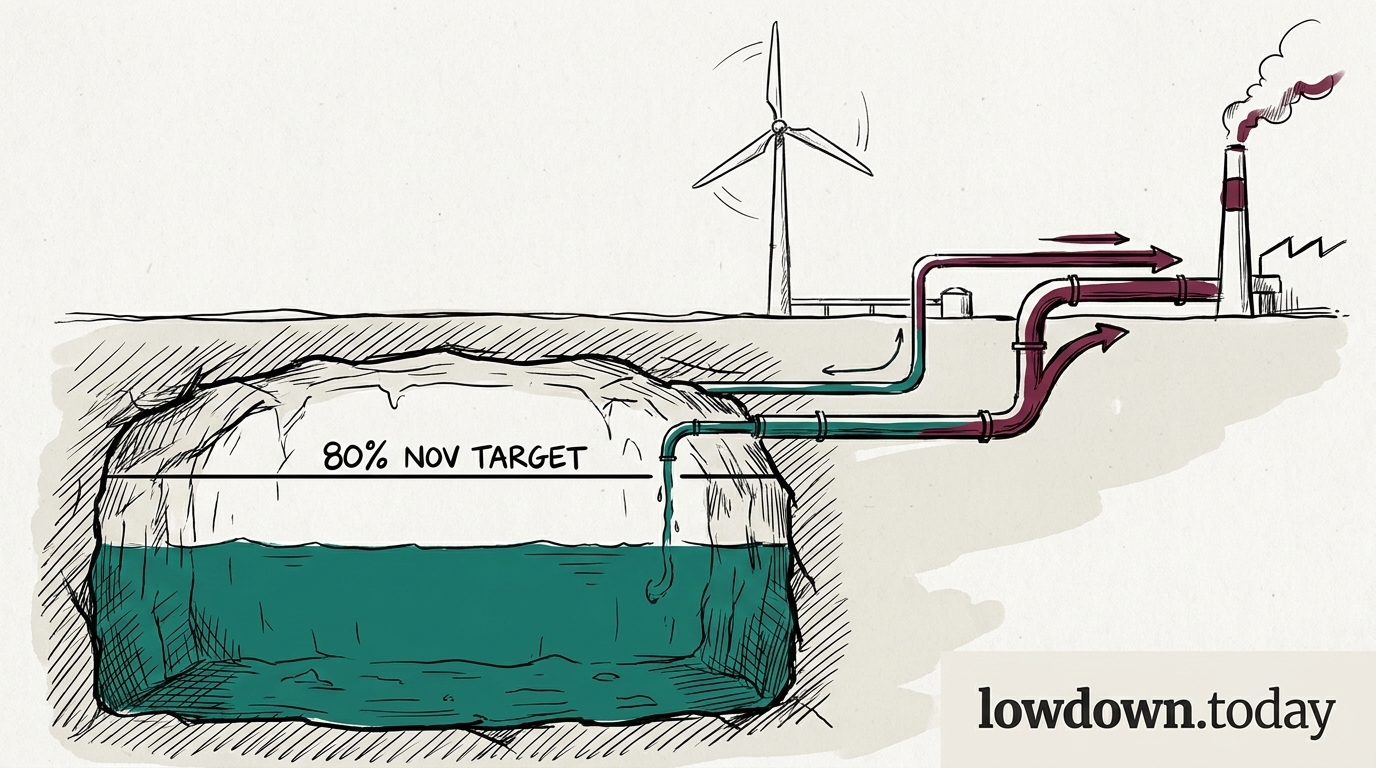
Spain's 9,145 GWh terminal inventory is the largest single stock in the EU LNG network, an option value that can reroute cargoes wherever the winter strip pays best rather than a cavern gas obligation tied to a fixed date. That flexibility matters more as Germany's cavern shortfall pushes more of the winter security question onto import infrastructure.
European Commission
European Commission
Brussels holds the bloc to 90% on a flexible window while Germany, holding roughly a quarter of EU storage capacity, tracks toward missing its own lower 80% figure by 21 points. A national shortfall this size in the anchor market matters more to bloc security than the flexible timetable alone can absorb.
French power exporters and CRE
French day-ahead rose in step with Germany but by less, reopening a EUR 7-17 premium that makes northward export flows commercially attractive again after the EUR 43.09 discount evaporated in days. CRE separately authorised RTE and Enedis to buy flexibility locally, betting the coming winter's binding constraint is grid congestion rather than a shortage of firm capacity.
TTF trading desk
TTF trading desk
A visible national shortfall like Germany's 21-point gap is a directional signal, not noise, for a desk holding the summer-winter spread. TTF's flat EUR 58-60 range through this week's German price swings says the market has not yet chosen to reprice refill risk into the front of the curve.
German cavern and CCGT operators
German caverns kept buying prompt gas at TTF near EUR 58-60 through the inversion; the wind collapse to 2.4 GW then flipped the spark spread to plus EUR 29 and put turbines back in the same queue. Every day turbines win that bid, injection at a third of the 877 GWh/day pace needed falls further behind.
Slovakia
Slovakia
Slovakia says it dropped its hold-out on the 21st sanctions package only after Ursula von der Leyen personally signed written gas-price and supply guarantees. The Council of the European Union's own 17,238-character release on the package names neither Slovakia nor any guarantee, leaving Bratislava's account unconfirmed by the institutional record.



