Skip to content
You can now search across every topic, entity and event.What's new
European Energy Markets
31JUL

India's Chabahar waiver lapses on Sunday

4 min read
09:44UTC

India's only sanctions exemption for its Iranian port investment expires at 00:01 EDT on Sunday 26 April. No substitute text has been published.

EconomicDeveloping
Key takeaway

Three India-US-Iran pressure points converge on one desk before Sunday's waiver lapse.

India's Chabahar port sanctions waiver lapses at 00:01 EDT on Sunday 26 April 2026, roughly two days from publication. India's Ministry of External Affairs (MEA) confirmed on Friday that it is "engaging with US" on renewal; no text has been published 1. The waiver is Delhi's sole US sanctions exemption covering investment in the Iranian port built around the 2016 trilateral agreement, which carries Afghan and Central Asian trade through a route that bypasses Pakistan.

The deadline stacks on two unresolved India files. Foreign Secretary Vikram Misri's office has now held public silence for nine days on the 15 April Shamkhani network designations, which named five Indian nationals and eight India-registered firms . On 22 April the IRGC seized the tanker Epaminondas, carrying cargo bound for Mundra port in Gujarat, and the MEA engaged Tehran quietly the following day while still refusing public comment on the Treasury list .

Three US-Iran pressure points converge on one desk over the weekend. Indian crews are at sea under IRGC fire; Indian firms sit on a live OFAC designation list; Indian port rights lapse at the weekend. For Indian charterers with cargo bound for Mundra or Chennai, a waiver lapse translates to secondary sanctions exposure on ships already afloat, because the statute does not distinguish between cargoes booked before expiry and after.

The structural beneficiary of any Indian pullback is Chinese carriage. Delhi has used Chabahar as the anchor of a triangulation that worked only because the US carved a bespoke exemption out of the broader Iran sanctions architecture; let it lapse and the triangulation collapses into two bilateral disputes, India-US over sanctions and India-Iran over ship safety, with Chinese-flagged shipping the default replacement. Every additional day Misri stays silent on Treasury designations while demanding IRGC restraint is a day Mumbai and Chennai operators cannot price their next cargo.


Deep Analysis

In plain English

India built a port in Iran called Chabahar as part of a deal to give Afghanistan and Central Asian countries a trade route that bypasses Pakistan. The US allowed this, despite its sanctions on Iran, through a special waiver. That waiver runs out on Sunday 26 April at midnight US time. If the waiver is not renewed in time, any Indian company or shipping firm that uses the port after that point faces potential US sanctions. This matters especially because India is already dealing with two other Iran-related crises at the same time: its sailors are being fired on by Iranian gunboats in the Gulf, and its firms have just been named on a US sanctions list. The Indian foreign ministry is quietly trying to get the waiver extended but has not announced any deal.

What could happen next?
  • Consequence

    A waiver lapse without substitute text forces Indian charterers to choose between completing cargoes already at sea and accepting secondary-sanctions exposure, or abandoning the cargo and the charter, with insurance claims contested in post-war litigation.

  • Risk

    China, which operates under CENTCOM's separate carve-out for Hormuz transits, gains a structural advantage in Iranian crude access if India's Chabahar channel closes, deepening Beijing's share of Iran's post-war reconstruction trade.

First Reported In

Update #78 · Allies flagged, adversaries listed, nothing signed

The Hindu· 24 Apr 2026
Read original
Different Perspectives
Spain's LNG terminal operators
Spain's 9,145 GWh terminal inventory is the largest single stock in the EU LNG network, an option value that can reroute cargoes wherever the winter strip pays best rather than a cavern gas obligation tied to a fixed date. That flexibility matters more as Germany's cavern shortfall pushes more of the winter security question onto import infrastructure.
European Commission
European Commission
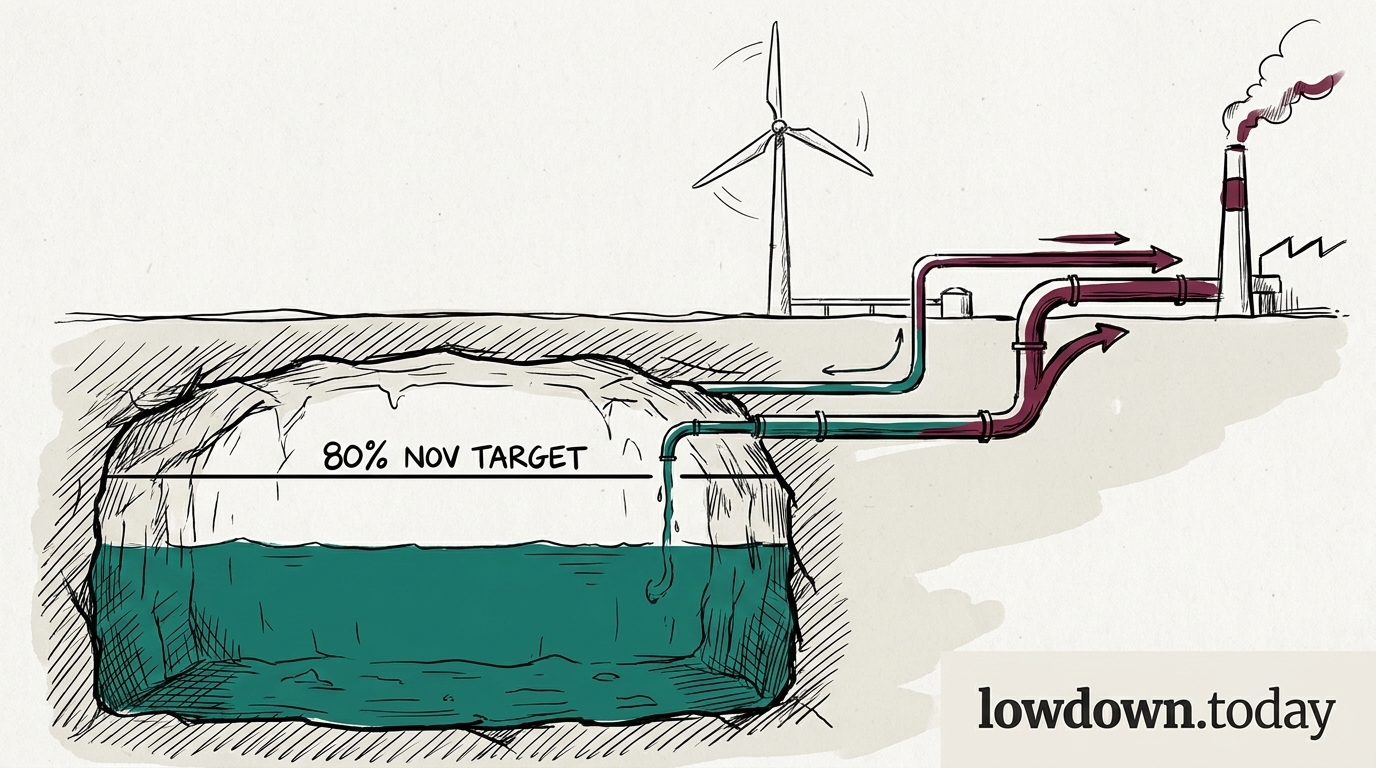
Brussels holds the bloc to 90% on a flexible window while Germany, holding roughly a quarter of EU storage capacity, tracks toward missing its own lower 80% figure by 21 points. A national shortfall this size in the anchor market matters more to bloc security than the flexible timetable alone can absorb.
French power exporters and CRE
French day-ahead rose in step with Germany but by less, reopening a EUR 7-17 premium that makes northward export flows commercially attractive again after the EUR 43.09 discount evaporated in days. CRE separately authorised RTE and Enedis to buy flexibility locally, betting the coming winter's binding constraint is grid congestion rather than a shortage of firm capacity.
TTF trading desk
TTF trading desk
A visible national shortfall like Germany's 21-point gap is a directional signal, not noise, for a desk holding the summer-winter spread. TTF's flat EUR 58-60 range through this week's German price swings says the market has not yet chosen to reprice refill risk into the front of the curve.
German cavern and CCGT operators
German caverns kept buying prompt gas at TTF near EUR 58-60 through the inversion; the wind collapse to 2.4 GW then flipped the spark spread to plus EUR 29 and put turbines back in the same queue. Every day turbines win that bid, injection at a third of the 877 GWh/day pace needed falls further behind.
Slovakia
Slovakia
Slovakia says it dropped its hold-out on the 21st sanctions package only after Ursula von der Leyen personally signed written gas-price and supply guarantees. The Council of the European Union's own 17,238-character release on the package names neither Slovakia nor any guarantee, leaving Bratislava's account unconfirmed by the institutional record.



