Skip to content
You can now search across every topic, entity and event.What's new
European Energy Markets
31JUL

India warns Iran after tankers fired on with clearance

3 min read
09:44UTC

Foreign Secretary Vikram Misri personally warned Iran's ambassador in New Delhi of 'consequences' after the IRGC fired on two Indian-flagged vessels that had been given radio clearance.

EconomicDeveloping
Key takeaway

India's Foreign Secretary summoned Iran's envoy after an open-channel tape showed radio clearances counted for nothing.

Vikram Misri, India's Foreign Secretary, personally warned Iran's ambassador in New Delhi, Mohammad Fathali, of "consequences" after the Revolutionary Guard struck two Indian-flagged tankers that Iran's own foreign ministry had cleared by radio, per the Indian Ministry of External Affairs read-out relayed by The Wire 1. The underlying 18 April strikes on the Sanmar Herald and Jag Arnav have been the proximate trigger for every non-Western diplomatic reaction the war has produced.

Misri's personal delivery of the warning carries weight Delhi does not usually spend on Tehran. India has held a studied non-alignment across the Iran war and the parallel Russia track, and has declined to characterise the US blockade in public. A personal warning from India's Foreign Secretary is not routine consular language; it is the diplomatic register Delhi reserves for situations in which an Indian-flagged hull or Indian citizens have been put under fire.

For Tehran the cost is the distance between Foreign Minister Araghchi's clearance system and the IRGC's enforcement. The same pattern that produced the Spruance seizure also produced Misri's summoning: a foreign ministry clearance that did not hold once a Guard Corps vessel opened fire. A counter-view from Iranian officials is that the Sanmar Herald and Jag Arnav were operating on a corridor already voided by the 17 April Tabnak order, and that the crew tape reflects a miscommunication rather than a policy. That reading does not explain why the foreign ministry had cleared the hulls at all.


Deep Analysis

In plain English

Israel and Lebanon declared a 10-day ceasefire on 17 April. But Israel's Prime Minister Benjamin Netanyahu told his cabinet that Israeli troops would not pull back from a 10-kilometre strip of Lebanese territory they currently occupy. Israel calls this a 'Yellow Line' buffer zone. Lebanon and Hezbollah say this buffer violates the ceasefire because it keeps Israeli forces on Lebanese soil. Netanyahu has said he wants to apply the same model as Gaza, where Israel declared a ceasefire but kept troops in parts of the territory. The Lebanon truce expires on 26 April with this dispute unresolved.

Deep Analysis
Root Causes

Netanyahu told his cabinet the ceasefire did not apply to Hezbollah operations, treating the Lebanon truce as a temporary tactical pause rather than a territorial settlement. The Yellow Line is the physical expression of that reading: it holds the military gains of the initial advance without committing to a withdrawal that would restore Hezbollah's pre-conflict position.

The structural dependency is domestic: Netanyahu's coalition requires Itamar Ben Gvir and Bezalel Smotrich's parties, whose platforms explicitly oppose any withdrawal from territory taken in conflict. The 26 April expiry date was agreed while that political constraint was fully visible to all parties, meaning its terms are contested regardless of the truce text.

What could happen next?
  • Risk

    The Lebanon truce expires 26 April with the Yellow Line dispute unresolved; a second unsigned deadline converges with the Iran 22 April expiry, compressing the window for any mediated settlement.

First Reported In

Update #74 · Two unsigned rulebooks collide at Hormuz

The Wire· 20 Apr 2026
Read original
Different Perspectives
Spain's LNG terminal operators
Spain's 9,145 GWh terminal inventory is the largest single stock in the EU LNG network, an option value that can reroute cargoes wherever the winter strip pays best rather than a cavern gas obligation tied to a fixed date. That flexibility matters more as Germany's cavern shortfall pushes more of the winter security question onto import infrastructure.
European Commission
European Commission
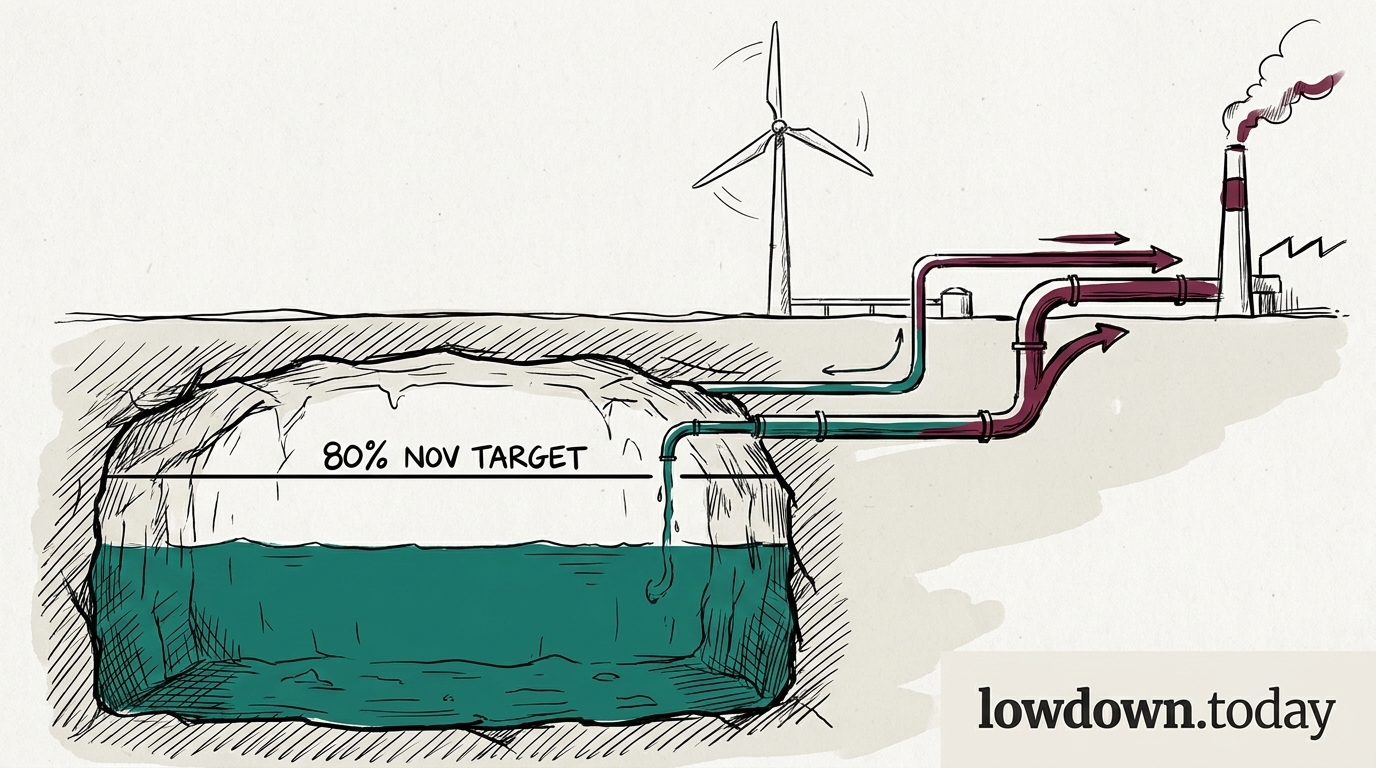
Brussels holds the bloc to 90% on a flexible window while Germany, holding roughly a quarter of EU storage capacity, tracks toward missing its own lower 80% figure by 21 points. A national shortfall this size in the anchor market matters more to bloc security than the flexible timetable alone can absorb.
French power exporters and CRE
French day-ahead rose in step with Germany but by less, reopening a EUR 7-17 premium that makes northward export flows commercially attractive again after the EUR 43.09 discount evaporated in days. CRE separately authorised RTE and Enedis to buy flexibility locally, betting the coming winter's binding constraint is grid congestion rather than a shortage of firm capacity.
TTF trading desk
TTF trading desk
A visible national shortfall like Germany's 21-point gap is a directional signal, not noise, for a desk holding the summer-winter spread. TTF's flat EUR 58-60 range through this week's German price swings says the market has not yet chosen to reprice refill risk into the front of the curve.
German cavern and CCGT operators
German caverns kept buying prompt gas at TTF near EUR 58-60 through the inversion; the wind collapse to 2.4 GW then flipped the spark spread to plus EUR 29 and put turbines back in the same queue. Every day turbines win that bid, injection at a third of the 877 GWh/day pace needed falls further behind.
Slovakia
Slovakia
Slovakia says it dropped its hold-out on the 21st sanctions package only after Ursula von der Leyen personally signed written gas-price and supply guarantees. The Council of the European Union's own 17,238-character release on the package names neither Slovakia nor any guarantee, leaving Bratislava's account unconfirmed by the institutional record.



