Skip to content
You can now search across every topic, entity and event.What's new
European Energy Markets
4JUN

TTF retraces to EUR 47.69 on Trump

4 min read
10:45UTC

TTF front-month settled EUR 47.69/MWh on Friday 22 May, a 5% retrace from the 18 May EUR 50.17 close, after Trump rejected Iran's Pakistan-mediated ceasefire response as totally unacceptable.

EconomicDeveloping
Key takeaway

EUR 50 holds as ceiling on diplomatic premium alone; physical supply is doing none of the price work.

TTF front-month settled EUR 47.69/MWh on Friday 22 May, down 5% from the EUR 50.17 close on Monday 18 May that took the contract above EUR 50 for the first time since early April1. Iran returned a Pakistan-mediated response to the US ceasefire proposal on the same Monday and Donald Trump rejected it as "totally unacceptable", calling the ceasefire "on massive life support" 2. The retrace returned TTF towards the EUR 47.23 print on Tuesday 12 May and the EUR 43-47/MWh band that held through Project Freedom .

EU storage stayed inside its 0.17 pp/day commercial vacuum, the Bruegel model was unrevised at the post-break price, and the Bundesnetzagentur held its supply-stable language unchanged. Pakistan's back-channel role through army chief Asim Munir has been the primary US-Iran conduit since early May, and Tehran's reply walked past the 14-point MOU Washington had routed through Islamabad on 7 May. NBP traded 126 p/therm on Wednesday 20 May, approximately EUR 45.3/MWh at prevailing EUR/GBP, leaving the TTF-NBP basis at EUR +3.9/MWh; BBL capacity halved to 22 mcm/d from October 2026 caps the physical convergence between the two hubs, so basis trades inside a balance-sheet constraint rather than an arbitrage that closes itself.

Physical supply did none of the work: 14 loaded LNG cargoes were still waiting on Hormuz, Hammerfest LNG was 49 days into its 79-day outage, and the Trading Economics print of EUR 47.69 sits inside the band TTF held for five sessions of physical supply unchanged. EUR 50 holds as a technical ceiling for desks short the strike; a Hormuz signal breaks it from above and a breakdown in the Pakistan-mediated channel tests EUR 45 support from below.

Deep Analysis

In plain English

The price of natural gas at the Dutch TTF hub jumped to EUR 50 per megawatt-hour on 18 May 2026, driven by anxiety over the US-Iran ceasefire talks collapsing. When Iran sent back a response to American proposals via Pakistan - and Trump dismissed it as totally unacceptable - traders bought gas futures, worried that the Strait of Hormuz (the main shipping lane for Middle East gas) might stay closed. By 22 May, as the diplomatic signal faded without a new escalation, the price retraced to EUR 47.69. GIE AGSI+ storage fill held at 0.17 pp/day, Norwegian send-out held, and no new LNG arrivals changed across those four sessions. TTF tracked the Pakistan back-channel alone, not any shift in European supply.

Deep Analysis
Root Causes

The diplomatic-premium component of TTF prompt is the isolated variable since EU storage pace, Norwegian send-out, and LNG arrival rates were all unchanged between the 18 May EUR 50.17 close and the 22 May EUR 47.69 retrace.

Iran returned a Pakistan-mediated response on 18 May that walked past the 14-point MOU Washington had routed through Islamabad on 7 May; Trump rejected it as totally unacceptable and called the ceasefire on massive life support. TTF retraced exactly as the diplomatic signal reversed, with no change in physical supply.

The TTF-NBP basis at EUR +3.9/MWh is structurally wider than the historical mean because the October 2026 BBL capacity halving to 22 mcm/d has turned the Bacton-Balgzand interconnector into a balance-sheet position rather than a physical arbitrage corridor. When the interconnector ran at 44 mcm/d, a EUR 3.9 TTF-NBP premium would attract GB-to-continental flows within the trading day. At 22 mcm/d, the constraint binds before the arbitrage clears, leaving basis open.

First Reported In

Update #11 · Germany cannot inject at this price

Trading Economics· 22 May 2026
Read original
Different Perspectives
Marine insurers and AIS trackers covering Hormuz
AIS data shows severe curtailment on 20 July, 479 vessels anchored, 36 dark, 123 still broadcasting inside the strait, not the closure the IRGC claims. War-risk premiums move on the unresolved CENTCOM-IRGC contest itself, since underwriters price the dispute as much as the count.
QatarEnergy
QatarEnergy
Ras Laffan has run at minimum output under force majeure into August since 9 July, a constraint already priced before this week's claim. The 17-20 July move is risk premium stacked on that standing loss, not a new physical loss at the plant.
ACER and the European Commission
ACER opened the REMIT reporting consultation on schedule on 16 July, giving firms to 11 September before a quarter to build systems against Regulation 648/2012. Brussels' separate silence on StromVKG state-aid clearance leaves Berlin's own capacity mechanism without legal authorisation.
EDF and French grid operator RTE
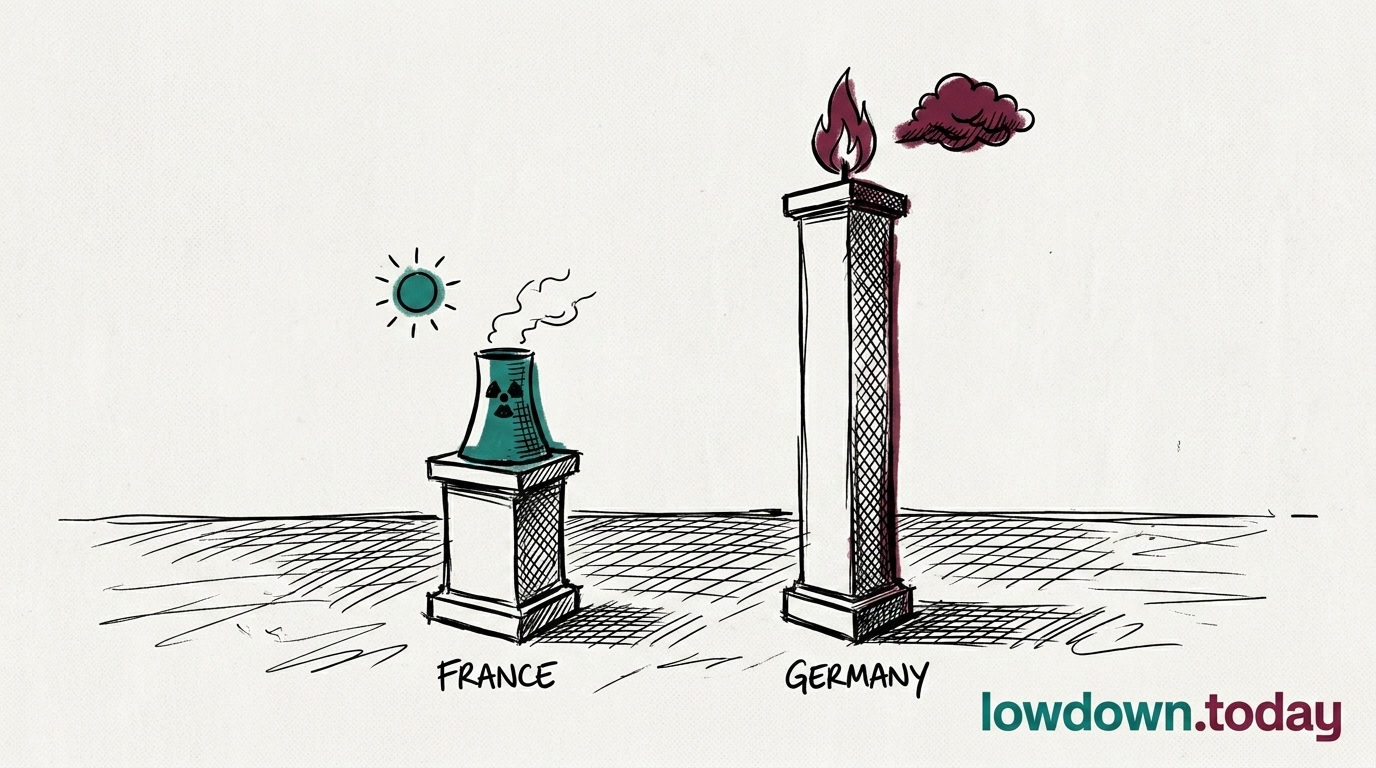
France's discount to Germany rests on an ASNR derogation from the 28C river-cooling limit at Bugey that expires today, not on a nuclear recovery; Chooz, Golfech and Bugey restarts run to 25 July. The cheap leg holds only as long as regulators keep waiving the limit each heatwave.
German CCGT operators and grid balancers
German gas plants went off-merit on 20 July as the clean spark spread inverted to minus EUR 15 to minus EUR 21/MWh, sidelining the flexible capacity storage injection needs. Operators are pricing 2027-28 capacity revenue against Bundesnetzagentur's own admission that Brussels has not cleared the 9 GW StromVKG auctions.
LNG spreads desk
LNG spreads desk
The JKM-TTF arb flipped to a TTF premium of roughly USD 0.6/MMBtu on 15 July, the first time this cycle Europe has outbid Asia, yet no Atlantic cargo has rerouted west. Until a cargo actually moves, the desk reads the Hormuz premium as unconfirmed and the EUR 55 print as vulnerable to a fast reversal.

