Skip to content
Briefings are running a touch slower this week while we rebuild the foundations.See roadmap
European Energy Markets
4JUN

France EUR 9, Germany EUR 103: heat splits

2 min read
10:45UTC

The France-Germany day-ahead power spread blew out to EUR 93.68/MWh on 3 June as French nuclear surplus met a heatwave solar surge while Germany's gas-and-carbon stack held above EUR 100. The ACER Gas Market Task Force called EU gas markets 'functioning well' days after German TSOs declared the storage-refill mechanism broken. TTF broke its range above EUR 48.9 and the 17 June Russian pipeline cliff sits 13 days out with no court stay.

EconomicEDFACER
Key takeaway

European energy markets are bifurcating by generation mix, with France and Germany now on structurally different cost trajectories, and the storage mechanism propping up injection on mandates rather than price signals.

This briefing mapped
Loading map…
Economic
Infrastructure
Regulatory

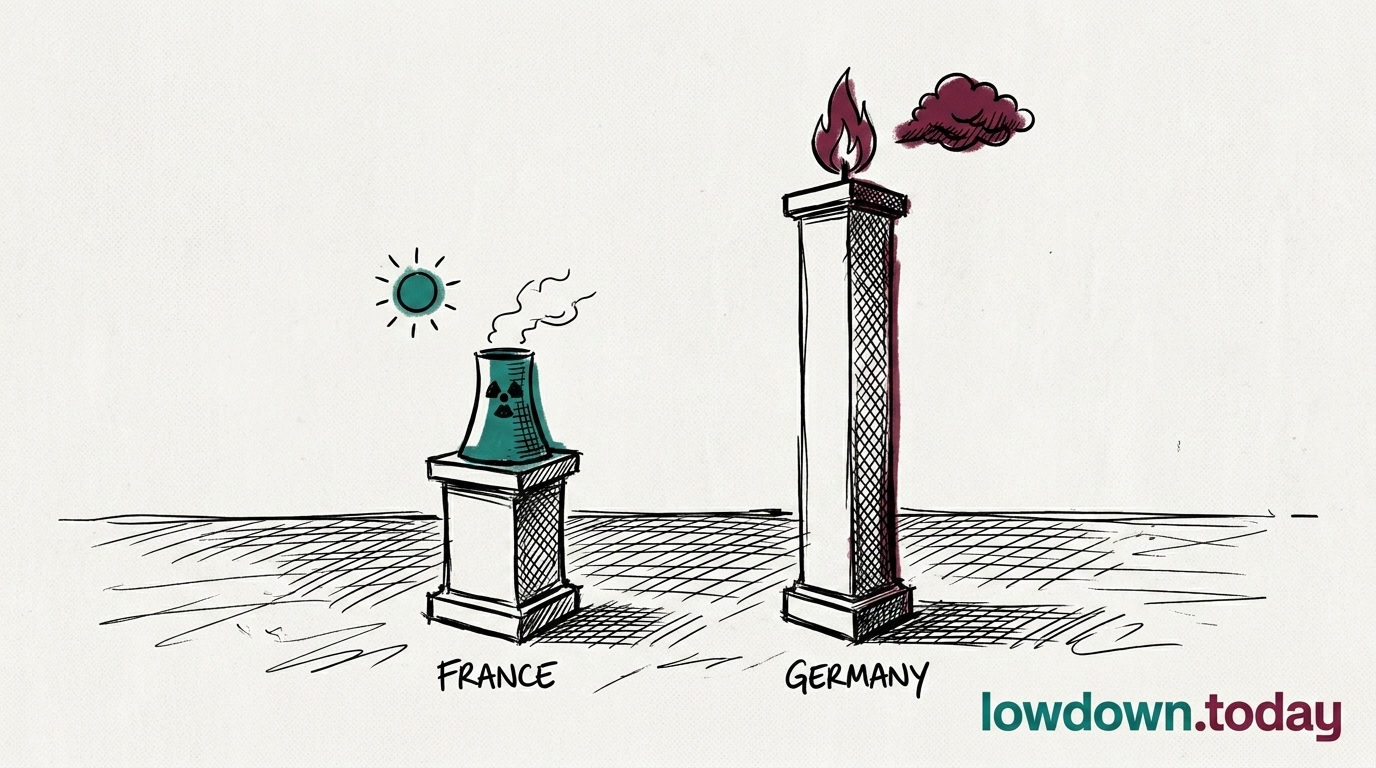
The France-Germany day-ahead power spread blew out to a series record EUR 93.68/MWh on 3 June, with France clearing near EUR 9 on a heatwave solar surge and Germany holding above EUR 100 on its gas-and-carbon stack.

Sources profile:This story draws on neutral-leaning sources

On 3 June 2026, France's electricity price hit EUR 8.96 per megawatt-hour as a heatwave pushed solar power into an already-full nuclear grid. Germany cleared at EUR 102.64, relying on gas-fired plants.

The EUR 93.68 spread set a series record. French manufacturers on VNU (France's nuclear pass-through pricing scheme) paid near-zero while German competitors paid above EUR 100. The gap narrows from September when Flamanville-3 enters a one-year overhaul. 

EU gas storage reached 41.0% on 4 June, crossing the 40% milestone, but the 3,309 GWh/day refill pace still points to a ~67% November landing against the 80% mandatory floor.

Sources profile:This story draws on neutral-leaning sources

EU gas storage reached 41.0% on 4 June 2026, crossing the 40% milestone. At the 3,309 GWh/day refill pace, storage will reach only 67% by November: 13 points below the EU's own mandatory 80% floor.

Refill runs on government mandates from Dutch, French and Italian operators, not commercial economics. Bruegel estimates each percentage point below 80% on 1 November adds EUR 1.5-2.5 billion to EU winter gas costs. 

The Gas Market Task Force published SWD(2026)147 on 2 June certifying EU gas spot and derivatives markets as 'functioning well', arriving five days after German pipeline operators declared the physical storage-refill mechanism broken.

Sources profile:This story draws on neutral-leaning sources from Belgium
Belgium

The Gas Market Task Force (GMTF) published its first formal assessment on 2 June 2026, finding EU gas markets 'functioning well'. It arrived five days after German pipeline body FNB Gas declared the physical storage-refill mechanism broken.

The two verdicts measure different things: derivatives integrity versus injection economics. Both can be true at once. With derivatives cleared, a storage-levy reinstatement is now the only policy instrument left to address the physical shortfall. 

TTF rose 6% on 2 June to EUR 48.9/MWh, breaking the 38-session EUR 46-47 band, as Equinor issued no Troll A restart notice through 4 June and Iran diplomacy stayed stalled.

Sources profile:This story draws on neutral-leaning sources

TTF (Europe's benchmark gas price) broke its 38-session range on 2 June 2026, rising 6% to EUR 48.9 per megawatt-hour. Equinor issued no Troll A restart notice after the 31 May deadline, and Iran talks remained stalled.

The move re-tests the EUR 50 ceiling that a ceasefire headline erased on 26 May. At EUR 48.9, TTF sustains the German gas-plant cost stack that cleared electricity above EUR 100 on 3 June. 

EU carbon allowances settled near EUR 78.22/tCO2 on 4 June, extending above the EUR 77.46 clawback that reversed the 11 May ETS benchmark selloff and confirming the cost floor under German CCGT power clearing.

Sources profile:This story draws on neutral-leaning sources

EU carbon allowances settled at EUR 78.22 per tonne on 4 June 2026, holding above the EUR 77.46 clawback that confirmed recovery from the May selloff.

At EUR 78 carbon plus EUR 49 gas, German gas plants clear electricity at roughly EUR 100-105 per megawatt-hour with a near-zero margin. Carbon above EUR 78 raises German power costs without triggering fuel switching, because Germany has no dispatchable clean alternative at scale until after 2031. 

Spain recorded 397 hours of negative day-ahead power prices in Q1 2026, eight times the 48 hours of Q1 2025, with the clean-spark squeeze now spreading north into the Continental midday stack.

Sources profile:This story draws on centre-leaning sources from France
France
LeftRight

Spain recorded 397 hours of negative electricity prices in Q1 2026, eight times the 48 hours in Q1 2025. Solar panels generated more power than the grid could use at midday, pushing prices below zero.

The same dynamic reached France on 3 June 2026, where prices hit EUR 8.96 per megawatt-hour on a heatwave solar surge. Spanish gas-plant operators spent 18% of Q1 hours generating at a loss, compressing their economics into a narrow peak window. 

Sources:Euronews
Closing comments

TTF has broken successive resistance levels: EUR 47.23 on 12 May, EUR 50.17 on 18 May (ID:3388), EUR 48.9 on 2 June. EUA carbon held EUR 78.22 on 4 June above its 11 May clawback, confirming the German cost floor is durable. Direction: upward, with a discrete step-change risk on 17 June when short-term Russian pipeline contracts expire with no CJEU stay on the Hungary-Slovakia challenge (ID:3229); Central European hub premium above EUR 2/MWh over TTF tightens the basis exposure. The counter-scenario requires both a confirmed Equinor Troll A restart and a diplomatic breakthrough on Iran before 17 June; neither has materialised as of 4 June 2026.

Different Perspectives
EDF / French government
EDF held full-year nuclear guidance at 350-370 TWh after April output of 29.3 TWh, anchoring the surplus that collapsed French day-ahead to EUR 8.96 on 3 June and passed that price to VNU industrials. Flamanville-3's September overhaul removes 1.6 GW at heating-season onset, reversing the nuclear surplus that made VNU pricing competitive.
FNB Gas / Bundesnetzagentur
FNB Gas declared the storage-refill mechanism broken on 27 May after zero bookings in January 2026 auctions, and German day-ahead cleared EUR 102.64 on 3 June on a CCGT stack set by TTF near EUR 49 plus EUA near EUR 78. Winter storage fill now depends on state mandates with no commercial self-correction.
European Commission / GMTF
SWD(2026)147 found EU gas spot and derivatives markets functioning well on 2 June, recommending MiFID-REMIT legislative alignment rather than emergency intervention. The GMTF verdict addressed derivatives-market integrity, not the physical injection mechanism FNB Gas declared broken five days earlier: the Commission's immediate next step is a legislative proposal, not an emergency storage order.
Equinor
Equinor
Equinor issued no Troll A restart notice through 4 June despite extending the combined outage to 31 May, keeping up to 51 mcm/day of Norwegian supply offline alongside Hammerfest LNG dark since 22 April. The company's silence follows its 2025 Hammerfest pattern, which ran 24 days past target, and each day without a notice sustains the TTF supply premium.
Red Electrica / Spanish grid operators
Spain logged 397 negative-price hours in Q1 2026, eight times the 48 hours of Q1 2025, documenting midday solar surplus now embedding structurally into Continental pricing. Spain is four to six quarters ahead of France and Germany on the solar-penetration curve, making it the clearest forward indicator of where Continental midday clearing is heading.
TTF traders / Amsterdam hub desks
TTF broke its 38-session EUR 46-47 band on 2 June to EUR 48.9 on stalled Iran diplomacy and an unconfirmed Troll A restart; Dutch EBN mandates carry storage trajectory while commercial injection books nothing. The 17 June pipeline expiry is the next binary level: Central European hub premium above EUR 2/MWh widens sharply on any physical step-down.

