NBP
UK National Balancing Point; virtual gas trading hub and primary UK gas price reference alongside Dutch TTF.
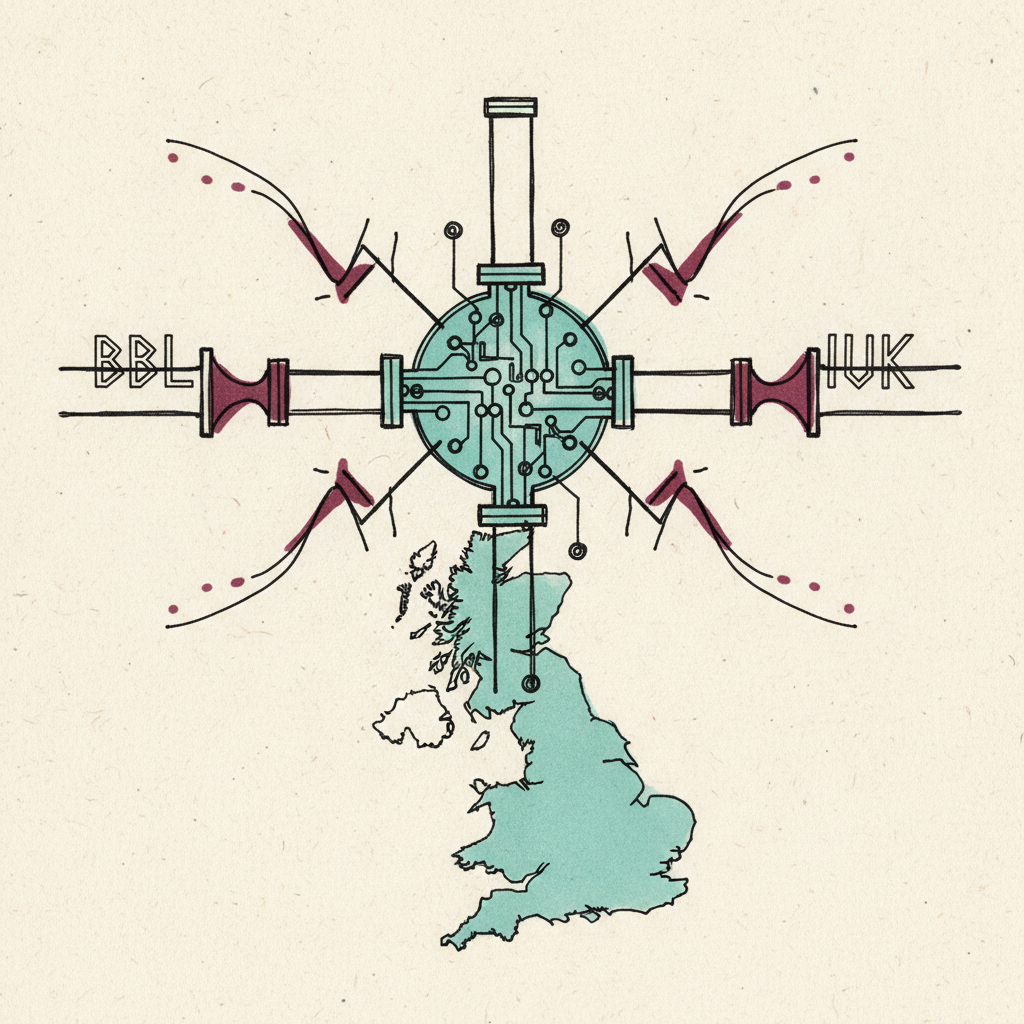
NBP is the UK's benchmark gas trading hub. Its premium over Dutch TTF is set to widen from October 2026 as IUK interconnector capacity falls to 36 MCM/d, cutting Great Britain's Continental import share from 17% to 12%.
Last refreshed: 20 July 2026 · Appears in 1 active topic
Why is the gap between UK gas prices and European TTF widening in 2026?
Timeline for NBP
Mentioned in: TTF breaks 38-session range to €48.9
European Energy Marketssettled at TTF parity of ~EUR 46.5/MWh, eliminating the historical UK LNG discount
European Energy Markets: TTF holds €46-47 range; NBP reaches parityMentioned in: ACER 11 June workshop is REMIT enforcement, not storage
European Energy MarketsTraded 126 p/therm on 20 May, establishing EUR +3.9/MWh basis premium of TTF
European Energy Markets: TTF retraces to €47.69 on TrumpMentioned in: Equinor locks in five-year retail strip
European Energy MarketsBackground
NBP (National Balancing Point) is the United Kingdom's virtual wholesale gas trading hub, the reference price for gas delivered onto Great Britain's National Transmission System, operated by National Gas Transmission. It sits alongside the Dutch Title Transfer Facility (TTF) as one of Europe's two principal gas benchmarks.
NBP's alignment with TTF depends on physical interconnection: the BBL pipeline from the Netherlands and the IUK Interconnector from Belgium let gas arbitrage between the two markets. That link is shrinking: BBL capacity halved to 22 MCM/d in December 2024, and IUK falls to 36 MCM/d from October 2026, cutting Great Britain's Continental import share from 17% to 12% of demand.
As Continental pipeline capacity falls, Great Britain leans more heavily on Norwegian pipeline supply and LNG imports to cover winter demand, a structural shift that traders treat as the most predictable driver of a widening NBP premium over TTF into winter 2026-27.
Reference
How does the Isle of Grain LNG terminal affect NBP prices?
What is NBP gas and how does it differ from TTF?
How does the Iran-Hormuz crisis affect UK gas prices at NBP?
Why is the NBP-TTF gas price spread widening in 2026?
What is the NBP gas price now?

