Skip to content
Briefings are running a touch slower this week while we rebuild the foundations.See roadmap
European Energy Markets
4JUN

TTF breaks EUR 50; US LNG hits 58%

3 min read
10:45UTC

TTF settled EUR 50.17/MWh on Monday 18 May, an 11% weekly gain that finally prices the storage arithmetic into the curve as ACER confirmed US suppliers now provide 58% of EU LNG imports.

EconomicDeveloping
Key takeaway

TTF priced the storage deficit and the US 58% LNG share into the curve in the same week.

TTF (Title Transfer Facility, the Dutch wholesale gas benchmark) settled at EUR 50.17/MWh on Monday 18 May, the first close above EUR 50 since early April , an 11% weekly gain from the EUR 47.23 close on Tuesday 12 May. ACER, the EU energy regulator, published its Annual LNG Report 2025 on Wednesday 13 May confirming US suppliers now provide 58% of EU LNG imports, projected by IEEFA to reach 65% in 2026 as Russian short-term contracts wash out under the 25 April ban.

The Dutch front-month is finally pricing two pricing dynamics at once: the storage arithmetic the beat has tracked since the season opened , and the structural concentration story ACER's report quantified this week. Russian pipeline gas peaked at roughly two-fifths of total EU gas in 2021; the US 58% LNG share, multiplied through LNG's share of total EU supply, now equates to roughly a fifth of EU gas demand routing through one country's terminals. Commission Executive Vice-President Teresa Ribera warned the same week that Europe should 'avoid replacing one energy dependency with another'; her institution has spent approximately EUR 117 billion on US LNG since 2022.

Deep Analysis

In plain English

TTF is the main European gas price benchmark, like Brent crude for oil. When it breaks EUR 50, it means European wholesale gas costs more, which eventually flows through to household energy bills. The trigger this week was twofold: gas storage tanks are not filling fast enough for winter, and a report confirmed that over half of Europe's gas ship imports now come from a single country, the United States.

Deep Analysis
Root Causes

The 25 April 2026 EU Russian LNG short-term ban accelerated US LNG's share shift from 58% toward a projected 65% faster than the 2025 baseline assumed, removing the residual Russian short-term contract buffer that had kept US deliveries below two-thirds.

The 1 January 2026 abolition of Germany's gas storage levy removed the principal incentive instrument for early-season injection, leaving the EU without a mechanism to incentivise fills at TTF levels above industrial demand-destruction thresholds.

Middle East LNG to Europe fell to its lowest level since 2019 in April 2026 (Bruegel dataset), reducing the swing-supplier cushion that had historically moderated US pricing power in Atlantic Basin spot markets.

What could happen next?
  • Meaning

    If TTF holds above EUR 50 through June, the Bruegel EUR 26 billion refill cost estimate becomes materially understated on both the price and pace assumptions used in the model.

    Short term · Assessed
  • Meaning

    US LNG tariff exposure becomes a politically live risk vector for the first time since 2022: a 65% single-supplier share concentrates European gas pricing power in a single bilateral trade relationship.

    Short term · Assessed
  • Meaning

    Industrial demand destruction at EUR 50+ front-month may slow European gas consumption enough to partially offset the storage injection shortfall, creating an involuntary demand-side adjustment the EU has not formally planned for.

    Short term · Assessed
First Reported In

Update #10 · TTF breaks EUR 50; US LNG hits 58% of imports

EnergyRiskIQ / GIE AGSI+· 18 May 2026
Read original
Causes and effects
This Event
TTF breaks EUR 50; US LNG hits 58%
Two regimes priced at once: the storage deficit and a structural supplier-concentration story whose 2026 trajectory points to roughly a fifth of EU gas demand routing through one country's logistics chain.
Different Perspectives
TTF traders / Amsterdam hub desks
TTF broke its 38-session EUR 46-47 band on 2 June to EUR 48.9 on stalled Iran diplomacy and an unconfirmed Troll A restart; Dutch EBN mandates carry storage trajectory while commercial injection books nothing. The 17 June pipeline expiry is the next binary level: Central European hub premium above EUR 2/MWh widens sharply on any physical step-down.
Red Electrica / Spanish grid operators
Spain logged 397 negative-price hours in Q1 2026, eight times the 48 hours of Q1 2025, documenting midday solar surplus now embedding structurally into Continental pricing. Spain is four to six quarters ahead of France and Germany on the solar-penetration curve, making it the clearest forward indicator of where Continental midday clearing is heading.
Equinor
Equinor
Equinor issued no Troll A restart notice through 4 June despite extending the combined outage to 31 May, keeping up to 51 mcm/day of Norwegian supply offline alongside Hammerfest LNG dark since 22 April. The company's silence follows its 2025 Hammerfest pattern, which ran 24 days past target, and each day without a notice sustains the TTF supply premium.
European Commission / GMTF
SWD(2026)147 found EU gas spot and derivatives markets functioning well on 2 June, recommending MiFID-REMIT legislative alignment rather than emergency intervention. The GMTF verdict addressed derivatives-market integrity, not the physical injection mechanism FNB Gas declared broken five days earlier: the Commission's immediate next step is a legislative proposal, not an emergency storage order.
FNB Gas / Bundesnetzagentur
FNB Gas declared the storage-refill mechanism broken on 27 May after zero bookings in January 2026 auctions, and German day-ahead cleared EUR 102.64 on 3 June on a CCGT stack set by TTF near EUR 49 plus EUA near EUR 78. Winter storage fill now depends on state mandates with no commercial self-correction.
EDF / French government
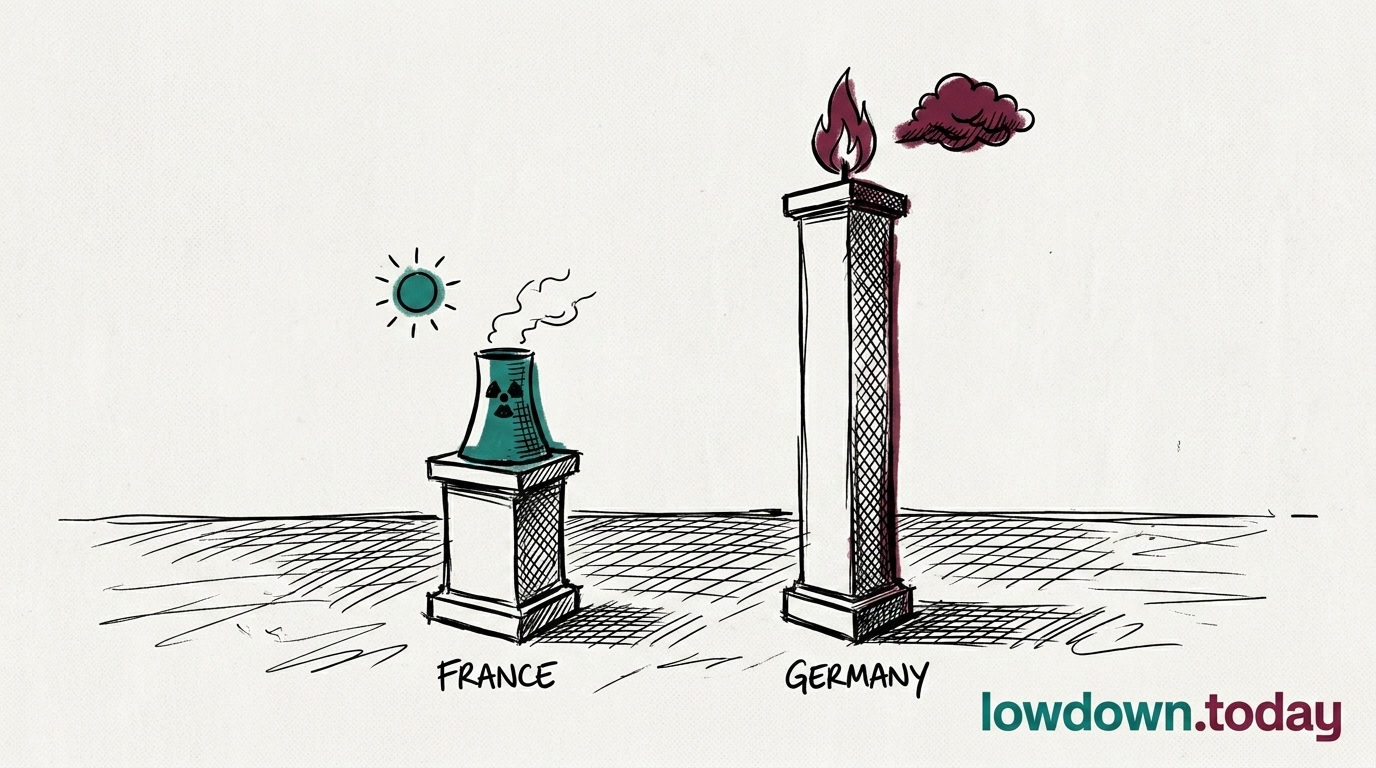
EDF held full-year nuclear guidance at 350-370 TWh after April output of 29.3 TWh, anchoring the surplus that collapsed French day-ahead to EUR 8.96 on 3 June and passed that price to VNU industrials. Flamanville-3's September overhaul removes 1.6 GW at heating-season onset, reversing the nuclear surplus that made VNU pricing competitive.

