Skip to content
Briefings are running a touch slower this week while we rebuild the foundations.See roadmap
European Energy Markets
4JUN

FR-DE spread to EUR 37 at higher floors

4 min read
10:45UTC

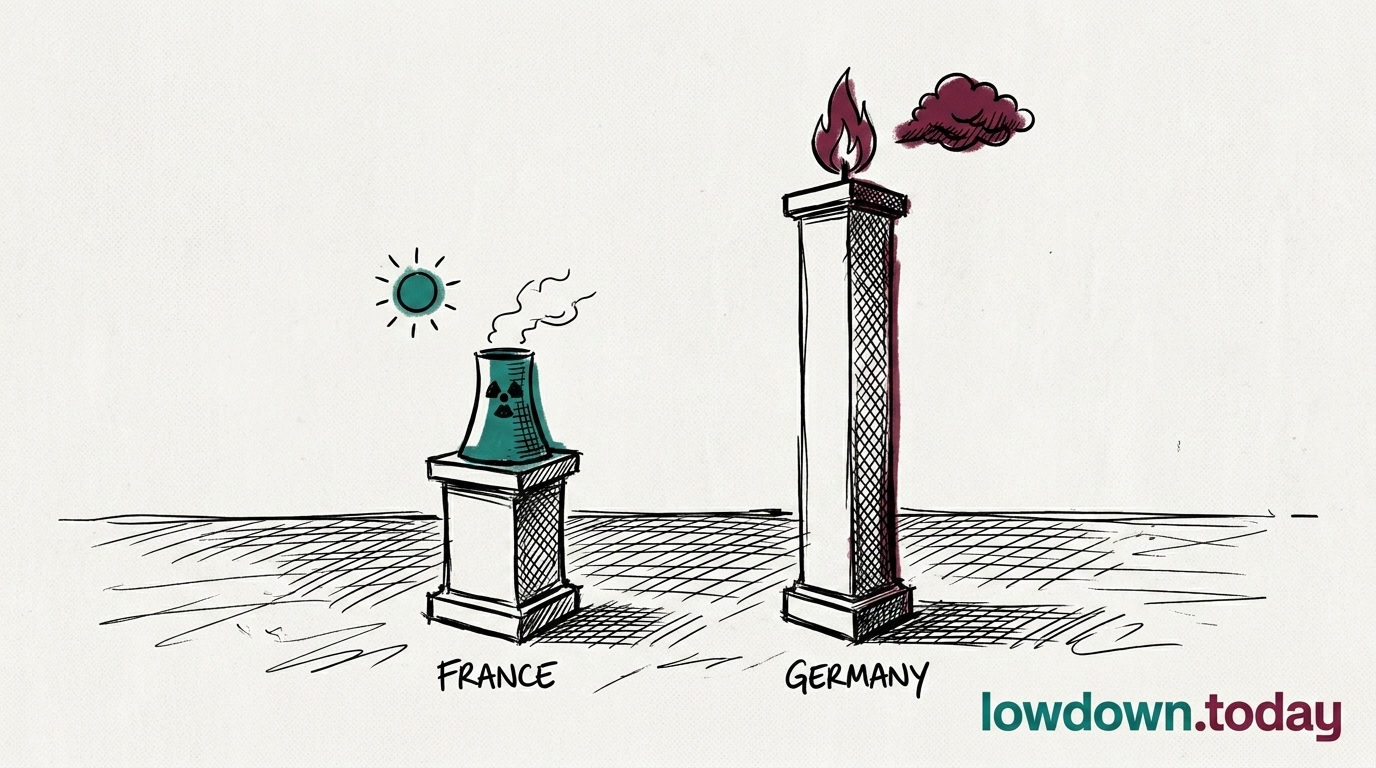
The France-Germany day-ahead spread compressed to EUR 37.47/MWh on 7 May from EUR 55.75 on 28 April, but only because both markets rose sharply in absolute terms.

EconomicDeveloping
Key takeaway

Spread compression at higher absolute levels means more borders are now gas-set, not fewer.

The France-Germany day-ahead spread compressed to EUR 37.47/MWh on 7 May, ENTSO-E data via euenergy.live shows, down from EUR 55.75/MWh on 28 April . Germany cleared at EUR 136.03/MWh, up 11% day-on-day; France cleared at EUR 98.56/MWh, down 13%. Italy reached EUR 135.86/MWh near parity with Germany, the Netherlands cleared at EUR 130.51/MWh, and Spain held the lowest major-market clearing at EUR 86.90/MWh.

ENTSO-E is the European Network of Transmission System Operators for Electricity, the Brussels-based association publishing real-time and day-ahead electricity market data. The day-ahead clearing price is the marginal-unit cost set in each country's hourly auction, and gas peaker plants are the marginal unit across most of Continental Europe outside Spain and the Nordics.

France's day-ahead has gone from EUR 21.80/MWh on 28 April to EUR 98.56 on 7 May, a 352% jump; Germany has risen from EUR 77.55 to EUR 136.03, up 75%. The narrowing therefore reflects gas-set clearing across more borders, not reduced gas exposure, and traders pricing the EUR 55.75 print as relief now reprice relief itself at the higher floor.

EDF's April nuclear output of 29.3 TWh (+2.2 TWh year-on-year) is still suppressing French clearing relative to Germany, but the buffer is doing less work as renewables vary and gas peakers fill gaps. Flamanville-3, EDF's 1.6 GW EPR reactor in Normandy, enters its first one-year overhaul from September 2026, taking that buffer down further at the cycle's most exposed point. The Italy-Spain spread sits at EUR 48.96/MWh on 7 May, up from EUR 24.54 on 17 April. Spread geometry is widening at higher floors across the Continental map.

Deep Analysis

In plain English

Electricity prices in Europe are set by what is called the 'merit order': power stations compete to supply each hour, and the most expensive source that is needed to meet demand sets the price for everyone. Usually, solar and wind are cheapest, nuclear second, and gas-fired power stations most expensive. When gas stations end up setting the price, because there is not enough wind, solar, or nuclear available, the whole market clears at a much higher level. On 7 May, gas stations were setting the price across Germany, Italy, and the Netherlands simultaneously. That is why Germany hit EUR 136/MWh and Italy EUR 135/MWh on the same day. France has more nuclear power, which is cheaper, so it cleared lower at EUR 98/MWh. But even France is increasingly relying on expensive gas stations on days when its nuclear plants are not running at full output. When more countries hit the gas price simultaneously, the effect goes beyond a single bad day: the floor on which all Continental power trades rises each time gas sets the marginal clearing price across multiple borders in the same hour.

Deep Analysis
Root Causes

The FR-DE spread compression from EUR 55.75 to EUR 37.47 reflects two markets converging toward the same marginal unit, gas peakers, rather than France remaining on its lower-cost nuclear-set merit order. France's day-ahead move from EUR 21.80 to EUR 98.56 over ten days reflects the same gas-peaker step-in on days when nuclear output variance and renewable intermittency create net demand above nuclear clearing capacity.

EDF's April nuclear output of 29.3 TWh (+2.2 TWh year-on-year) remains solid, but 29.3 TWh/month equates to roughly 40.7 GW of average output against nameplate capacity of 63 GW, meaning France's nuclear fleet is running at 65% average availability. On low-wind days, the margin between nuclear output and demand gets cleared by gas peakers that have a much higher marginal cost, pulling French clearing toward German clearing and compressing the spread.

The Italy-Spain spread widening from EUR 24.54 to EUR 48.96 since 17 April reflects Spain's persistent partial renewables insulation versus the Italian market, which is structurally more gas-dependent. The widening signals that Spain's wind and solar capacity maintains its pricing advantage on higher-price days even as the absolute floor rises across the rest of the map.

What could happen next?
  • Consequence

    The Italy-Spain spread widening from EUR 24.54 to EUR 48.96 since 17 April confirms Spain's renewables base provides structural price protection even at elevated absolute levels, a signal relevant to industrial relocation decisions currently in progress across EU chemical and aluminium sectors.

    Medium term · 0.77
  • Risk

    Flamanville-3's September 2026 overhaul removes approximately 1.6 GW from France's nuclear fleet at the heating-season onset, increasing French clearing's gas-peaker dependence by roughly 38 GWh/day on average output days and pulling FR-DE spread convergence forward.

    Medium term · 0.82
  • Consequence

    Simultaneous gas-set clearing across Germany, Italy, and the Netherlands on 7 May signals the Continental power map is operating in a structural gas-floor pricing state, where renewable variability and nuclear oscillation alone are insufficient to prevent high-cost marginal clearing.

    Short term · 0.7
First Reported In

Update #8 · Storage 34.3 as 12 May test nears; Hammerfest silent

euenergy.live (relaying ENTSO-E data)· 8 May 2026
Read original
Different Perspectives
TTF traders / Amsterdam hub desks
TTF broke its 38-session EUR 46-47 band on 2 June to EUR 48.9 on stalled Iran diplomacy and an unconfirmed Troll A restart; Dutch EBN mandates carry storage trajectory while commercial injection books nothing. The 17 June pipeline expiry is the next binary level: Central European hub premium above EUR 2/MWh widens sharply on any physical step-down.
Red Electrica / Spanish grid operators
Spain logged 397 negative-price hours in Q1 2026, eight times the 48 hours of Q1 2025, documenting midday solar surplus now embedding structurally into Continental pricing. Spain is four to six quarters ahead of France and Germany on the solar-penetration curve, making it the clearest forward indicator of where Continental midday clearing is heading.
Equinor
Equinor
Equinor issued no Troll A restart notice through 4 June despite extending the combined outage to 31 May, keeping up to 51 mcm/day of Norwegian supply offline alongside Hammerfest LNG dark since 22 April. The company's silence follows its 2025 Hammerfest pattern, which ran 24 days past target, and each day without a notice sustains the TTF supply premium.
European Commission / GMTF
SWD(2026)147 found EU gas spot and derivatives markets functioning well on 2 June, recommending MiFID-REMIT legislative alignment rather than emergency intervention. The GMTF verdict addressed derivatives-market integrity, not the physical injection mechanism FNB Gas declared broken five days earlier: the Commission's immediate next step is a legislative proposal, not an emergency storage order.
FNB Gas / Bundesnetzagentur
FNB Gas declared the storage-refill mechanism broken on 27 May after zero bookings in January 2026 auctions, and German day-ahead cleared EUR 102.64 on 3 June on a CCGT stack set by TTF near EUR 49 plus EUA near EUR 78. Winter storage fill now depends on state mandates with no commercial self-correction.
EDF / French government
EDF held full-year nuclear guidance at 350-370 TWh after April output of 29.3 TWh, anchoring the surplus that collapsed French day-ahead to EUR 8.96 on 3 June and passed that price to VNU industrials. Flamanville-3's September overhaul removes 1.6 GW at heating-season onset, reversing the nuclear surplus that made VNU pricing competitive.

