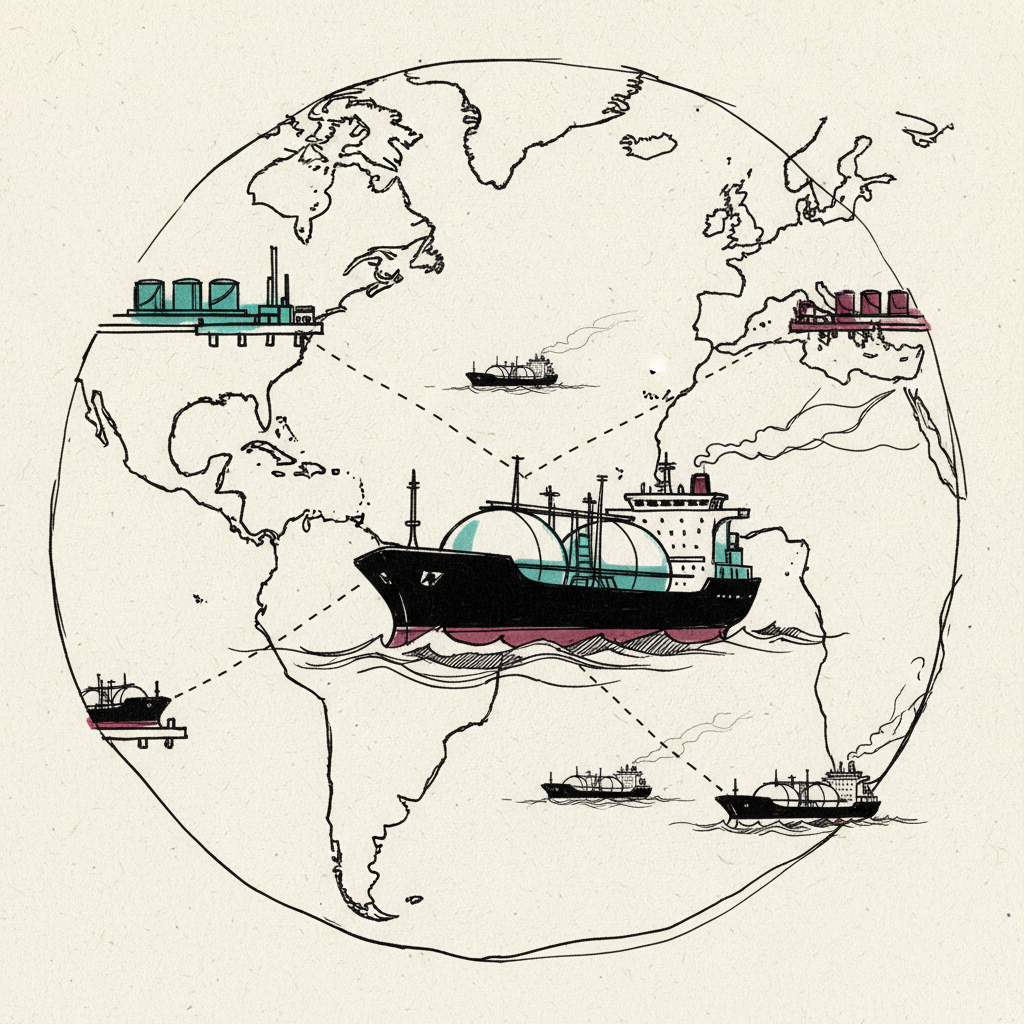
Atlantic Basin
LNG supply zone linking US Gulf, Trinidad, West Africa, and Norway to European terminals; Europe's sole supply corridor since Hormuz closed.
Last refreshed: 18 June 2026 · Appears in 1 active topic
Is Atlantic Basin LNG enough to cover Europe's shortfall while Hormuz stays disrupted?
Timeline for Atlantic Basin
Mentioned in: Asia clears the LNG queue first
European Energy MarketsMentioned in: The squeeze is the LNG the ban misses
European Energy MarketsMentioned in: OPEC adds 188kbd into 37-year output low
European Oil MarketsMentioned in: Med Aframax freight jumps as VLCCs hold
European Oil MarketsMentioned in: Drone hits Oman's last safe oil route
European Oil MarketsBackground
With Hormuz disrupted since 28 February 2026 and Qatari LNG exports suspended, the Atlantic Basin became Europe's sole short-haul LNG supply corridor during the 2026 injection season. Golden Pass LNG added a new Atlantic source from April 2026, routing some Qatari-origin volumes via Texas. However, the JKM-TTF arbitrage has kept Atlantic cargoes routing east rather than west for much of the season: with the JKM-TTF spread above the freight-adjusted diversion threshold of approximately $2.50-3.00/MMBtu, cargo owners earn a higher netback selling into Asia. As of 18 June 2026, the spread stood at approximately $4.35/MMBtu, compressing from $5.26 on 12 June on diplomacy news but remaining above the diversion level. The first LNG carrier to transit Hormuz after the June memorandum, the Disha, docked at Dahej in India rather than a European terminal, illustrating the queue and arbitrage dynamics. OIES quantified the resulting European net LNG shortfall at 2.1 bcm per month through October, contributing to the central case of EU storage reaching only 70% by 1 November.
The Atlantic Basin is the geographic LNG trading zone connecting liquefaction terminals on the US Gulf Coast (Sabine Pass, Corpus Christi, Freeport, Cove Point, Golden Pass), Trinidad and Tobago (Atlantic LNG), West Africa (Nigeria LNG, Equatorial Guinea LNG, Angola LNG), and Norway (Hammerfest Snohvit) with regasification terminals in Northwest Europe, the Iberian Peninsula, and West Africa. Atlantic Basin LNG cargoes have shorter transit times to European terminals (typically 7-10 days from the US Gulf) than Pacific Basin cargoes, which originate from Australia, Qatar, and Southeast Asia. Before the 2026 conflict, US exports supplied approximately 58% of EU LNG imports.
What is the Atlantic Basin in the context of LNG shipping?
Why is Atlantic Basin LNG important to Europe since the Hormuz closure?
Does European TTF price always attract Atlantic Basin LNG over Asian markets?
What is the Atlantic Basin for LNG and where does it include?
Why is Atlantic LNG not all going to Europe despite the Hormuz closure?
Written with AI from Lowdown's published reporting. Not individually reviewed by an editor. Updated 18 June 2026. Editorial standards.