Skip to content
You can now search across every topic, entity and event.What's new
Cuba Dispatch
17JUL

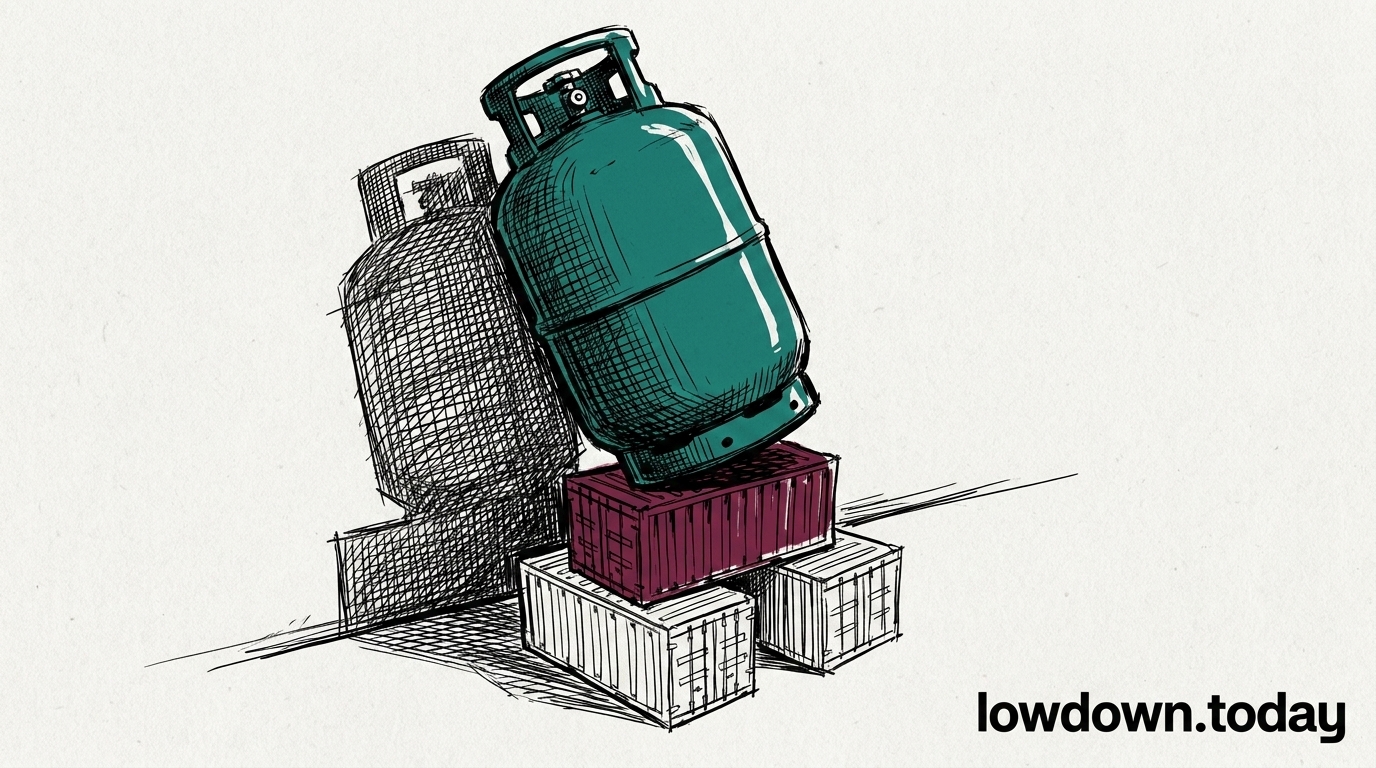
Cuba blames the blockade for a 64% gas rise

4 min read
14:00UTC

Havana raised bottled cooking gas 64 per cent on 16 July and blamed an escalating US blockade. Washington had designated two Cuban fuel importers three days earlier, and Cuba's own Vice Prime Minister had already said on 3 July that fuel now arrives in shipping containers, not tankers. The grid collapsed totally twice more in the same week.

Key takeaway

Havana blamed a 16 July price rise on sanctions three days old when its own minister had already dated the fuel shift to 3 July.

This briefing mapped
Economic
Regulatory
Infrastructure
Military
Legal
Humanitarian
Diplomatic

Resolution 155/2026 took a 10kg cooking gas cylinder from 213 to 350 CUP on 16 July, and Havana named the American blockade. The designations it pointed at were three days old.

Sources profile:This story draws on neutral-leaning sources

Cuba raised the price of a 10kg bottled cooking gas cylinder 64 per cent, from 213 to 350 Cuban pesos, under Resolution 155/2026, effective 16 July. The rise hits 1.7 million contracted customers, most of them outside Havana.

The government blames the US blockade. But deputy prime minister Óscar Pérez-Oliva had already admitted, on 3 July, that fuel now arrives by shipping container rather than tanker. That shift predates this week's price rise. 

The State Department named ten Cuban entities in a single day, four instruments of repression and six sources of funding. Two of the rationales had never appeared in the campaign before.

Sources profile:This story draws on neutral-leaning sources

The US State Department designated ten Cuban entities under Executive Order 14404 on 13 July, the largest single-day batch since 18 May. Four target repression apparatus; six target funding, including, for the first time, the Ministry of Tourism.

The wave followed a 16-day pause and landed two days after Secretary Rubio's anniversary statement on the 2021 protests. One firm, Antex, was named for exporting labour to Angola, which Washington calls forced labour. 

A 220kV line between Santa Clara and Sancti Spíritus failed at 15:55 on 10 July. Thirty-five minutes later the whole of Cuba was dark.

Sources profile:This story draws on neutral-leaning sources

A 220kV transmission line between Santa Clara and Sancti Spíritus failed at 15:55 on 10 July. The resulting frequency swing knocked out the whole national grid by 16:30, with only 935 MW available against 3,100 MW of demand.

Eleven of Cuba's 16 thermal units were already offline before the fault, leaving no spare capacity to absorb a single line failure. Afterwards, just 12.6 per cent of Havana had power back. 

Felton unit 1 tripped at 11:05 on 14 July and took the national grid down with it, four days after a broken transmission line did the same job.

Sources profile:This story draws on neutral-leaning sources

The Felton unit 1 thermal plant tripped at 11:05 on 14 July. It collapsed Cuba's national grid for the second time in a week and widened the generation deficit to 2,020 MW.

The grid had no reserve margin left after 10 July's collapse, when 11 of 16 thermal units were already offline. Cuba's grid operator later confirmed the deficit was still climbing, to a 2,240 MW forecast. 

CBS reported on 16 July that Pentagon planners have reviewed a range of Cuba options. Officials told the network an operation is not likely, because assets have gone to the Iran war.

Sources profile:This story draws on neutral-leaning sources from United States
United States

CBS (a US television network) reported on 16 July that Pentagon planners reviewed contingency options for Cuba, including a hypothetical 101st Airborne Division air assault. Officials said an operation isn't likely now because forces are tied up in the restarted US-Iran war.

A Pentagon spokesman would not confirm or deny it. The real story is the gap between the administration's tough public rhetoric on Cuba and intelligence agencies' own more measured private assessment. 

OFAC gave GECOMEX and GEMAR until 12 August to unwind their contracts. It published nothing at all for the tourism ministry designated the same day.

Sources profile:This story draws on neutral-leaning sources

OFAC (the US Treasury's sanctions arm) published same-day guidance for two of the ten newly designated Cuban firms, GECOMEX and GEMAR. It gave them a 30-day window, to 12 August, to wind down existing deals. It said nothing about the Ministry of Tourism, designated the same day.

That leaves travel agents, tour operators and card processors handling existing Cuba bookings with no published guidance at all. 

OCDH's 14 July dictamen names a prosecutor's office, a penitentiary directorate and the president of Cuba's highest court as answerable if Otero Alcántara's detention continues without judicial basis.

Sources profile:This story draws on neutral-leaning sources

Cuba's human rights observatory (OCDH) published a formal legal opinion on 14 July naming three institutions as responsible for Luis Manuel Otero Alcántara's continued detention. They are the Havana Provincial Prosecutor's Office, the Penitentiary Legality Control Directorate, and the Supreme Popular Court's president.

The group says it has had no official whereabouts information on him since 7 July, two days before his sentence formally expired. It is demanding an immediate review. 

On the day his sentence formally expired, Cuban State Security telephoned an exiled activist with Luis Manuel Otero Alcántara on speakerphone, to ask how his US parole application was going.

Sources profile:This story draws on neutral-leaning sources

Cuban State Security telephoned activist Anamely Ramos on 9 July, with Luis Manuel Otero Alcántara on speakerphone, the same day his five-year sentence formally expired. They asked about his pending US humanitarian parole application.

A broader parole route for Cubans, Haitians, Nicaraguans and Venezuelans closed in March 2025, leaving this individual filing his only path out. Only Ramos herself has described the call so far. 

UNE told the public on 16 July to expect a 2,240 MW shortfall that day, with 990 MW of generation available against 3,200 MW of demand.

Sources profile:This story draws on neutral-leaning sources

Cuba's state grid operator reported on 16 July that the actual peak power deficit on 15 July hit 2,126 MW. It forecast an even larger 2,240 MW shortfall for 16 July, with only 990 MW available against 3,200 MW of demand.

These are the operator's own figures, not relayed diaspora reporting. They confirm the deficit is still climbing days after the 10 and 14 July total collapses, not easing. 

Prisoners Defenders counted 1,306 political prisoners on the fifth anniversary of 11J, and documented 40 detained minors, 16 of them held in adult facilities.

Sources profile:This story draws on neutral-leaning sources

Prisoners Defenders published its political prisoner census on 9 July, the fifth anniversary of the 2021 protests. It recorded 1,306 prisoners against 1,281 in June, a rise of 25 in under a month.

For the first time, the group also reported 40 detained minors, 16 of them held in adult facilities rather than youth detention. That figure comes from Prisoners Defenders alone. 

Salazar, Díaz-Balart, Giménez and Smith asked Rubio and Bessent on 10 July to sanction the state operator behind Cuba's overseas medical missions as forced labour.

Sources profile:This story draws on neutral-leaning sources

The US Ambassador to Panama warned Panamanian banks and firms on 13 July over Cuban sanctions evasion, naming Fincimex and BFI as examples of the risk.

Sources profile:This story draws on neutral-leaning sources

US Ambassador to Panama Kevin Marino Cabrera and State Deputy Assistant Secretary Samuel Parker warned Panamanian banks and firms on 13 July over Cuban sanctions evasion. They named Fincimex and Banco Financiero Internacional as risk examples.

The named entities were already sanctioned, in 2020 and June 2026. The meeting extended existing sanctions pressure into Panama's banking sector rather than announcing anything new. 

Sources:CiberCuba

A Catholic priest was barred from flying to an episcopal ordination on 10 July, and two Protestant pastors were detained or threatened in the same fortnight.

Sources profile:This story draws on neutral-leaning sources

Cuba's human rights observatory (OCDH) documented a religious-freedom repression pattern in the fortnight to 14 July. Catholic priest Castor Álvarez Devesa was barred from travelling to the US for an episcopal ordination on 10 July. Police also detained pastor Alián López Rodríguez on 28 June and interrogated pastor Rolando Pérez Lora separately.

The group filed a formal complaint with the UN Special Rapporteur on religious freedom the same day, escalating beyond its usual domestic monthly reporting. 

Closing comments

Sideways on the military track, upward on the sanctions and repression tracks. The Pentagon contingency reporting from 16 July 2026 does not indicate an operational shift; CBS itself frames deployment as unlikely while assets are committed to the Iran war, and Valdez's non-denial does not change that calculus. The mechanism that would tip the sanctions track further is a second State Department wave naming CSMC, the medical-mission operator four members of Congress asked Rubio and Bessent to sanction on 10 July; the mechanism that would tip the humanitarian track is confirmation of Otero Alcántara's whereabouts, which OCDH's 14 July 2026 dictamen demands but has not received.

Different Perspectives
Cuban Ministry of Foreign Affairs
Foreign Minister Bruno Rodríguez Parrilla called the 13 July designation package 'criminal and genocidal' and said 'Cuba is not a threat and US intelligence agencies know it'. State media frame the 16 July gas-price rise as a direct consequence of the intensifying blockade, though Havana has not disclosed its own container-import shift dated 3 July.
US State Department
US State Department
Secretary Rubio said Cuba 'continues to ally itself with America's enemies' and framed the 13 July designations as deploying 'every tool at our disposal', now citing forced-labour export to Angola for the first time. These quotes rest on cached web snippets; state.gov was unreachable this run and could not be directly verified.
Human rights monitors (OCDH and Prisoners Defenders)
OCDH's 14 July dictamen named the specific offices responsible for holding Otero Alcántara past his sentence-expiry date; Prisoners Defenders counted 1,306 political prisoners, including 40 detained minors, on 9 July. Both oppose the Cuban government's account without endorsing Washington's sanctions instrument as a remedy.
