Skip to content
You can now search across every topic, entity and event.What's new
Autonomous Systems: Land & Sea
11JUL

UK airdrops a robot boat; Gulf order stalls

2 min read
10:27UTC

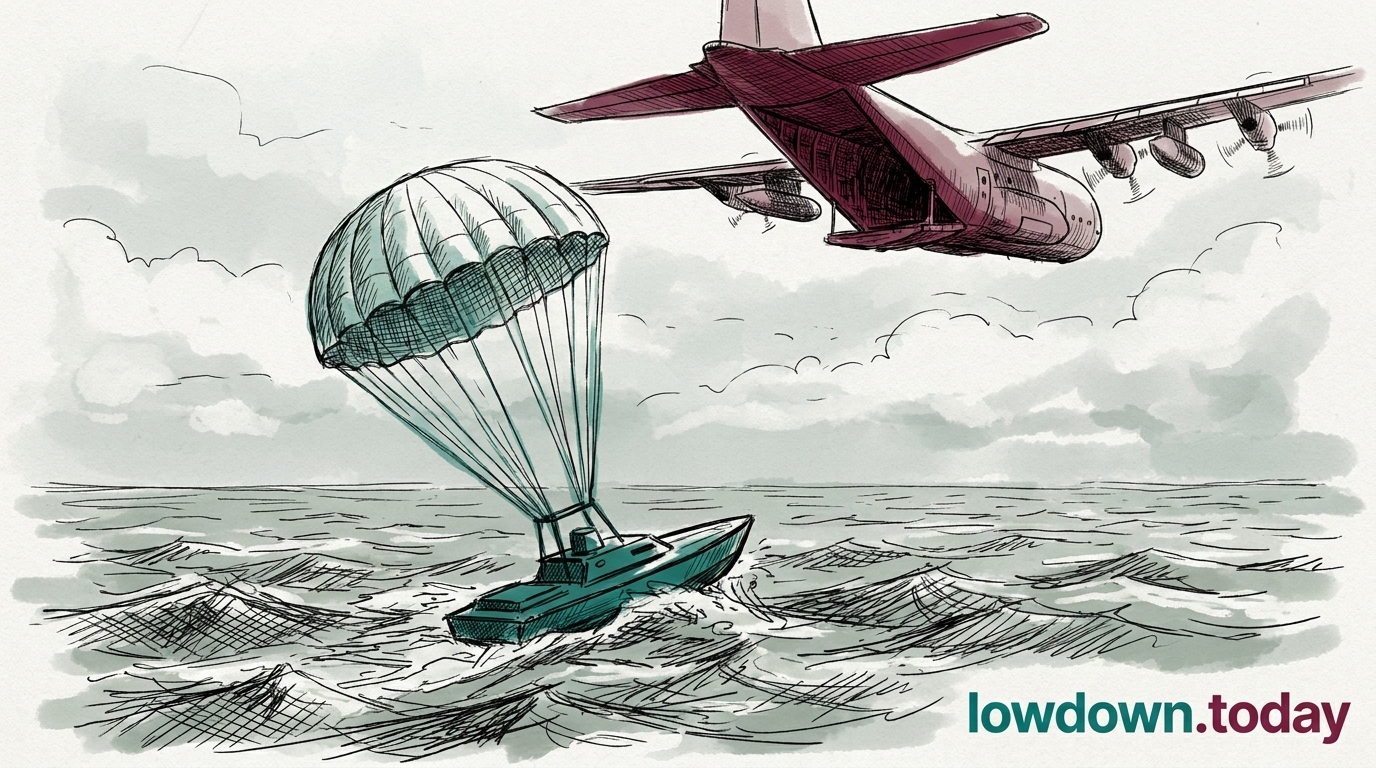
Kraken and Capewell airdropped a K3 SCOUT uncrewed boat from an A400M into Sea State 4, a world first that turns strategic airlift into a way to place robot minehunters far from any port. The most capable allied autonomous mine-clearance package meanwhile sits parked off Oman, authorised then set back by a 7 July tanker attack. Ukraine's Trinity Robotics doubled its own robot output; Kongsberg won a subsea-protection deal.

Key takeaway

Engineering has outrun the authority to deploy it, except where wartime or commercial demand routes around the gap.

This briefing mapped
Loading map…
Military
Competitive

Kraken and Capewell dropped a K3 SCOUT robot boat from an A400M into Sea State 4 waters four times, the world's first airdrop of an uncrewed surface vessel from an aircraft.

Sources profile:This story draws on neutral-leaning sources from United Kingdom
United Kingdom

Kraken Technology Group and Capewell airdropped a K3 SCOUT uncrewed boat from an A400M transport plane, dropping it four times over six days into rough Sea State 4 water.

It's the first airdrop of a boat straight into the sea, letting transport planes deliver uncrewed craft into contested waters without a ship nearby. But critics note it proved the rigging works, not survival in a real fight. 

Oman authorised Britain and France to clear mines on its Hormuz route, then a 7 July tanker strike stalled the most capable allied robot minehunting package before it could begin.

Sources profile:This story draws on centre-leaning sources from United States
United States
LeftRight

Oman authorised the UK and France to start clearing about 80 remaining Iranian sea mines from its southern Hormuz route in early July, before a 7 July strike on a Qatari LNG carrier reset the timeline.

RFA Lyme Bay, the autonomous minehunter RNMB Ariadne and HMS Dragon remain in Omani waters awaiting the order to begin. Authorisation without a start date leaves the mission a political signal as much as a working one. 

Trinity Robotics doubled its 2026 plan for the Konyk One supply-and-casevac ground robot to about 2,200 units and opened joint-venture talks with a French manufacturer, co-founder Oleksii Konik said.

Trinity Robotics doubled its 2026 production plan for the Konyk One logistics and medical-evacuation robot, from about 1,100 to 2,200 units, and opened talks on a French joint venture, co-founder Oleksii Konik said on 9 July.

Backers include Sweden's Front Ventures and Hede Capital Partners. It's the clearest sign yet of Ukrainian ground-robot manufacturing shifting into EU production, matching Kyiv's wartime pace of about 25,000 robots contracted in six months. 

Kongsberg Discovery won a contract from an unnamed international customer to guard offshore platforms, subsea cables and pipelines with fused sonar, cameras and its C-Scope software, converting infrastructure-protection demand into a signed deal.

Kongsberg Discovery won a contract from an undisclosed international customer to protect offshore platforms, subsea cables, pipelines, ports and energy grids, the Norwegian company said on 3 July.

It fuses sonar and camera data through its C-Scope software and can cue Kongsberg's own HUGIN underwater drone for inspection. Kongsberg won't name the buyer, a sign the market is moving ahead of any government order. 

Closing comments

Sideways through the rest of 2026, pending a single named trigger: Iran's mourning period for Supreme Leader Khamenei ending, which allied planners are treating as the condition for resuming Hormuz clearance rather than a fixed calendar date. A second tanker strike near Iranian-claimed waters, the same class of event that reset the 7 July timeline, is the mechanism most likely to tip this back down; a formal end to the mourning period without a further strike is what would tip it up.

AI-assisted, human-edited under the editorial responsibility of Bannermedia Ltd. Reviewed by Ed Woodcock on 11 July 2026. Editorial standards.

Different Perspectives
United Kingdom (Ministry of Defence and Royal Navy)
The Royal Navy proved it can airdrop a mine-hunting robot from any A400M into Sea State 4 waters, working round a front line of just six Type 45 destroyers and eight Type 23/26 frigates rather than waiting for more hulls. First Sea Lord Gwyn Jenkins's 'uncrewed wherever possible' doctrine gets a delivery method; it still lacks a named operational deployment.
Ukraine (Trinity Robotics)
Trinity Robotics doubled its Konyk One production target to 2,200 units and opened French joint-venture talks, co-founder Oleksii Konik said, because wartime demand outpaces what factories inside a live-fire war zone can safely hold. Ukraine is answering the authority gap other actors face by manufacturing around it.
Norway (Kongsberg Discovery)
Kongsberg Discovery's Camilla Kiss said the subsea-protection contract shows the industry 'moving from recognising the need to implementing solutions', selling fused sonar and C-Scope software to an unnamed buyer because fragmented cable, pipeline and platform ownership means no single navy commissions this the way it commissions a warship.
Iran (Ministry of Foreign Affairs)
Spokesman Kazem Gharibabadi said clearance of the Hormuz mines is 'Iran's sole responsibility', rejecting the Omani-authorised allied mine-clearance mission as a jurisdictional dispute rather than a technical favour. Tehran has not ratified UNCLOS, the treaty that would otherwise settle transit-passage rights through the strait.
China (military commentary)
Chinese military commentary has called uncrewed maritime equipment 'an excellent force multiplier' that cannot overturn the fundamental logic of naval warfare, the lone voice against the Western consensus that autonomy is the central axis of naval modernisation. Beijing reads the airdrop trial as an incremental logistics fix, not London's claimed doctrinal breakthrough.