Skip to content
You can now search across every topic, entity and event.What's new
Autonomous Systems: Land & Sea
12AUG

Navy robot boats' cameras called China

2 min read
14:17UTC

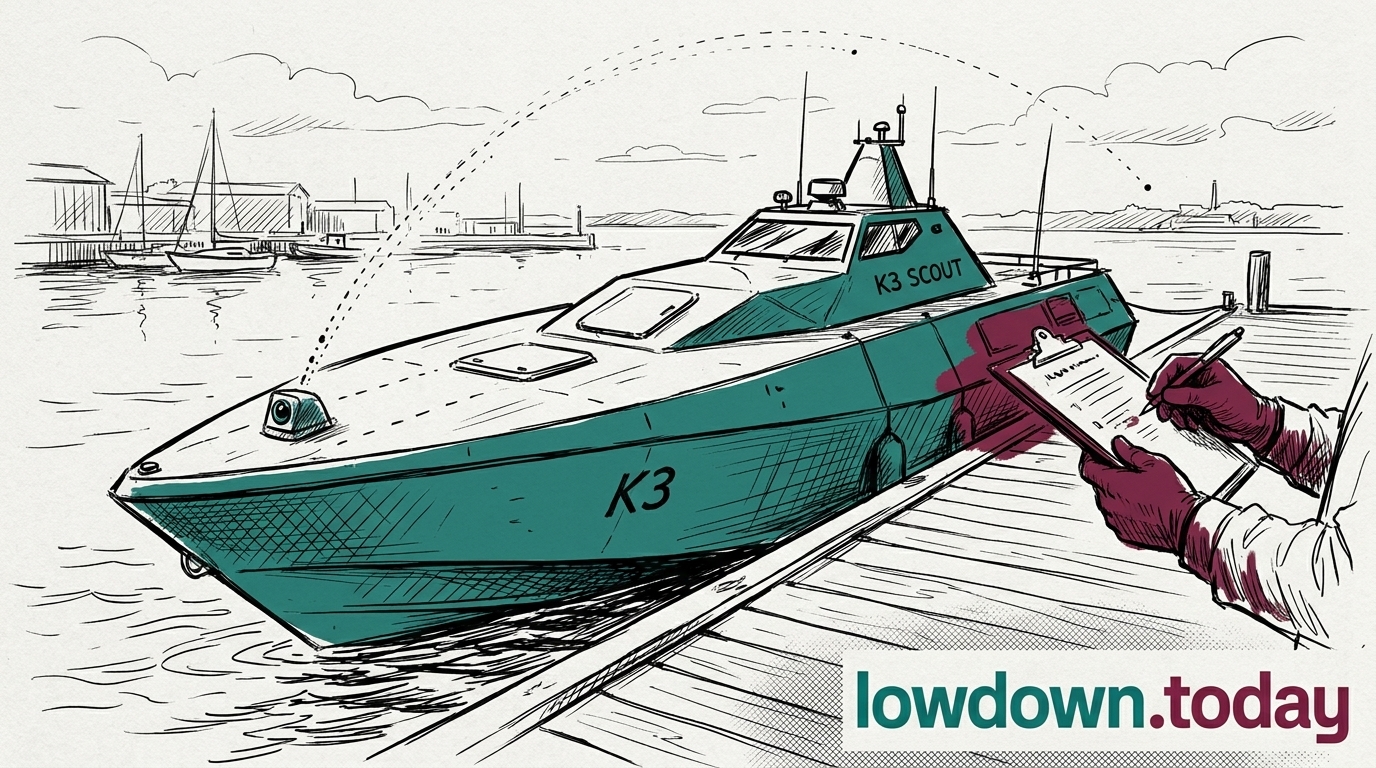
Camera components made in China and fitted to Royal Marines K3 SCOUT robot boats were found sending heartbeat traffic to an internet address in China, the Telegraph reported on 9 August.

TechnologyDeveloping
Key takeaway

The Telegraph reports Chinese-made cameras on Royal Marines K3 SCOUT boats sent traffic to China.

Camera components made in China and fitted to Royal Marines and Special Boat Service K3 SCOUT uncrewed surface vessels (USV) were found sending "heartbeat" traffic to an internet address in China, The Telegraph reported on 9 August 1. A USV carries sensors to sea with nobody aboard. The GBP12m fleet has been in use with both units since March 2026, and The Telegraph reported that the cameras stayed active with the boats powered down 2.

Kraken Technology Group, the Portsmouth firm that builds the K3 SCOUT, bought the cameras from a third party that had given security assurances 3. Kraken Technology Group is a British maritime-autonomy builder, and is not the Canadian sonar firm Kraken Robotics. A defence source told The Telegraph the department had "lost confidence in the platform" 4. The Telegraph attributes that judgement to one unnamed person, not to the department itself.

The reported facts are narrow and worth keeping narrow: components manufactured in China, traffic to a Chinese internet address, and cameras drawing power while the vessels were off. Nobody in the reporting alleges direction by the Chinese state.

This briefing has carried the same vessel class twice in six weeks. Kraken and Capewell dropped one from an Airbus A400M into Sea State 4 water, waves of roughly 1.25 to 2.5 metres, on 8 July , and the class was earmarked for a British freedom-of-navigation package in the Strait of Hormuz that stalled after a tanker attack . Britain committed GBP115m of mine-hunting drones and counter-drone systems to that multinational mission in May . Those records establish which boats were in the package. They do not corroborate The Telegraph's account of what the cameras did.

Deep Analysis

In plain English

The Royal Marines and Special Boat Service use small robot boats called K3 SCOUT to hunt mines and gather intelligence without putting a crew at risk. Some of these boats had cameras built with parts made in China. Those cameras were quietly sending a signal, called heartbeat traffic, to an internet address inside China, even though nobody had asked them to. The Telegraph's report does not show anyone in China watching live footage or pulling data from the boats. It shows the camera checking in with a server abroad on its own, unapproved by the Ministry of Defence, the way a phone app might ping a company server without being asked.

Deep Analysis
Root Causes

UK defence procurement audits prime contractors far more rigorously than the sub-tier components those contractors buy in. A camera module is treated as a commodity part, not a system with its own firmware and network stack, so it passes assurance checks that would catch a compromised autonomy controller.

Kraken Technology Group scaled K3 SCOUT production fast enough to reach a $1bn valuation within a year of the platform's first airdrop trial. Rapid scaling and commercial off-the-shelf sourcing pull in the same direction: speed rewards buying whatever camera module is available, not vetting its origin.

What could happen next?
  • Risk

    Other UK autonomous platforms sharing the same camera supplier may carry the same undisclosed connectivity, and the Telegraph's report did not establish how widely the component was used.

  • Precedent

    A formal component-sourcing audit for uncrewed maritime systems would give the Platform Authority proposal (ID:5077) a concrete first task rather than an abstract governance remit.

First Reported In

Update #11 · Chinese cameras in the Navy's robot boats

The Telegraph· 12 Aug 2026
Read original
Different Perspectives
Conservative opposition
The Conservative opposition called on the Government on 9 August to 'urgently audit' equipment for hidden Chinese components, after the Telegraph's K3 SCOUT report. No named MP has been quoted on the record; the call came at party level, alongside the Ministry of Defence's own 10 August statement that no data had been compromised.
Netherlands Ministry of Defence
The Netherlands Ministry of Defence authorised Dutch Naval Design on 4 August to design 12-metre anti-submarine warfare uncrewed vessels for the Dutch-Belgian frigate programme, and to buy an adapted Compact FLASH dipping sonar from Thales Underwater Systems France. The order commits money and a named supplier while Britain's own certification body remains at the market-engagement stage.
Kraken Technology Group
Kraken Technology Group is a UK maritime-defence company based in Portsmouth that builds the K3 SCOUT, and crossed a $1bn valuation in July on a single-sourced $175m raise. The camera components reached the fleet under a third party's written security assurance, which the Platform Authority, which does not yet exist, was never positioned to check.
Navy Commercial
Navy Commercial
Navy Commercial at Whale Island published two notices on 5 August: 074032-2026, asking industry how to build a Platform Authority to certify uncrewed vessels, and 074351-2026, a GBP10m multi-role USV testbed for the Defence Chief Technology Officer. Responses on the Platform Authority close 19 August, ten days after the cameras were found transmitting to China.
Ministry of Defence
Ministry of Defence
The Ministry of Defence said on 10 August that a routine cyber vulnerability assessment found the camera fault, and a thorough investigation found no evidence that MoD data or systems had been accessed, compromised or transmitted externally. It stripped the cameras of internet connectivity but did not say whether it acted against the supplier.
Thales
Thales
Thales converted its 6 July engaging accord with Exail into a definitive combination agreement on 30-31 July, but the tender offer for Exail's remaining shares now closes by early 2028, later than July's timetable implied. Thales integrates its new undersea prime while still bidding against Kongsberg and DRASS's 2027 target for the AUKUS Pillar II contest.
