Skip to content
You can now search across every topic, entity and event.What's new
Autonomous Systems: Land & Sea
12AUG

Navy asks how to certify a robot ship

3 min read
14:17UTC

Navy Commercial published preliminary market engagement notice 074032-2026 on 5 August, asking industry how to stand up a Platform Authority for uncrewed maritime systems. Responses close on 19 August.

TechnologyAssessed
Key takeaway

The Royal Navy is consulting industry on how to build the office that certifies uncrewed vessels.

Navy Commercial, the Royal Navy procurement office at Whale Island in Portsmouth, published preliminary market engagement notice 074032-2026 on 5 August, asking industry how to stand up a Platform Authority for maritime uncrewed systems 1. A preliminary market engagement is a pre-tender consultation, in which the Ministry of Defence asks suppliers what is possible before any contract is written. The scope covers governance, engineering, certification support and through-life assurance. Responses close on 19 August, the tender itself is estimated for 20 August, and a down-selected group attends industry days in Portsmouth on 1 and 2 September 2.

A Platform Authority is the office that certifies an uncrewed vessel as safe to operate. It is a harder job than certifying a crewed one, because no captain is aboard to override the automation when something goes wrong. The notice states that the authority's own post must be held by a crown servant, with supporting organisations seconding workforce and expertise into it 3. Small firms and voluntary-sector suppliers are named as suitable bidders, which matters because most of Britain's uncrewed-vessel builders are small firms.

The seaworthiness half of this went up fast. The International Maritime Organization (IMO), the United Nations agency for shipping standards, adopted the first Maritime Autonomous Surface Ships (MASS) Code in May , and the code entered force on 1 July . The Maritime and Coastguard Agency (MCA) published its Maritime Innovation Hub approval route on 3 June . Both answer whether the boat can be trusted at sea. Neither asks who made the parts fitted inside it.

The timing runs in Britain's favour on one reading. This notice went out four days before The Telegraph published, and the Marine Accident Investigation Branch (MAIB) refreshed its investigations register on 6 August, and both of the uncrewed-vessel cases on it date from September 2025 4. Assurance is working at the speed of a market engagement notice, and the boats have been in special forces hands since the spring.

Deep Analysis

In plain English

The Royal Navy is asking industry for advice on setting up a new body, a Platform Authority, whose job would be to make sure all its robot boats and submarines are built, tested and maintained to a proper standard. Right now, different uncrewed vessel programmes get checked in different ways, and there is no single group responsible for making sure they are all safe and secure before they go to sea. Companies have until 19 August to respond, and the Navy expects to put the actual contract out to tender the very next day.

Deep Analysis
Root Causes

Uncrewed maritime systems grew from single trial platforms to fleet-scale procurement (K3 SCOUT, the Mine Hunting Capability programme, the GBP10m testbed) faster than the Navy built a certification body to match. Each programme has been assured individually rather than against a shared standard.

Governance for crewed vessels rests on decades of classification-society and naval-architecture practice. Uncrewed systems inherit none of that automatically, because the engineering questions, who certifies an autonomy stack, who owns through-life software assurance, are new questions a Platform Authority is only now being asked to answer.

What could happen next?
  • Consequence

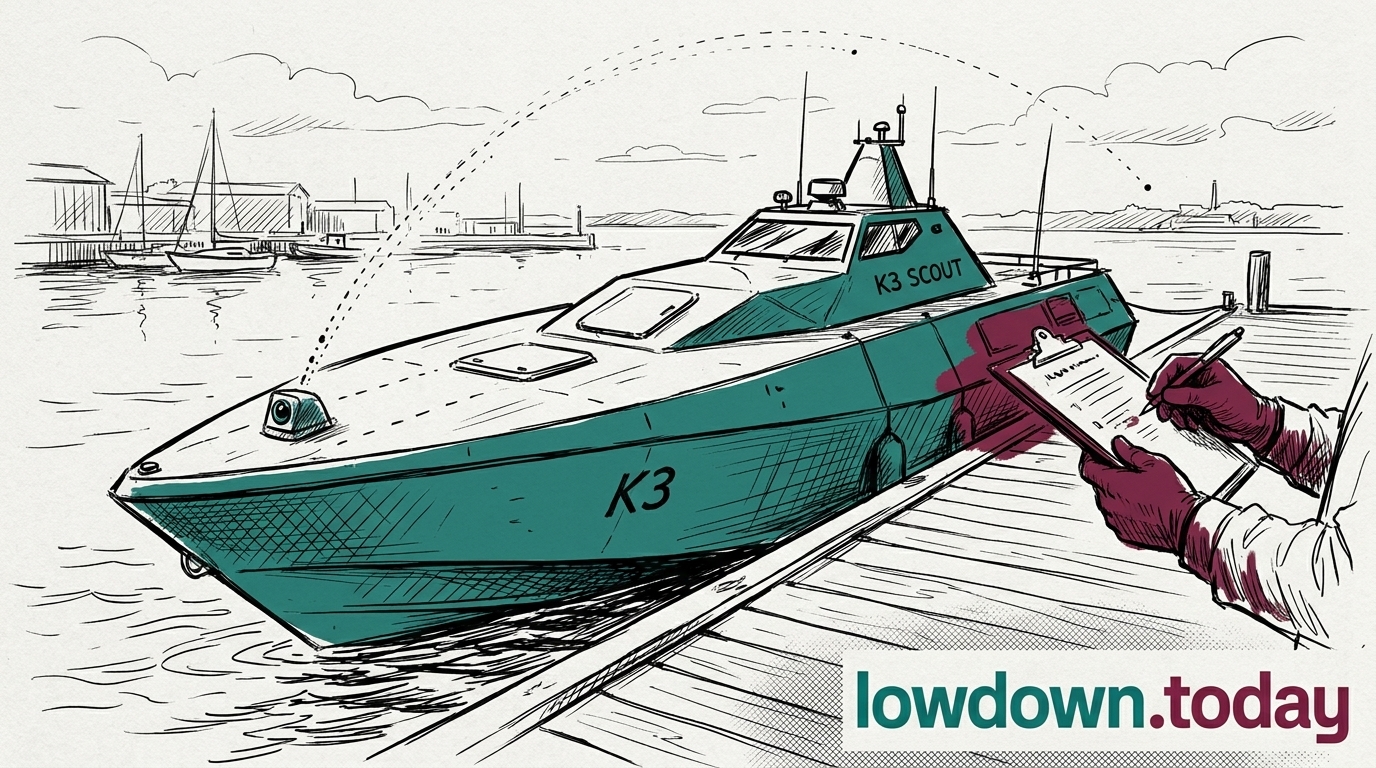
    A Platform Authority with certification power could have caught the K3 SCOUT camera fault before deployment, had it existed when the vessels entered service.

  • Risk

    A one-day gap between the 19 August response deadline and the 20 August tender estimate leaves little time to weigh competing bids before the Navy commits.

First Reported In

Update #11 · Chinese cameras in the Navy's robot boats

UK Find a Tender Service· 12 Aug 2026
Read original
Different Perspectives
Conservative opposition
The Conservative opposition called on the Government on 9 August to 'urgently audit' equipment for hidden Chinese components, after the Telegraph's K3 SCOUT report. No named MP has been quoted on the record; the call came at party level, alongside the Ministry of Defence's own 10 August statement that no data had been compromised.
Netherlands Ministry of Defence
The Netherlands Ministry of Defence authorised Dutch Naval Design on 4 August to design 12-metre anti-submarine warfare uncrewed vessels for the Dutch-Belgian frigate programme, and to buy an adapted Compact FLASH dipping sonar from Thales Underwater Systems France. The order commits money and a named supplier while Britain's own certification body remains at the market-engagement stage.
Kraken Technology Group
Kraken Technology Group is a UK maritime-defence company based in Portsmouth that builds the K3 SCOUT, and crossed a $1bn valuation in July on a single-sourced $175m raise. The camera components reached the fleet under a third party's written security assurance, which the Platform Authority, which does not yet exist, was never positioned to check.
Navy Commercial
Navy Commercial
Navy Commercial at Whale Island published two notices on 5 August: 074032-2026, asking industry how to build a Platform Authority to certify uncrewed vessels, and 074351-2026, a GBP10m multi-role USV testbed for the Defence Chief Technology Officer. Responses on the Platform Authority close 19 August, ten days after the cameras were found transmitting to China.
Ministry of Defence
Ministry of Defence
The Ministry of Defence said on 10 August that a routine cyber vulnerability assessment found the camera fault, and a thorough investigation found no evidence that MoD data or systems had been accessed, compromised or transmitted externally. It stripped the cameras of internet connectivity but did not say whether it acted against the supplier.
Thales
Thales
Thales converted its 6 July engaging accord with Exail into a definitive combination agreement on 30-31 July, but the tender offer for Exail's remaining shares now closes by early 2028, later than July's timetable implied. Thales integrates its new undersea prime while still bidding against Kongsberg and DRASS's 2027 target for the AUKUS Pillar II contest.
