Skip to content
You can now search across every topic, entity and event.What's new
Autonomous Systems: Land & Sea
12AUG

GEREON ran six days in the Mojave

2 min read
14:17UTC

ARX Robotics UK ran eight GEREON robots through six continuous days of a US Army exercise at Fort Irwin, alongside British troops, the Defense Post reported on 11 August.

TechnologyDeveloping
Key takeaway

Eight ARX GEREON robots survived six unbroken days of a US Army desert exercise.

ARX Robotics UK ran eight GEREON uncrewed ground vehicles (UGV) through Project Convergence-Capstone 6, the US Army-led exercise at Fort Irwin in California's Mojave Desert, working alongside British troops, the Defense Post reported on 11 August 1. The robots ran for six days without a break, on scouting, electronic warfare, counter-UAS (defence against uncrewed aircraft), logistics and casualty evacuation, with minimal human intervention through heat, dust and broken ground 2.

Most robot demonstrations last a scripted afternoon. Six unbroken days in a desert is long enough to surface the dull failures that kill fielded fleets: grit in the drive train, thermal throttling, batteries degrading, the tenth recovery of the day when a crew is already tired. Nothing in a procurement paper predicts those. Only running the thing does.

ARX has three production commitments to sell against. It opened a GBP45m UK GEREON line with Devon's Supacat under a British Army contract in April , expanded its Ukraine fleet fivefold in May , and founded ARX Industries with Ukraine's Roboneers in June to build in Germany and Ukraine . Factory capacity built that fast needs orders behind it, and an allied exercise at Fort Irwin is where the officers who write those orders stand and watch.

Deep Analysis

In plain English

GEREON is a robot ground vehicle, roughly the size of a small all-terrain vehicle, built by a British company called ARX Robotics UK. Eight of them spent six days working alongside British and American troops in the Mojave Desert in California, doing jobs like scouting ahead, jamming enemy signals, spotting drones, carrying supplies and evacuating casualties, mostly without a human directly controlling them. The trial was part of a big US Army exercise called Project Convergence, which tests how new technology performs alongside real soldiers in realistic conditions.

Deep Analysis
Root Causes

ARX Robotics UK already had a domestic manufacturing base through its GBP45m Task Force RAPSTONE contract with Supacat before this exercise, which is why GEREON could be deployed to a US Army exercise as a working platform rather than a prototype: British production capacity meant a unit was available to send.

Minimal human intervention across scouting, electronic warfare, counter-UAS, logistics and casualty evacuation in one continuous exercise reflects a deliberate design choice to prove multi-role capability in a single trial, since separate single-mission trials would not demonstrate the platform's ability to switch tasks without reconfiguration.

What could happen next?
  • Opportunity

    A successful multi-role trial at a major US Army exercise strengthens GEREON's case for wider British Army adoption beyond the existing Task Force RAPSTONE order.

First Reported In

Update #11 · Chinese cameras in the Navy's robot boats

The Defense Post· 12 Aug 2026
Read original
Different Perspectives
Conservative opposition
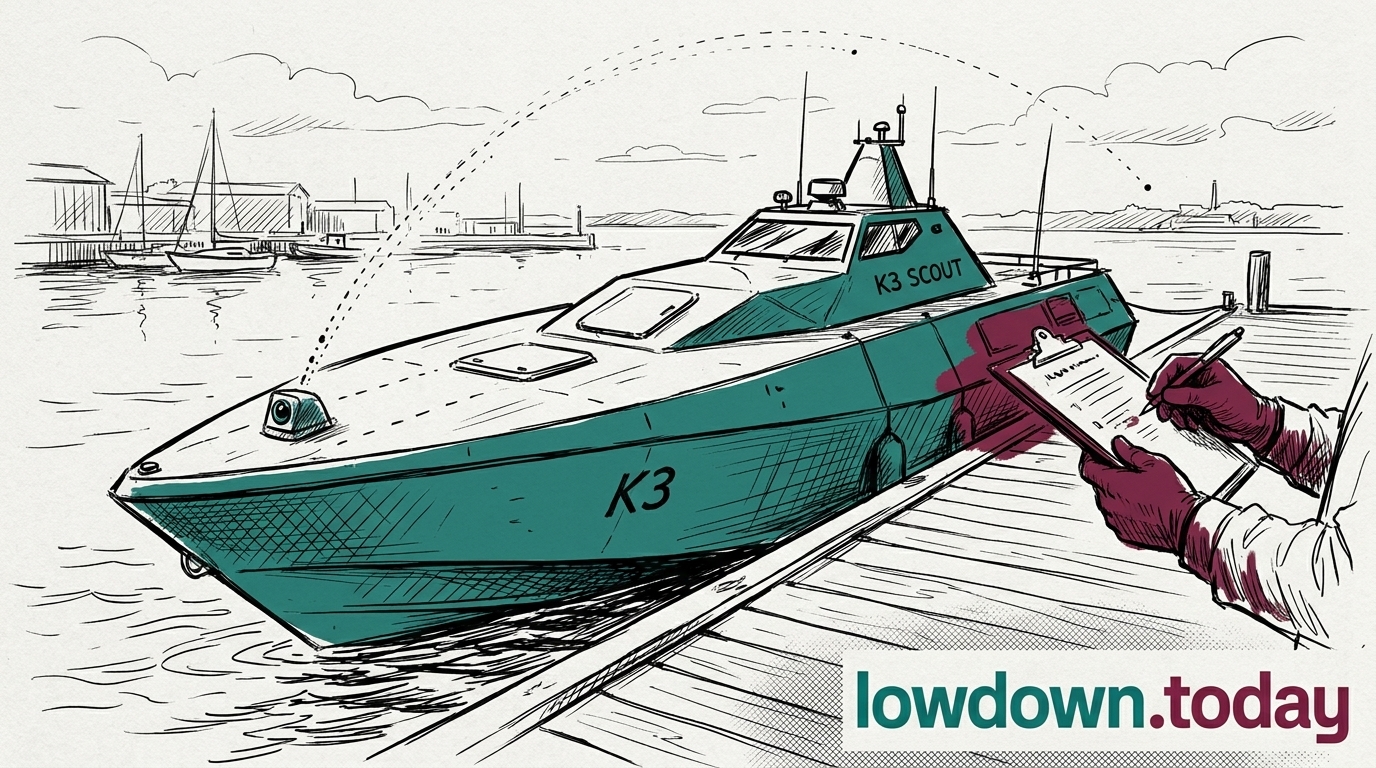
The Conservative opposition called on the Government on 9 August to 'urgently audit' equipment for hidden Chinese components, after the Telegraph's K3 SCOUT report. No named MP has been quoted on the record; the call came at party level, alongside the Ministry of Defence's own 10 August statement that no data had been compromised.
Netherlands Ministry of Defence
The Netherlands Ministry of Defence authorised Dutch Naval Design on 4 August to design 12-metre anti-submarine warfare uncrewed vessels for the Dutch-Belgian frigate programme, and to buy an adapted Compact FLASH dipping sonar from Thales Underwater Systems France. The order commits money and a named supplier while Britain's own certification body remains at the market-engagement stage.
Kraken Technology Group
Kraken Technology Group is a UK maritime-defence company based in Portsmouth that builds the K3 SCOUT, and crossed a $1bn valuation in July on a single-sourced $175m raise. The camera components reached the fleet under a third party's written security assurance, which the Platform Authority, which does not yet exist, was never positioned to check.
Navy Commercial
Navy Commercial
Navy Commercial at Whale Island published two notices on 5 August: 074032-2026, asking industry how to build a Platform Authority to certify uncrewed vessels, and 074351-2026, a GBP10m multi-role USV testbed for the Defence Chief Technology Officer. Responses on the Platform Authority close 19 August, ten days after the cameras were found transmitting to China.
Ministry of Defence
Ministry of Defence
The Ministry of Defence said on 10 August that a routine cyber vulnerability assessment found the camera fault, and a thorough investigation found no evidence that MoD data or systems had been accessed, compromised or transmitted externally. It stripped the cameras of internet connectivity but did not say whether it acted against the supplier.
Thales
Thales
Thales converted its 6 July engaging accord with Exail into a definitive combination agreement on 30-31 July, but the tender offer for Exail's remaining shares now closes by early 2028, later than July's timetable implied. Thales integrates its new undersea prime while still bidding against Kongsberg and DRASS's 2027 target for the AUKUS Pillar II contest.
