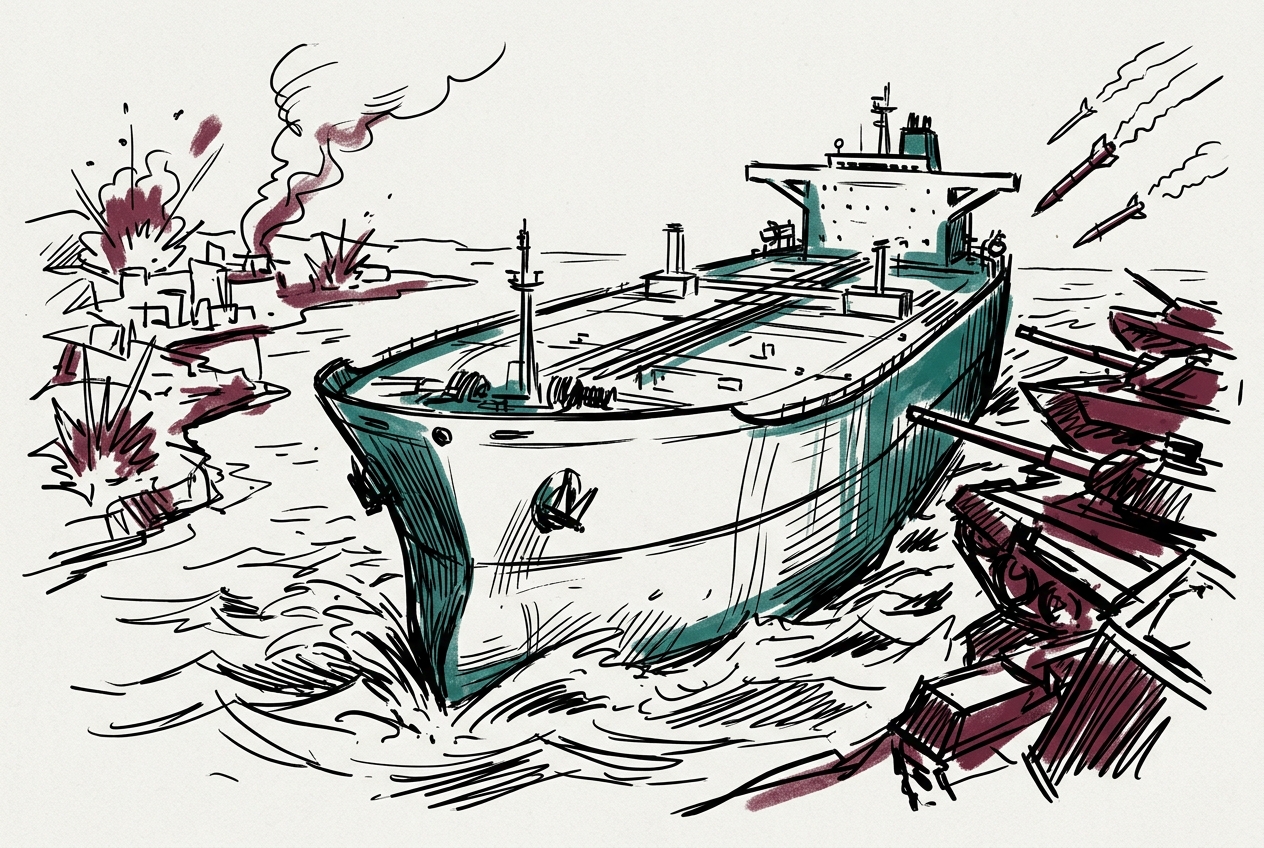
VLCC
200,000-320,000 DWT supertanker carrying 20% of global crude; hit hardest by Hormuz closure and CENTCOM blockade.
On 17 July, Gulf-to-China VLCC freight rose to WS372 and war-risk cover reached 5% of hull value after tanker strikes in The Gulf.
Last refreshed: 22 September 2026 · Appears in 2 active topics
Seven supertankers are waiting at Chabahar outside the blockade — what happens when they decide to move?
Timeline for VLCC
Mentioned in: A Hormuz fee, denied the same day
Iran Conflict 2026Mentioned in: Two Suezmaxes cost $2m more than one VLCC
European Oil MarketsMentioned in: Med aframax freight doubles in a week
European Oil MarketsMentioned in: Radio warnings close a second strait
Iran Conflict 2026Mentioned in: Singapore keeps barrels as ARA builds
European Oil MarketsBackground
VLCC is the standard abbreviation for Very Large Crude Carrier, a supertanker class of 200,000 to 320,000 deadweight tonnes built for long-haul crude transport. A single vessel can carry roughly two million barrels. Their scale makes them central to seaborne crude trade, but it also limits where they can load, discharge and reroute.
The class depends on deep-water terminals and cannot use the Panama Canal. That concentrates voyages through major maritime chokepoints, especially the strait of Hormuz. When Hormuz traffic fell to three transits on 19 April, seven VLCCs near Chabahar represented about 14 million barrels of capacity outside the strait. This combination of large cargoes and constrained routing makes VLCC availability a practical measure of disruption in the oil trade.
VLCC freight retains a risk premium
On 17 July, The Gulf-to-China TD3C VLCC route reached WS372, 27% above its 3 July assessment, while war-risk cover widened to 5% of hull value. Two tanker strikes forced underwriters and brokers to reprice a route that had remained calm for six weeks.
VLCC operators pay for insurance before cargo moves, making the distinction material to each voyage. On 22 June, fourth-quarter Gulf-to-China freight still stood at $181,163 a day, about twice the comparable US Gulf-to-China rate, even as Brent fell. The class therefore remains exposed to a cost floor that oil prices alone cannot show.
Reference
What is a VLCC tanker?
How high did Gulf VLCC war-risk insurance rise in July 2026?
What is the East-West oil arbitrage and why does it matter?
How much does it cost to charter a VLCC in 2026?
Why are VLCCs routing via Chabahar instead of Hormuz?
What is the difference between a VLCC and a shadow fleet tanker?
Has any country committed warships to escort VLCCs through Hormuz?
How are Russian oil tankers connected to the Hormuz crisis?
How much does it cost to ship oil through the Strait of Hormuz now?


