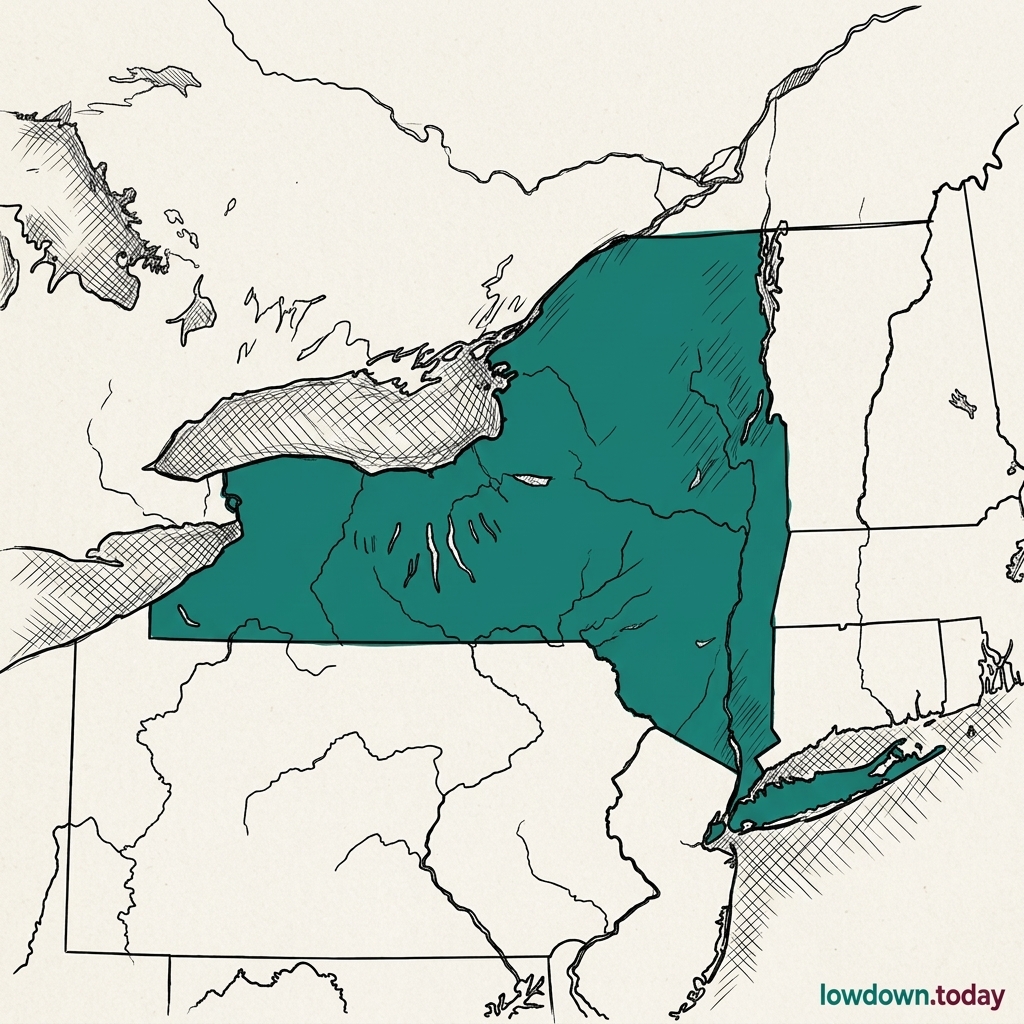
New York State
Most populous US north-east state; legislates ahead of Congress on technology and elections.
New York State published a voluntary $1m-per-megawatt community investment benchmark for data-centre developers on 15 September 2026, a document required by Governor Kathy Hochul's 14 July order freezing new hyperscale permits for a year.
Last refreshed: 18 October 2026 · Appears in 4 active topics
The world's first AI layoff law found nothing; is that proof it works or proof it can't?
Timeline for New York State
Mentioned in: Kotek seeks pause on data-centre permits
Data Centres: Boom and BacklashMentioned in: Quebec data centres face under-use fee
Data Centres: Boom and BacklashMentioned in: New York asks $1m per MW for host towns
Data Centres: Boom and BacklashMentioned in: Oracle's capex hits $28.5bn in a quarter
Data Centres: Boom and BacklashA third circuit takes the voter-file fight
US Midterms 2026Background
New York State moved first among US states to freeze data-centre growth by decree. On 14 July 2026 Governor Kathy Hochul signed an order freezing new discretionary environmental permits for hyperscale data centres for one year, bypassing the legislature. It gave Empire State Development 60 days to set what developers must offer host communities; the 15 September framework set a voluntary $1m per megawatt with no penalty for missing it.
Albany serves as the state capital and New York City as its largest city. A large population and a concentrated financial and media economy carry the state's laws well beyond its borders, and its control of land use, environmental permits and incentives put it at the centre of the data-centre negotiations.
Technology rules recur in Albany. An updated WARN Act made employers say whether AI caused a mass layoff, yet by 26 March 2026 none of 162 filers, covering 28,300 workers, had cited it. The Assembly passed bill A 9581 on 3 June, requiring an annual state report on AI and hiring, and on 5 June a bill making AI web crawlers identify themselves. On 28 May its attorney general, Letitia James, joined New Jersey in subpoenaing FIFA over World Cup ticket pricing at MetLife Stadium.
New York faces a voter-file appeal
Why is New York's voter file the subject of a federal appeal?
New York tracks AI job effects
Why did New York's AI layoff disclosure law produce no data?
What new AI employment laws did New York pass in 2026?
How does New York regulate artificial intelligence?
What is the New York AI crawler disclosure law?
Written with AI from Lowdown's published reporting. Not individually reviewed by an editor. Updated 18 October 2026. Editorial standards.