Skip to content
You can now search across every topic, entity and event.What's new
General License 134B
Legislation

General License 134B

Expired OFAC waiver for Russian crude in-transit completions; lapsed 16 May 2026; superseded by GL 134C (valid to 17 June 2026).

Last refreshed: 15 June 2026 · Appears in 4 active topics

Key Question

With no GL 134C, which European buyers are now exposed on incomplete Russian cargoes?

Timeline for General License 134B

#8 15 Jun

Unpublished successor to GL 134C; its absence is the binary risk on 17 June

European Oil Markets: Mentioned in: Two sanctions clocks pull opposite ways
#2 18 May

superseded by GL 134C

European Oil Markets: Mentioned in: OFAC signs GL 134C, third Russia bridge
#17 18 May

Authorised Russian crude delivery through 17 June 2026, excluding Cuba

Russia-Ukraine War 2026: Treasury Drops Cuba From Russian-Crude Waiver
View full timeline →

Background

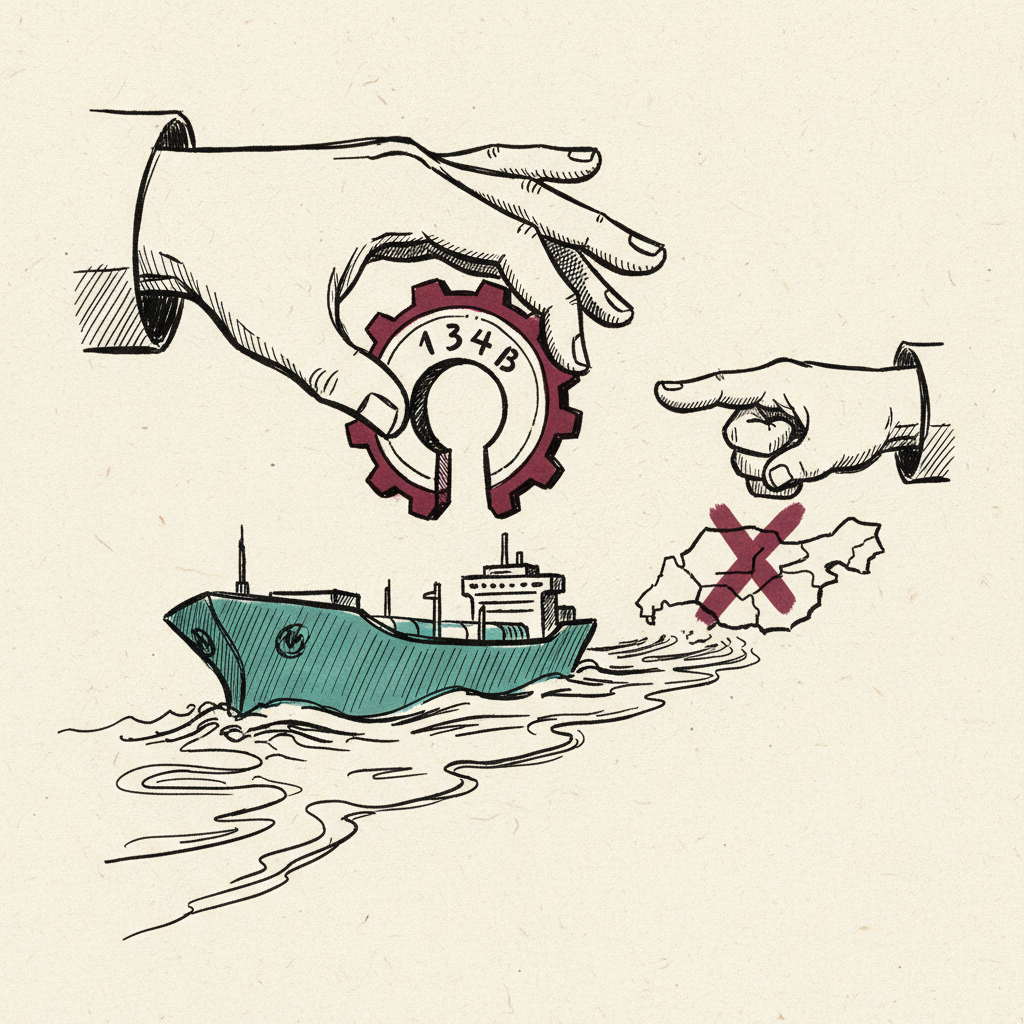
General License 134B is a Treasury Department instrument, signed 17 April 2026, that authorises ordinarily-prohibited transactions 'ordinarily incident and necessary' to the sale, delivery, and offloading of crude oil and petroleum products of Russian Federation origin loaded on vessels on or before 12:01 a.m. EDT, 17 April 2026. The licence is valid through 12:01 a.m. EDT, 16 May 2026, a 30-day window. Its scope includes vessel management, crewing, bunkering, insurance, registration, and other ancillary services required to transport sanctioned Russian crude to international buyers. Paragraph (b)(1) of the licence contains an explicit and non-negotiable carve-out: any transaction involving a person located in or organised under the laws of Iran, North Korea, Cuba, or controlled Ukrainian territories is prohibited. Paragraph (b)(2) reiterates this exclusion by reference to the Iranian Transactions and Sanctions Regulations (31 CFR part 560).

GL 134B supersedes GL 134A (dated 19 March 2026, expired 11 April 2026), continuing an iterative chain of short-term renewals that have governed Russian oil flows since the Ukraine conflict intensified. The 8-day gap between GL 134A's expiry and GL 134B's issuance created legal uncertainty; traders operated in a limbo zone where the prior licence was dead but the new one not yet signed. The pattern itself is instructive: rather than granting open-ended authorisation, OFAC issues narrow 30-day windows, forcing traders to re-negotiate their compliance posture monthly. This tactic allows the Treasury Department to signal policy shifts without invoking the formal, cumbersome process of sanctions designation or removal.

The Iran exclusion is textual, not incidental. On 16 April, Treasury Secretary Scott Bessent announced that GL-U (the equivalent licence for Iranian oil) would not be renewed, allowing it to lapse on 19 April without replacement. GL 134B's explicit mention of Iran in paragraph (b) thus stands in sharp relief: the government is not merely allowing Iranian oil sales to become illegal; it is actively designating Iran as an off-limits party whilst simultaneously renewing cover for Russian flows. This asymmetry reflects an administration strategy: Russia's oil revenues are constrained but still partially accessible to US-allied traders; Iran's are severed entirely. The timing: renewal on 17 April, Iranian lapse on 19 April. This compresses this pivot into 48 hours, affecting secondary-sanction exposure for approximately 325 tankers with roughly $31.5 billion in Iranian crude mid-transit.

GL 134B's expiry at 12:01 ET on 16 May 2026 is the lead regulatory anchor of European oil markets Update #1. GL 134B was superseded by General License 134C, which extended in-transit completion cover to 17 June 2026, continuing the iterative monthly waiver chain.

For European buyers, the practical consequence of each monthly expiry is the same: any in-transit Russian crude cargo loaded after the cut-off date falls back under the base sanctions regime unless a successor licence is in effect. The insurance and P&I umbrella that GL 134B extended to vessel management, crewing, bunkering, and salvage services for shadow-fleet operators expired with the licence until GL 134C was issued. International Group P&I clubs have no authority to continue coverage for transactions that fall back under primary OFAC jurisdiction. Two days after the GL 134B lapse, OFAC published the $275 million Adani Enterprises settlement for 32 Iran-LPG violations, a commodity-chain enforcement precedent that signals active prosecution rather than tolerance for in-transit completion arguments.

Common Questions
What is OFAC General License 134B?
GL 134B is a Treasury Department instrument signed 17 April 2026 that authorises the sale and delivery of Russian-origin crude oil and petroleum products through 16 May 2026.Source: US Treasury
Does GL 134B cover Iran?
No. Paragraph (b) of GL 134B explicitly prohibits any transaction involving Iran, and reiterates this exclusion by reference to the Iranian Transactions and Sanctions Regulations (31 CFR part 560).Source: US Treasury
When does General License 134B expire?
GL 134B expires at 12:01 a.m. EDT on 16 May 2026, a 30-day window from its signing on 17 April 2026.Source: US Treasury
Why did OFAC renew the Russian oil licence but not the Iranian one?
On 16 April, Treasury Secretary Bessent announced that GL-U (the Iranian equivalent) would not be renewed. GL 134B's renewal on 17 April thus represents an explicit policy choice to constrain but not sever Russian oil flows, whilst severing Iranian flows entirely.Source: White House / US Treasury
What happens to Russian oil cargoes now that General License 134B has expired?
With no GL 134C issued, any in-transit Russian crude cargo loaded after 17 April falls under the base OFAC sanctions regime. Insurance and P&I cover that GL 134B extended to vessel services — crewing, bunkering, management — has also lapsed.Source: OFAC
Why did the US not renew General License 134B with a new GL 134C?
Treasury explicitly ruled out GL 134C. The non-renewal follows the same pattern as the April lapse of GL-U (Iranian crude waivers), signalling deliberate enforcement intensification rather than administrative delay.Source: US Treasury
How does the Adani $275m fine relate to the GL 134B expiry?
OFAC posted the $275m Adani Enterprises settlement for 32 Iran-LPG violations two days after GL 134B lapsed on 16 May, establishing a commodity-chain enforcement precedent for buyers who complete Russian or Iranian cargoes without waiver cover.Source: OFAC
What did General License 134B cover for shadow-fleet tankers?
GL 134B covered vessel management, crewing, bunkering, insurance, registration, and other ancillary services necessary to transport sanctioned Russian crude — a 30-day umbrella for shadow-fleet operators completing in-transit cargoes.Source: OFAC
Source Material