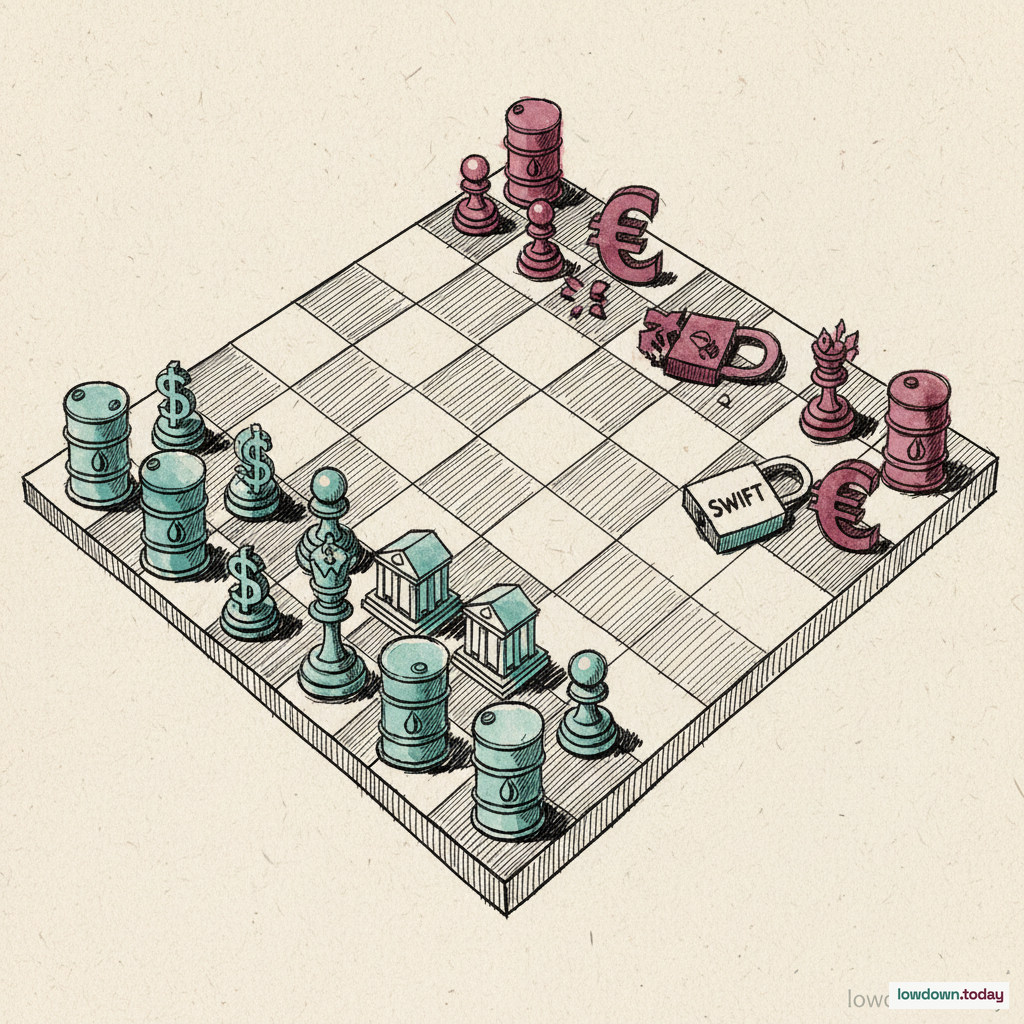
Economic warfare
Use of sanctions, asset freezes, and financial exclusion as instruments of geopolitical coercion.
Last refreshed: 1 April 2026
When does economic pressure cross the line from diplomacy into warfare?
Timeline for Economic warfare
Mentioned in: IEA: largest oil disruption in history
Iran Conflict 2026Mentioned in: 11.7m barrels of Iran oil reach China
Iran Conflict 2026Mentioned in: Iran switches to constant dispersed hits
Iran Conflict 2026Background
The 2026 Iran conflict demonstrated Economic warfare on multiple fronts simultaneously. Brent Crude peaked at $126 per barrel as the Strait of Hormuz closed to insured shipping, while Iran monetised its chokepoint leverage through a toll system that five nations queued to pay. Washington responded with targeted sanctions waivers to stabilise supply, illustrating the tension between punishment and market stability.
Economic warfare encompasses trade restrictions, SWIFT disconnection, secondary sanctions, export controls, and direct destruction of economic infrastructure. The broadest modern campaign, against Russia after February 2022, immobilised roughly $300 billion in central bank reserves and disconnected seven major banks from SWIFT, yet produced only a 2.1% GDP contraction as Moscow adapted through parallel imports via China and Turkey. The US dismantled its own sanctions enforcement apparatus even as the EU extended Russia sanctions through September 2026.
The weaponisation of the dollar has accelerated de-dollarisation. China's CIPS payment system links 4,800 banks in 185 countries, and the dollar's reserve share has declined from 71% in 2001 to roughly 58%. Iran's move to write the Hormuz toll into permanent law signals that Economic warfare is becoming institutionalised rather than reactive.
What is economic warfare?
How effective are economic sanctions?
What is de-dollarisation?
How did economic warfare play out in the Iran conflict?
What is SWIFT disconnection?
Did Russia sanctions work?
What is the Hormuz toll?


