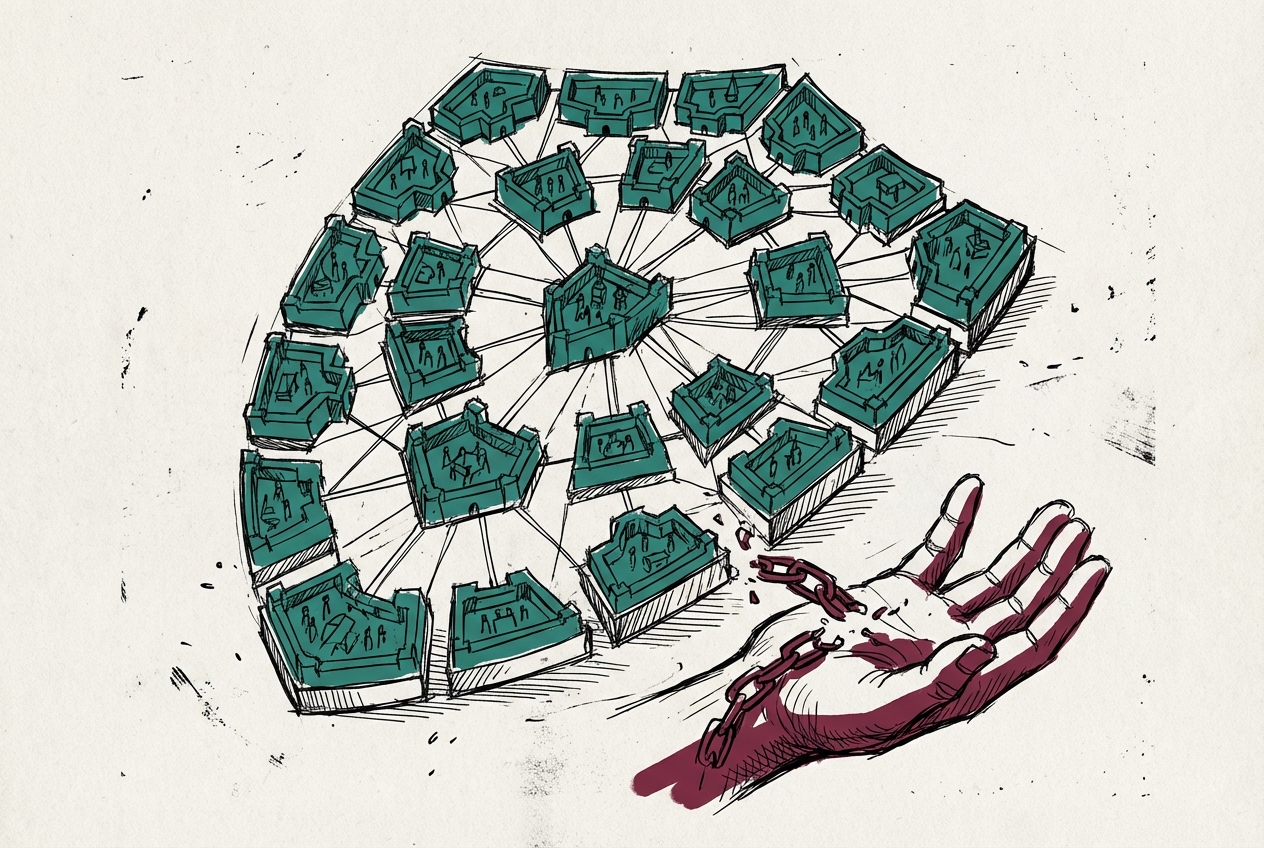
Decentralised Mosaic Defence
Iran's IRGC doctrine dispersing launch and mining authority to 31 autonomous provincial commands, designed to survive decapitation.
Israel declared air supremacy over Iran in early March 2026, yet Iranian fire continued: on 7 March the UAE faced 109 drones and nine ballistic missiles, and IRGC units kept firing hours after President Masoud Pezeshkian ordered a halt.
Last refreshed: 28 September 2026 · Appears in 1 active topic
Why can neither Tehran nor Washington credibly promise IRGC boats will stop during a ceasefire?
Timeline for Decentralised Mosaic Defence
Mentioned in: Drone hits ship in the safe corridor
Iran Conflict 2026Mentioned in: Iran fires drones at Hormuz ships, US downs all
Iran Conflict 2026Mentioned in: Iran's deal-signer cannot be reached at speed
Iran Conflict 2026Mentioned in: Iran hits US bases in three countries
Iran Conflict 2026Mentioned in: Iran and Israel halt, minus Lebanon
Iran Conflict 2026Background
Decentralised Mosaic Defence is an IRGC doctrine that disperses operational authority from Central Command to provincial units. Iran activated it in full on 5 March 2026, creating 31 autonomous units able to act without central approval.
The doctrine is built to keep military action going when headquarters, communications or senior commanders are under attack. Its cost is a gap between political direction and tactical control: a halt order cannot be relied on to reach every unit able to launch, mine or interdict. IRGC forces kept firing within hours of President Masoud Pezeshkian's halt order on 7 March 2026.
For outside powers, destroying Central Command is therefore an incomplete measure of Iranian capacity, and any Ceasefire depends on dispersed units accepting it. When Iran and Israel paused direct strikes on 9 June 2026, the absence of a single chain of command meant any field commander could breach the halt without Tehran's authorisation.
Air supremacy did not stop launches
The doctrine was switched on as Iran's Central Command came under sustained attack. On 5 March Iran fully activated Decentralised Mosaic Defence, splitting the IRGC into 31 autonomous units able to act without central approval. On 6 March CENTCOM's Admiral Brad Cooper reported Iran's Ballistic missile launches down 90% from the first day of the war.
The launches did not stop. On 7 March the UAE recorded its heaviest day of attacks, 109 drones and nine ballistic missiles, and IRGC forces kept firing within hours of President Masoud Pezeshkian's halt order and televised apology. That gap between an instruction from Tehran and the units in the field is what the doctrine was built to create.
Field units kept firing through talks
Late May showed the doctrine's split in practice. On 25 May US forces struck the Bandar Abbas naval base, destroying two IRGC mine-laying boats and a surface-to-air missile battery, while ceasefire talks in Doha continued that morning. The boats answer to the IRGC chain of command; the diplomats answer to the Foreign Ministry.
Launches continued around the talks. Iran fired a Ballistic missile at Ali Al Salem Air Base in Kuwait on 28 May, and Kuwait became the first Gulf state in the war to invoke Article 51 of the UN Charter. On 31 May and 1 June CENTCOM hit radar and drone command sites at Goruk and Qeshm Island, targeting fixed control infrastructure near Hormuz after the Guards shot down a US MQ-1 drone.
What is the Decentralised Mosaic Defence doctrine?
Why did IRGC ignore Pezeshkian's ceasefire order?
Did US strikes destroy Iran's missile capability?
How does Decentralised Mosaic Defence differ from normal IRGC command?
When did Iran activate the mosaic defence doctrine?
What is Iran's Decentralised Mosaic Defence doctrine?
Why did IRGC forces keep firing after Iran's president ordered a ceasefire?
How did Iran prove its military was not destroyed despite CENTCOM claims?
Can a ceasefire actually stop Iran's mine-laying in the Strait of Hormuz?


