Skip to content
Briefings are running a touch slower this week while we rebuild the foundations.See roadmap
UK Local Elections 2026
10APR

27 Days to Go: New Money Rules, Old Party Fractures

6 min read
18:20UTC

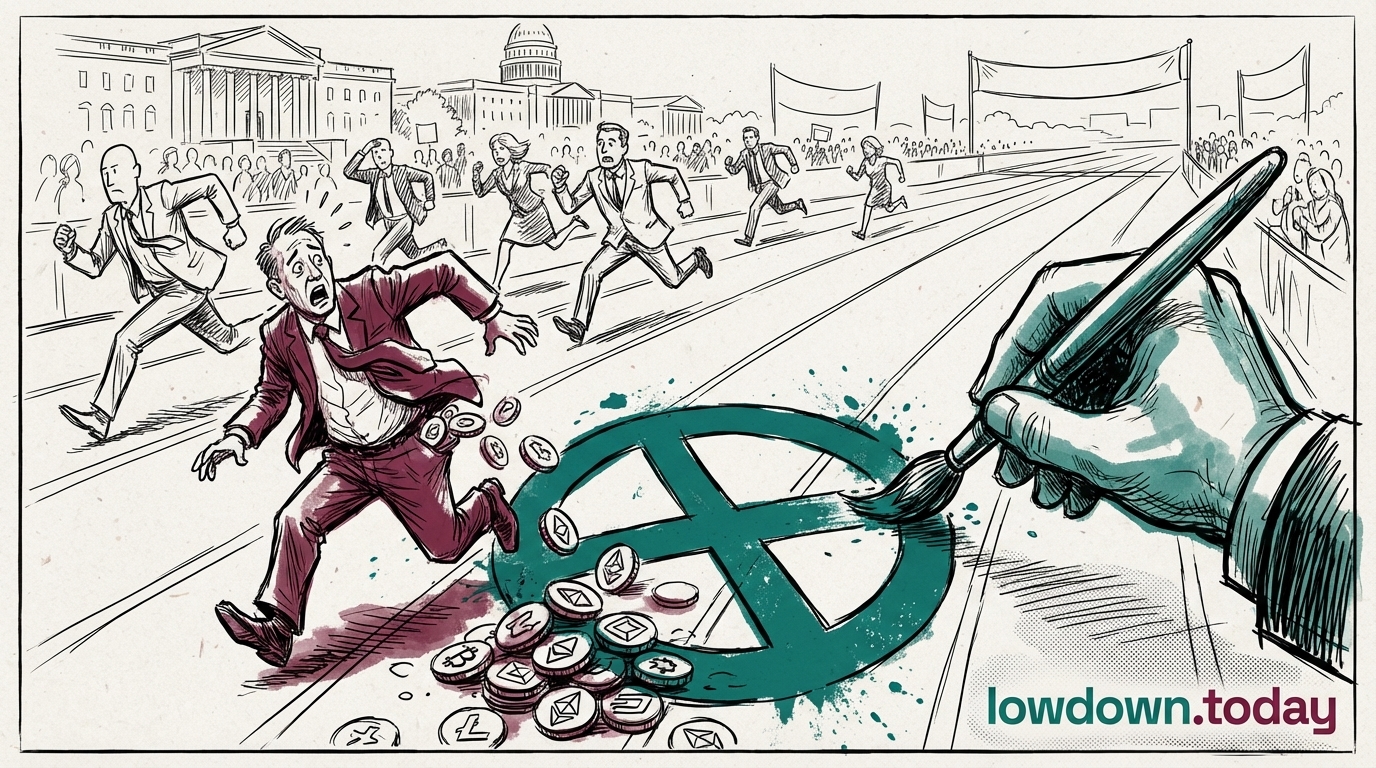
The Representation of the People Bill rewrites party finance law mid-campaign with a retrospective crypto donation ban, a £100,000 overseas elector cap, and shell company restrictions that land hardest on Reform UK.

Key takeaway

Three electoral systems, a retrospective finance law, and collapsing opposition candidacies converge on one polling day.

This briefing mapped
Loading map…
Regulatory
Domestic
Economic

Parliament has rewritten party finance law mid-campaign, applying a cryptocurrency donation ban backwards to money already banked. The only party confirmed to have accepted crypto is Reform UK, which now faces a 30-day compliance window that expires near election day.

Sources profile:This story draws on neutral-leaning sources

The Representation of the People Bill was amended to introduce a retrospective moratorium on Cryptocurrency donations to political parties, a £100,000 annual cap on donations from overseas electors, and restrictions capping donations from companies with foreign-owned parent companies at £500 for parties and £50 for candidates. Reform UK is the only major party confirmed to have received crypto donations and has 30 days after Royal Assent to return any unlawful receipts.

Retrospective application of a donation ban during a live regulated campaign is constitutionally novel in UK electoral law. For voters, the question of whether their local campaign was lawfully funded may not be answered until after the ballots are counted. 

Electoral Calculus published a Holyrood MRP on 7 April projecting the Scottish Conservatives at nine seats, every one of them from the regional list. All five current Conservative constituency seats fall to the SNP. It would be the first time since devolution began that the party holds no geographic representation whatsoever.

Sources profile:This story draws on neutral-leaning sources

Electoral Calculus published a Holyrood MRP on 7 April 2026, based on 4,105 respondents surveyed 13-31 March, projecting the Scottish Conservatives at nine seats — all from regional lists — and zero constituency seats. All five current Conservative constituency seats (Aberdeenshire West, Dumfriesshire, Eastwood, Ettrick Roxburgh and Berwickshire, and Galloway and West Dumfries) are projected to fall to the SNP. This would be the first time since devolution began in 1999 that the Scottish Tories held no constituency representation. Scottish Labour is projected at 17 seats, overtaking the Conservatives as official opposition.

Losing all constituency seats removes the local accountability link that MSPs provide to individual communities; the Scottish Tories would become a list-only operation with no geographic foothold, and Labour would overtake them as official opposition for the first time since devolution. 

Caroline Jones, a former UKIP Member of the Senedd who had joined Reform UK, quit on 7 April citing parachute candidates and racism allegations. She was the sixth Reform Senedd candidate to leave since late March, three of them from Bridgend alone.

Sources profile:This story draws on neutral-leaning sources

At least six Reform UK Senedd candidates quit between late March and 7 April 2026, including former UKIP Member of the Senedd Caroline Jones, who resigned on 7 April citing parachute selections and allegations relating to racism and discrimination. Three candidates quit the Bridgend constituency alone. Departing candidates described the party's vetting as expensive, flawed and unprofessional; one Swansea candidate described the organisation as a sewer.

Under closed-list PR, a shorter candidate list is a permanent structural ceiling: voters choose the party, not the person, so fewer listed candidates means fewer potential seats regardless of vote share. High polling numbers cannot compensate for an incomplete slate. 

The Institute for Fiscal Studies described the Scottish Conservative pensioner tax cut as unlikely to survive contact with reality, and found no credible evidence that Reform UK's Scottish income tax cuts would pay for themselves. The independent watchdog has now assessed both parties bidding to be Scotland's official opposition and rejected both.

Sources profile:This story draws on neutral-leaning sources

The Institute for Fiscal Studies assessed the Scottish Conservative manifesto Get Scotland Working, launched by Russell Findlay, and described its £500 pensioner tax cut as unlikely to survive contact with reality. In a separate assessment, the IFS costed Reform UK's Scottish income tax cuts at a minimum of £2 billion per year, rising to £3.7 billion for the full pledge, and found no credible evidence the cuts would self-fund.

A party asking Scottish voters for power while the country's pre-eminent independent fiscal watchdog dismisses its flagship pledge is a compounding problem: Reform UK faces this at the same time it is losing candidates in Wales and managing a crypto donation compliance deadline. 

A former Conservative Prime Minister said the English voting system is acting more erratically and throwing into doubt its own validity. He said it at the Attlee Foundation, a Labour institution, six weeks before England, Scotland and Wales each use a different system on the same polling night.

Sources profile:This story draws on neutral-leaning sources

Former Prime Minister Sir John Major delivered the Attlee Foundation Lecture at King's College London on 18 March 2026, stating that recent general elections had thrown into doubt the continuing validity of the First past the post system and that it was acting more erratically as votes spread across more parties. He stopped short of endorsing proportional representation.

When a senior Conservative breaks cover on electoral Reform, the argument escapes its usual party-political container. The 7 May results will produce a natural experiment visible in a single night's count: same electorate, three systems, one comparison. 

Rhun ap Iorwerth launched Plaid Cymru's Senedd manifesto in Newport on 28 February, promising free childcare from nine months, a weekly child payment for families on universal credit, and ten new surgical hubs. There will be no independence referendum in a first term, only a £500,000 commission to study options.

Sources profile:This story draws on neutral-leaning sources

Plaid Cymru leader Rhun ap Iorwerth launched the party's Senedd manifesto on 28 February 2026 at Newport, promising free childcare for children from 9 months to 4 years, a Welsh Child Payment (Cynnal) of £10 per week for children aged 0 to 6 in Universal credit households, and 10 new surgical hubs for hip, knee, hernia and cataract procedures. The manifesto commits to no independence referendum in a first term but would establish a national Commission with a £500,000 budget to examine constitutional options.

Plaid's decision to lead with domestic delivery rather than constitutional ambition is a direct pitch for Labour-to-Plaid consolidation voters who support devolution but are not ready for independence; it transforms the party from a pressure group into a plausible government. 

Sources:Herald.Wales

Cardiff University researchers describe Welsh political realignment not as voters changing their minds but as two opposing camps becoming more internally coherent. Nobody is crossing the divide; everyone is moving towards their bloc's preferred party.

Sources profile:This story draws on neutral-leaning sources

Wales Governance Centre at Cardiff University published research describing Welsh political realignment as consolidation not conversion: progressive voters are moving from Labour to Plaid Cymru within the Welsh/Left bloc, while conservative voters are moving from Welsh Conservatives to Reform UK within the British/Right bloc. Researchers describe the 2026 Senedd election as the most consequential since 1999.

The consolidation framework explains why the YouGov Senedd MRP and PollCheck five-poll average both show a two-bloc pattern: as the new PR system locks in this split proportionally, the 2026 Senedd becomes the first election to institutionalise it. 

The Scottish Parliament dissolved at 23:59 on 8 April 2026, entering formal dissolution on 9 April. No MSP holds the title between now and the election on 7 May. Civil service purdah has been in effect since 26 March.

Sources profile:This story draws on neutral-leaning sources

The Scottish Parliament dissolved at 23:59 on 8 April 2026, entering formal dissolution on 9 April, triggering the regulated short campaign spending limits, publication restrictions on government communications, and Purdah for civil servants. No MSPs hold the title between dissolution and the 7 May election. The Scottish Government's pre-election Purdah guidance had been in effect since 26 March 2026.

Dissolution triggers regulated short campaign spending limits and closes the window for government announcements; the departure of 39 retiring MSPs, many of them experienced committee chairs and former ministers, represents the largest loss of institutional memory in Holyrood's 27-year history. 

Democracy Club's candidate database went from covering 81 of 3,074 areas to 2,636 in the three days following English and Welsh Statement of Persons Nominated publication. Scotland hit 100 per cent. Volunteer verification of imported records continues; the North East lags at 39 per cent entered.

Sources profile:This story draws on neutral-leaning sources

Democracy Club's candidate database jumped from 2.6 per cent of areas (81 of 3,074) on 7 April to 86 per cent (2,636 of 3,074) by 10 April 2026, driven by English and Welsh Statement of Persons Nominated publication on 9 and 10 April. Scotland reached 100 per cent. Candidate data has been entered for 2,068 areas and double-checked for 1,457. North East England lags at 39 per cent entered.

The SoPN data surge closes the structural gap that made candidate-level analysis unreliable until now; verification quality rather than coverage is the remaining variable, with the North East's 39 per cent entry rate the most significant outstanding lag. 

Cambridge, North Hertfordshire, Tunbridge Wells and Milton Keynes are running the UK's first flexible voting pilots at the May 2026 local elections. Three offer weekend early voting; Milton Keynes opens a single central hub in a shopping centre on polling day itself.

Sources profile:This story draws on neutral-leaning sources

Four English councils — Cambridge, North Hertfordshire, Tunbridge Wells, and Milton Keynes — are running the UK's first Flexible voting pilots at the May 2026 local elections. Cambridge, North Hertfordshire and Tunbridge Wells offer early voting hubs on Saturday 2 May and Sunday 3 May. Milton Keynes is piloting the country's first central voting hub at Midsummer Place shopping centre, open 7am to 10pm on polling day itself.

The pilots generate the first British evidence base for whether flexible access meaningfully increases turnout; in a high-stakes election already testing three different electoral systems across the UK, the results will be scrutinised as evidence for or against a national access Reform

Your Party announced on 2 April that it would endorse 250 candidates across Muslim-majority urban wards in Tower Hamlets, Newham, Redbridge and Bradford, targeting areas where Labour's vote has collapsed since Gaza. Most are independent candidates and community groups aligned with the party platform.

Sources profile:This story draws on neutral-leaning sources

Your Party announced on 2 April 2026 that it would endorse 250 candidates targeting Muslim-majority urban wards across Tower Hamlets, Newham, Redbridge and Bradford, concentrating on areas where Labour support has collapsed. Most are independent candidates and community groups aligned with the party platform. The party cites Gaza and Labour's cost-of-living response as the reasons for Muslim voter desertion.

A 250-candidate slate concentrated on wards where Labour is already weak constitutes a third front in Labour's three-front squeeze: the party faces nationalist consolidation in Wales, projected collapse in Scotland, and now a structured Muslim-vote challenge in its English urban heartlands. 

Ed Davey launched the Liberal Democrats' local election campaign positioning it as a straight choice between his party and Reform UK, with Stockport as the primary target for outright council control. The party defends 684 seats across England.

Sources profile:This story draws on neutral-leaning sources

Liberal Democrats leader Ed Davey launched the party's local election campaign framing it as a two-way fight between the Liberal Democrats and Reform UK, with Stockport identified as the primary target for outright council control. The party defends 684 seats in the 2026 local elections.

The binary framing is designed to pull anti-Reform tactical votes from Labour and Conservative supporters in English seats where neither major party is competitive; it mirrors the squeeze politics the Lib Dems used to win parliamentary seats in 2024. 

Rupert Lowe's Restore Britain party, launched in February, is fielding candidates only in the Great Yarmouth area as a proof-of-concept for 2028. Seven Kent councillors have defected to the party. It is not trying to win this election; it is trying to demonstrate it can field credible candidates for the next one.

Sources profile:This story draws on neutral-leaning sources

Rupert Lowe's Restore Britain party, launched on 13 February 2026, announced it would field candidates only in the Great Yarmouth area as a proof-of-concept for the 2028 electoral cycle. Seven Kent councillors defected to Restore Britain. The party's partner local group, Great Yarmouth First, registered on 4 March 2026.

A new populist-right party explicitly building for 2028 while Reform UK loses candidates in Wales illustrates the fractured state of the British right; if Restore Britain can establish a local foothold, it becomes a structural complication for Reform UK's 2028 national ambitions. 

Different Perspectives
HM Government / UK-wide parties
The government frames the Representation of the People Bill as a proportionate foreign-influence response implemented at unusual speed. Reform UK holds its polling position while staying silent on crypto donation quantum. The Liberal Democrats frame the English local elections as a binary contest against Reform.
Scottish parties (SNP, Conservatives, Labour)
The SNP enters the regulated campaign as projected majority government through opposition fragmentation, not a vote surge. The Scottish Conservatives defend a manifesto the IFS dismisses and face zero constituency seats. Labour is the only party projected to retain any constituency presence beyond the SNP.
Welsh parties (Plaid Cymru, Reform UK Wales, Welsh Conservatives)
Plaid Cymru campaigns as the credible Welsh/Left bloc anchor with a costed governing programme and no first-term independence referendum. Reform UK Wales polls at 27-30 per cent while losing candidates at a rate that directly reduces its seat ceiling under closed-list PR.
