Skip to content
You can now search across every topic, entity and event.What's new
Russia-Ukraine War 2026
23JUL

Sharif, Munir and Xi meet in Beijing

3 min read
20:33UTC

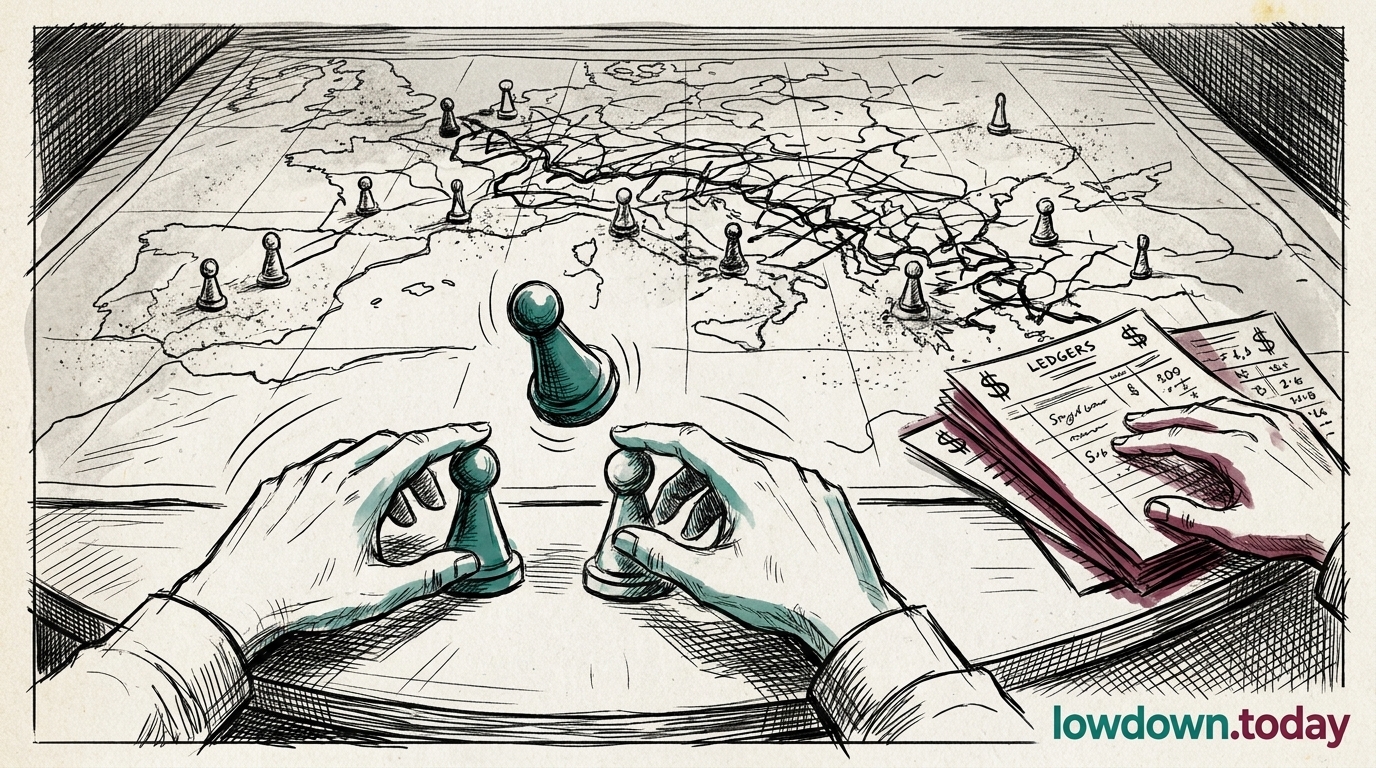
Pakistan's prime minister and army chief were in Beijing together on Monday, meeting Xi Jinping as the Iran deal nears its sequencing decision. The two principal mediators are coordinating with China face to face for the first time.

ConflictDeveloping
Key takeaway

The mediation has consolidated in the one capital that can underwrite a frozen-asset release.

Pakistani prime minister Shehbaz Sharif met Xi Jinping in Beijing on Monday 25 May, day three of a four-day state visit, with army chief Asim Munir also in the Chinese capital 1. Munir had flown to Beijing straight from Tehran, which he visited on 23 May , while Sharif and his foreign minister arrived in China on the same Saturday .

Pakistan has run as the principal back-channel between Washington and Tehran through the war. For the first time both of its principals are in Beijing at once, coordinating with China in person rather than through relayed messages, and on the days the deal sits at its closest. Munir's shuttle from Tehran on 23 May to Beijing by 25 May collapses two mediation tracks into a single room.

The venue matters more than the photographs. China holds the tools the sequencing deadlock needs a third party to provide: frozen-fund mechanics, yuan settlement, and the standing to vouch for who pays whom and when. Beijing also already hosts Iran's designated China envoy, speaker Mohammad Bagher Ghalibaf, appointed in late April with sign-off from both President Masoud Pezeshkian and Supreme Leader Mojtaba Khamenei , so the Iranian contact is already in the city.

A joint Pakistan-China statement is expected by 27 May, its content still undisclosed. Whether it names a mechanism for escrowing the frozen assets against a reopening of the strait, or leaves that clause untouched, will matter more than anything in the visit's choreography.


Deep Analysis

In plain English

Pakistan has been acting as the go-between in talks to end the war between the United States and Iran. On 25 May, both Pakistan's Prime Minister Shehbaz Sharif and its army chief Asim Munir were in Beijing at the same time, meeting Chinese President Xi Jinping. Munir had flown there directly from Tehran, which he visited on 23 May. Iran's own special envoy to China was also in Beijing. This is the first time all the main mediators have gathered in the same city at once. China matters here because it is Iran's biggest oil customer, and it may be the only country that could help resolve the argument over the $12 billion in frozen money that Iran wants released before reopening the strait.

Deep Analysis
Root Causes

Pakistan's role as the principal back-channel emerged from three structural conditions: a 959-kilometre shared border with Iran, a general-officer-led military intelligence relationship with both Washington and Tehran, and the China-Pakistan Economic Corridor (CPEC) financial dependency that gives Pakistan unique access to Chinese credit facilities.

Asim Munir's ability to fly Tehran-to-Beijing without a 24-hour public announcement reflects the operational security of the military-to-military channel, which has carried every nuclear-monitoring concession of the war.

The simultaneous presence of both Sharif (civilian, economic track) and Munir (military, security track) in Beijing signals that the Pakistan side has concluded the $12bn sequencing problem requires both tracks resolved in parallel, not sequentially.

What could happen next?
  • Consequence

    The joint Pakistan-China statement expected by 27 May will indicate whether China is prepared to act as guarantor for the $12bn sequencing mechanism, or merely as a diplomatic host.

  • Opportunity

    If China agrees to route the $12bn release through its state banking system rather than a US Treasury channel, it bypasses the US re-freeze risk Iran has demanded protection against, potentially unlocking the sequencing deadlock.

First Reported In

Update #107 · Two markets, two prices on one Iran deal

Pakistan Today· 25 May 2026
Read original
Different Perspectives
IAEA (Rafael Grossi)
IAEA inspectors logged Zaporizhzhia's 22nd loss of off-site power, ten of them in the last three months, after a thunderstorm knocked out the plant's sole surviving backup line. Grossi reads the accelerating frequency, not any single outage, as the safety signal now that the plant's redundancy is exhausted.
United States (Treasury/OFAC)
Washington has let general licence 134C, its Russian crude waiver, lapse for 36 days with no successor, the longest gap of the war. Treasury has not said whether the non-renewal reflects deliberate policy or administrative delay, leaving buyers to price in compliance risk rather than wait for clarity.
Slovakia
Slovakia
Slovakia dropped its hold-out on the EU's 21st sanctions package only after winning a 2028 guarantee phasing out Russian gas, the exact pipeline dependency, roughly 80% of its crude supply, that gave it leverage. Bratislava's climbdown clears the package but leaves the same single-veto mechanism intact for the next round.
Russia (Kremlin and general staff)
General staff chief Gerasimov claimed Donetsk captures on 18 July that ISW says it cannot corroborate, extending a pattern ISW clocked at a 5:1 exaggeration ratio earlier this year. Moscow is conditioning its public for a possible autumn mobilisation after September's Duma elections rather than acknowledging the front has stalled.
Ukraine (Zelenskyy government)
Zelenskyy dismissed his commander-in-chief, defence minister and chief of general staff within eight days, replacing Syrskyi with Drapatyi and Hnatov with Skybiuk as protesters demanded Syrskyi go and Fedorov return. Kyiv frames the sweep as a bet on manoeuvre capacity ahead of a feared Russian autumn surge, not the disarray critics read into three changes in a week.
The United Kingdom
The United Kingdom
Starmer pledged £300 million in Kyiv on 16 July toward Ukraine's Gripen E squadron, adding to the PURL expansion Trump and Rutte had announced two days earlier. London is paying into a scheme built around a shortfall NATO's own published $4bn-plus pledge does not close against Zelenskyy's roughly $15bn stated need.



