Skip to content
Briefings are running a touch slower this week while we rebuild the foundations.See roadmap
Iran Conflict 2026
1MAY

Senate sixth WPR fails 47-50; Collins flips

3 min read
10:38UTC

Susan Collins voted Yes on the sixth Iran War Powers Resolution on 30 April 2026, becoming the first Republican to back a WPR challenge since the war began on 28 February.

ConflictDeveloping
Key takeaway

Collins became the first Republican Yes on Iran WPR, narrowing the count by four votes.

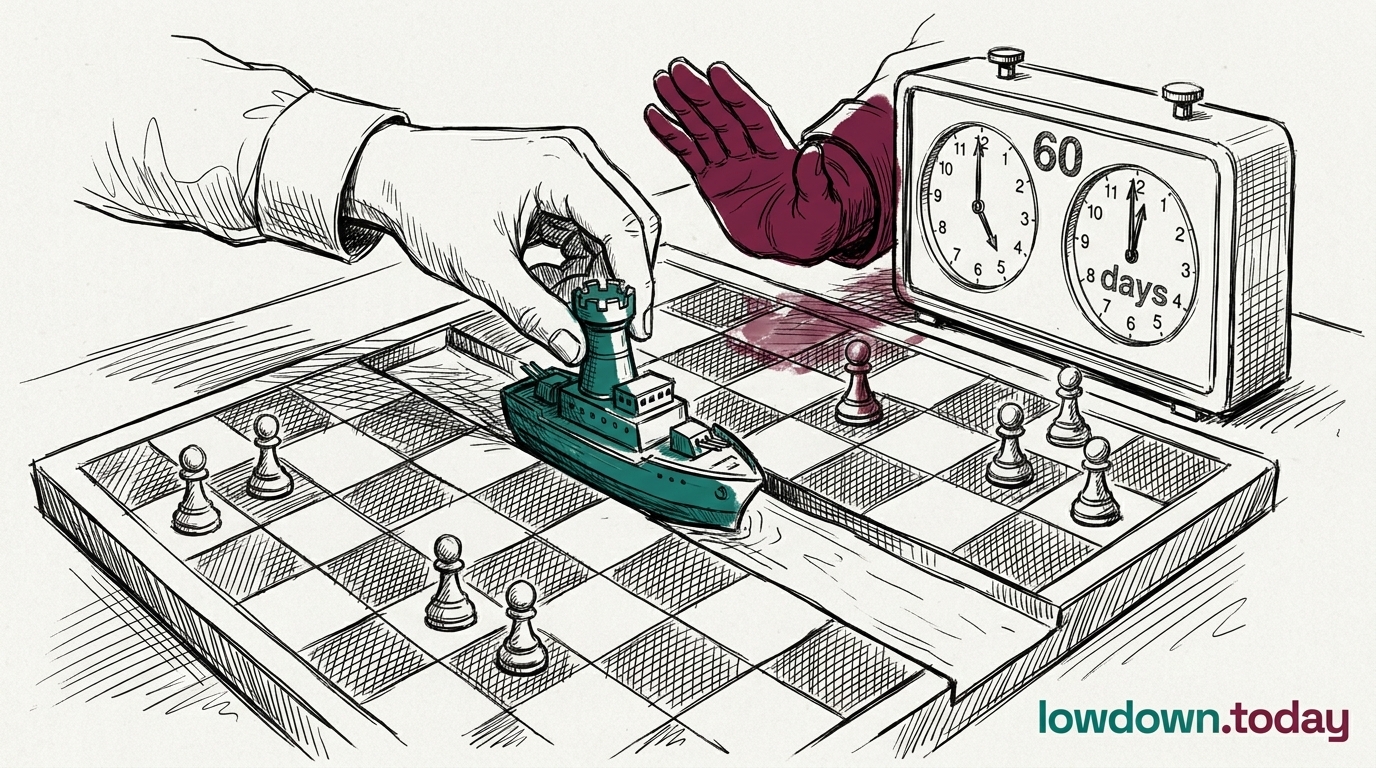
The Senate rejected the sixth Iran War Powers Resolution (WPR) by 47 votes to 50 on Thursday 30 April 2026 1. Susan Collins (R-ME) voted Yes, the first Republican to back a War Powers challenge since the war began on 28 February. "The 60-day deadline is not a suggestion; it is a requirement," Collins said on the floor, citing the Constitution's grant of war powers to Congress 2. Rand Paul held with the resolution as he has on each prior vote. John Fetterman remained the lone Democrat against.

The 47-50 tally versus the fifth vote's 51-46 is a four-vote narrowing in two days: Collins flipping plus one absent No. Two more Republicans on the same trajectory take the count to 49-48 and the war becomes the first since Vietnam to be voted unauthorised on the Senate floor. Eight further Democratic WPRs are queued through May, and Collins' Yes lowers the bar for moderates whose offices have been studying the floor speeches rather than the underlying calculus.

Thom Tillis and Lisa Murkowski had drawn Collins onto the substantive side of the issue a week earlier when the three publicly backed Murkowski's drafted Iran AUMF without committing to the procedural vote . Republican defections on war-power votes typically run substantive endorsement first, then procedural Yes, rather than the reverse.

Deep Analysis

In plain English

The US Senate has now voted six times on whether to force the White House to end or seek approval for the Iran war. Every time, the vote has failed. But the margins tell a story. The first vote, on 4 March 2026, failed 47-53. Six votes later, on 30 April, it failed 47-50. Three fewer senators are willing to back the White House than when the war started. And for the first time, a Republican voted against it: Senator Susan Collins from Maine, a moderate who has broken with her party before on institutional issues. This matters because the war has no formal congressional approval. The War Powers Resolution of 1973 says the president must get such approval within 60 days of committing troops. That deadline passed on 1 May. If two more Republicans follow Collins, a future vote could reach 49-48, the closest it has ever come to passing.

Deep Analysis
Root Causes

Collins' vote reflects the structural pressure on moderate Republicans from states where the Iran war is a net negative in November 2026 midterm polling. Maine's relatively high proportion of independent voters and Collins' prior history of institutional-prerogative crossings (Kavanaugh, impeachment, PACT Act) make her the natural first Republican defector.

Electoral geography, not ideology, drove the decision: Maine's independent-voter share means Collins' November 2026 exposure is higher than any other Senate Republican running in a cycle when the Iran war carries a cost.

A secondary structural cause: Hegseth's 29 April HASC Posture Statement disclosed for the first time that the war has cost $25 billion in munitions. That figure, entered into the congressional record the day before the WPR vote, gave Collins a concrete fiscal basis for her 'not a suggestion; it is a requirement' statement. The disclosure converted an abstract constitutional argument into an appropriations-committee-relevant dollar figure.

What could happen next?
  • Consequence

    Collins' vote reduces Murkowski's political cost to file the AUMF week of 11 May: she no longer acts as the sole Republican defector on war-powers grounds.

    Short term · 0.82
  • Risk

    A 49-48 majority becomes reachable if two more Republicans follow Collins' trajectory before the June 1 Section 1544(b) cliff, but requires senators from competitive states with November exposure.

    Short term · 0.58
  • Precedent

    Collins' vote establishes that the Republican coalition on Iran is not monolithic at the 64-day mark, the first formal crack in party discipline on the war.

    Medium term · 0.88
First Reported In

Update #85 · "Not at war": three claims, no treaty

Spectrum News· 1 May 2026
Read original
Different Perspectives
Israel
Israel
Israeli strikes on Hezbollah positions in Lebanon continued through the weekend, maintaining the secondary front. The IDF has publicly named Mojtaba Khamenei as an assassination target; his courier-governance mode complicates targeting but does not remove him from the order.
Russia
Russia
Putin told a Moscow press conference that Washington, not Tehran or Moscow, killed the Russia-custody uranium arrangement by demanding US-territory-only storage. Neither Tehran nor Washington has corroborated the account, which appeared in second-tier outlets only, consistent with a trial balloon rather than a formal position.
United Kingdom
United Kingdom
HMS Dragon was redeployed from the Eastern Mediterranean to the Middle East on 9 May, the first physical European platform commitment to the Gulf. The Ministry of Defence called it "prudent planning" while publishing no rules of engagement, no tasking order, and no vessel name, committing a named asset to a conflict zone before the political instrument authorising it exists.
United Arab Emirates
UAE air defences intercepted two Iranian drones over its territory on 10 May, a kinetic escalation six days after the Fujairah oil terminal strike that drew no formal protest. The three-state simultaneous operation, not the severity of individual strikes, appears to have crossed the threshold at which the GCC states collectively began responding.
Saudi Arabia
Saudi Arabia
Riyadh issued the first formal Gulf-state protest of the conflict on 10 May, demanding an "immediate halt to blatant attacks on territories and territorial waters of Gulf states", ending 10 weeks of channelling displeasure through OPEC+ quota discussions. The protest forecloses Saudi Arabia's preferred quiet-channel role and reduces the functioning back-channel architecture to Pakistan alone.
Qatar
Qatar
Doha is simultaneously a strike target, the site of the Safesea Neha attack 23 nautical miles offshore, and an active MOU mediator: Qatar's prime minister met Rubio and Vance in Washington the same weekend. Whether Qatar issues its own formal protest or maintains its dual role is the critical escalation indicator for the week of 11 May.