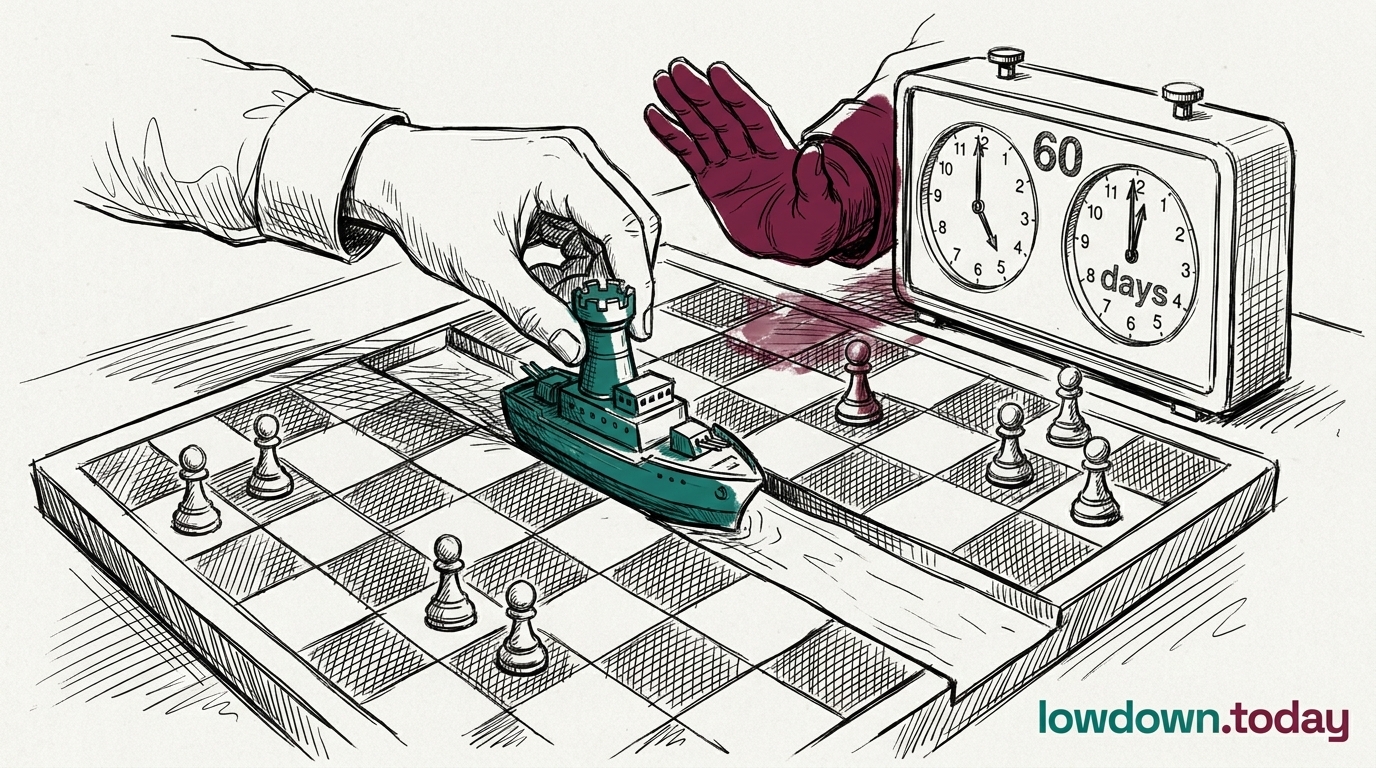
The Trump administration told reporters on Friday 1 May 2026 that the United States is not at war with Iran, on the day the War Powers Resolution (WPR) 60-day deadline expired1. The WPR is the 1973 statute that requires presidential withdrawal of US forces from undeclared hostilities within 60 days unless Congress authorises the deployment. Sixty-four days of blockade, three carrier battle groups in CENTCOM (US Central Command) waters, and 44 commercial vessels redirected at sea, on this reading, do not amount to hostilities for the statute that says they do.
The formal claim moves past the position Pete Hegseth offered the Senate Armed Services Committee on Thursday, that a ceasefire merely pauses the WPR clock2. Not at war asserts the clock never ran. Two days earlier Trump had told Axios the blockade was "somewhat more effective than the bombing" and described Iran as "choking like a stuffed pig", language The Administration is now arguing carries no statutory weight.
Section 1544(b) of the WPR triggers an automatic 30-day wind-down once the 60-day mark passes without congressional authorisation; the operative cliff sat at 1 June. A clock that never started cannot trigger a 30-day clause downstream of it. The Office of Legal Counsel (OLC) at the Department of Justice would need to ratify the reading before OFAC (the Treasury's Office of Foreign Assets Control) and the Pentagon could realign their compliance positions; OFAC has continued sanctioning Iran on a wartime cadence the State Department now calls peacetime.
No court has been asked. Federal courts have dismissed individual senators' WPR suits on standing grounds since Kucinich v. Obama in 2011. Whether anyone with standing can force a court to rule before the 1 June Section 1544(b) cliff is the constitutional question of the next four weeks.


