Skip to content
Briefings are running a touch slower this week while we rebuild the foundations.See roadmap
Iran Conflict 2026
23APR

Zero pledges for Hormuz coalition

4 min read
08:02UTC

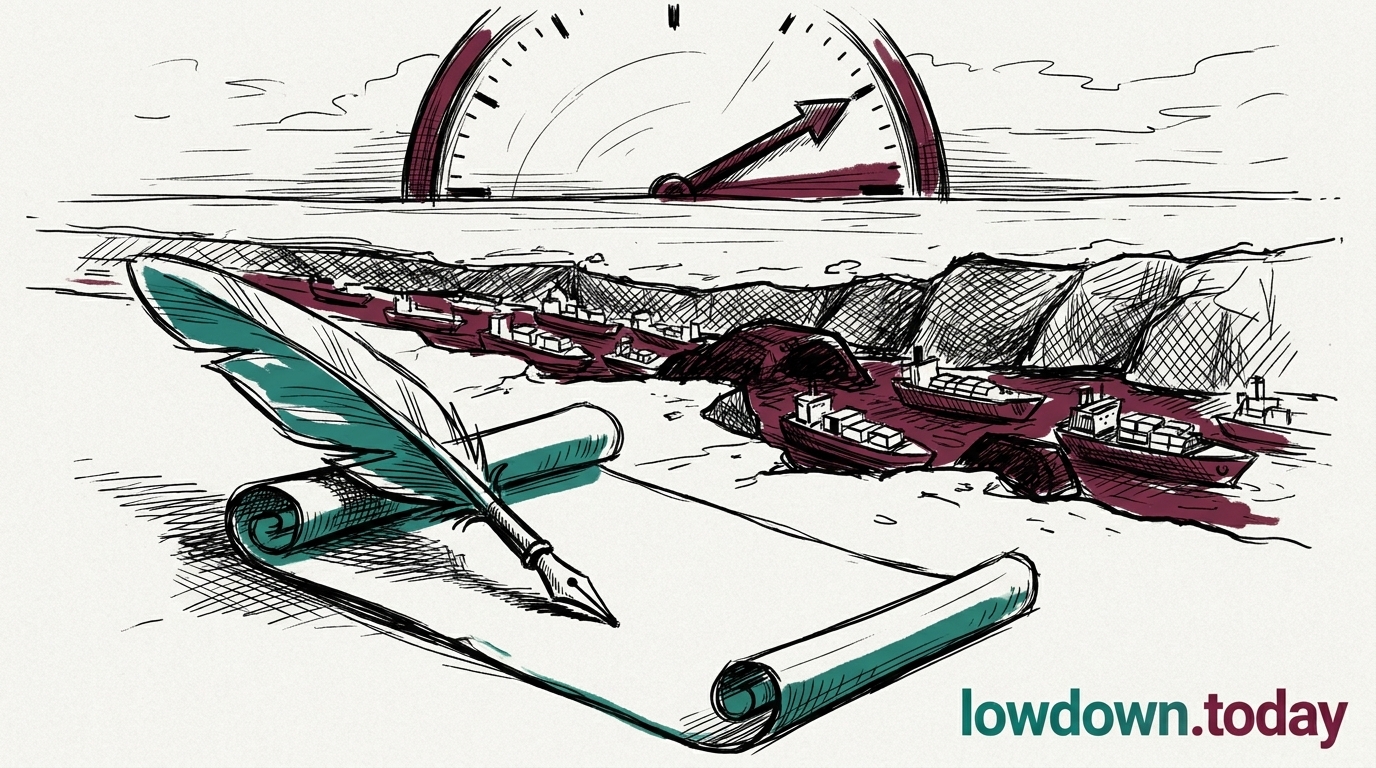
Forty-eight hours after Trump demanded allied warships for the Strait of Hormuz, not a single country has pledged a vessel — not even Japan, which routes roughly 90% of its crude oil imports through the waterway.

ConflictDeveloping
Key takeaway

Zero pledges in 48 hours confirms the coalition failed before it launched.

Not a single country committed warships to President Trump's proposed Coalition to escort commercial vessels through the strait of Hormuz. Forty-eight hours after Trump's call — originally issued on Truth Social — the tally stood at zero pledges 1.

Germany's Foreign Minister Johann Wadephul called the proposal "sceptical" — his word 2. France offered Paris as a venue for Lebanon talks, not frigates for tankers. The UK "discussed importance" in a Saturday phone call with Trump without committing ships 3. Japan and South Korea said nothing — despite both nations' near-total dependence on Gulf crude. Japan imports approximately 90% of its oil through the strait. South Korea roughly 70%.

The refusals are specific to the risk each government has already weighed. Germany and France are absorbing the oil price shock that has pushed Brent from $67.41 on 27 February past $103 . Yet none will send warships into a zone the United States' own officials have described as an Iranian "Kill box" with more than 300 ships stranded . Energy Secretary Wright said on 11 March that the Navy is "simply not ready" for escorts . Allies are being asked to accept military risk in a combat zone for a war they did not start and that Washington itself cannot yet secure.

The last comparable effort — Operation Earnest Will during the 1987–88 Tanker War — succeeded partly because it was confined to escort duty rather than offensive combat, and partly because Cold War alliance structures compelled participation. Neither condition holds in 2026. The US is simultaneously prosecuting a full-scale air campaign against Iran and asking allies to share the maritime risk. Defence Secretary Hegseth's assurance four days earlier that the Hormuz situation need not be worried about contradicted Wright's admission the same week — a dissonance allies noticed. No allied navy appears willing to enter a waterway where the power that initiated hostilities has not yet established control.

Deep Analysis

In plain English

Trump asked allied countries to send warships to protect oil tankers sailing through the Strait of Hormuz — the narrow waterway between Iran and Oman through which roughly one-fifth of the world's oil passes every day. Iran has threatened to close it. Not one country agreed. This matters because the US Navy cannot simultaneously bomb Iran from the air, protect oil tankers in the strait, and maintain its other global commitments without help. Without allies filling the maritime gap, the US faces a binary choice: scale back the air campaign to free naval resources, or accept that Hormuz shipping is unprotected. Either option raises oil prices further above the current $103-per-barrel level.

Deep Analysis
Synthesis

The coalition's collapse in 48 hours is qualitatively faster than the 2019 IMSC, which took weeks to prove hollow. The speed indicates pre-decided refusal, not hesitation — allies have already completed their risk-benefit calculation and concluded that participation costs outweigh US favour. This represents a structural shift: the era of US-convened Gulf maritime coalitions attracting meaningful European naval participation may have closed, leaving the US to choose between unilateral action, inaction, or trading air campaign tempo for maritime resources.

Root Causes

Allied non-participation has three structural drivers absent from the body. First, post-Cold War European naval contraction — the UK Royal Navy operates 13 destroyers and frigates in 2024, down from 35 in 1990 — leaves insufficient hulls for a sustained Gulf deployment without stripping NATO's northern and eastern flanks. Second, Gulf Cooperation Council states face an existential asymmetry: Iranian retaliation against Saudi Aramco's Ras Tanura terminal or Abu Dhabi's Jebel Ali port would dwarf any diplomatic benefit from coalition membership. Third, Trump's 2025 tariff rounds have depleted the diplomatic reciprocity reserves that enabled the 2003 Iraq coalition and the 2019 IMSC to attract even token contributions.

What could happen next?
  • Risk

    Lloyd's and P&I club war-risk exclusions could functionally halt commercial Hormuz transits within days of sustained Iranian interdiction — closing the strait without requiring Iranian military success against US forces.

    Immediate · Suggested
  • Consequence

    The US must now choose between scaling back the air campaign to free naval assets or accepting unprotected Hormuz shipping — no coalition exists to resolve the dilemma that the body identifies.

    Short term · Assessed
  • Precedent

    Zero allied commitments in 48 hours establishes that Trump's transactional foreign policy cannot rapidly assemble a Gulf maritime coalition — a capability previous US administrations could reliably activate.

    Medium term · Assessed
  • Risk

    China, importing 11 million barrels per day through Hormuz, may position its own naval assets as a corridor guarantor, creating a parallel Chinese security architecture in the Gulf that excludes the US.

    Medium term · Suggested
First Reported In

Update #37 · Six more weeks of strikes; Hormuz deal dead

Gov.uk· 16 Mar 2026
Read original
Different Perspectives
International human rights monitors (NetBlocks, IHR, Hengaw)
NetBlocks recorded 1,704 cumulative hours of near-total internet blackout for roughly 90 million Iranians on Day 74, while IHR documented ongoing executions under emergency provisions. These organisations are the only active monitoring windows into a civilian population cut off from the global internet for 71 consecutive days.
UK / France coalition
The Royal Navy confirmed HMS Dragon's Hormuz deployment on its own website on 11 May, converting a press-reported presence into declared force posture; UK and French defence ministers hosted a coalition meeting the same day. Britain and France are now the only named contributors to a Hormuz escort mission all five allies Trump originally asked had declined.
Saudi Aramco / Gulf producers
Saudi Aramco CEO Amin Nasser warned on 11 May that a Hormuz closure could remove 100 million barrels of weekly supply from global markets (roughly 15 million barrels per day for a week), a figure that dwarfs any OPEC+ swing capacity. The warning functions as both a price-floor signal and a public pressure on Washington to protect transit.
Beijing / Chinese Government
China has not publicly acknowledged the four Hong Kong-registered entities designated on 11 May or extended MOFCOM's Blocking Rules cover to HK-domiciled firms. Xi Jinping hosts Trump on 14–15 May having already de-risked state-bank balance sheets via NFRA's quiet loan halt, entering the summit partially compliant before any negotiation.
Tehran / Iranian Government
Foreign Minister Araghchi described Iran's 10-point counter-proposal as 'reasonable and responsible' via spokesman Baqaei on 11 May, and widened the mediator pool by meeting Turkish, Egyptian, and Dutch counterparts in a single day. Tehran is buying procedural runway while Trump's verbal rejection went unmatched by any written US counter.
Trump White House
Trump White House
Trump called the ceasefire 'on massive life support' and dismissed Iran's 10-point counter-proposal as 'a piece of garbage' on 11 May, while departing for Beijing two days later with no signed Iran instrument to show Congress. The verbal maximum and the paper void coexist: the administration is running a legal pressure campaign through Treasury while the president free-lances the rhetoric.