
Skip to content
Briefings are running a touch slower this week while we rebuild the foundations.See roadmap
Iran Conflict 2026
16MAR

Day 17: Six more weeks of strikes; Hormuz deal dead

6 min read
05:08UTC

Israel revealed plans for at least six more weeks of strikes while rushing $826 million in emergency interceptor procurement it officially says it does not need. Iran's foreign minister denied ever seeking a ceasefire, no country committed warships to Trump's Hormuz escort coalition, and Iranian cluster munitions again struck central Israel.

Key takeaway

The gap between what this war requires and what any single actor can sustain — interceptors, warships, allies, diplomatic leverage — widened on every front simultaneously.

This briefing mapped
Loading map…
Military
Humanitarian

An IDF brigadier general told CNN the campaign has plans through mid-April and beyond, publicly rejecting the timeline the White House sold as a short war.

Sources profile:This story draws on left-leaning sources from Israel and United States
United StatesIsrael
LeftRight

IDF Brig. Gen. Effie Defrin disclosed to CNN that Israel has operational plans 'through at least the Jewish holiday of Passover' (mid-April) with 'deeper plans for even three weeks beyond that' — the longest operational horizon announced since the war began. Defrin stated there is 'no stopwatch or timetable,' directly rejecting the four-week window Trump implied when he called the conflict a 'little excursion.' Since 28 February the Israeli Air Force has conducted approximately 400 waves of strikes in western and central Iran.

Israel's first disclosure of a multi-month war timeline exposes the gap between Jerusalem's operational planning and Washington's 'short war' public framing, while the 5,000-strong Marine force redeploying from Japan arrives precisely as the IDF says deeper plans begin. 

Briefing analysis

During the 1973 October War, Israel lost 102 aircraft in 18 days to Egyptian and Syrian air defences — losses that outpaced replacement rates and forced a strategic reassessment because the supply chain could not sustain the campaign's tempo. The current interceptor burn rate poses an analogous production-versus-consumption constraint: Arrow and David's Sling missiles take 12–18 months to manufacture, and no emergency spending resolves that bottleneck within a six-week campaign.

Khiam, where Hezbollah and the IDF clashed Saturday night, housed Israel's most notorious detention centre during the 1982–2000 occupation of southern Lebanon. The facility became a symbol of the occupation's human cost and its political unsustainability. Israeli ground forces are now fighting in the same towns they withdrew from 26 years ago.

Hours after categorically denying it is running low on interceptors, Israel's cabinet approved the war's largest emergency procurement — $826 million described as 'urgent and essential.'

Sources profile:This story draws on centre-left-leaning sources from Israel
Israel
LeftRight

Israel's cabinet approved NIS 2.6 billion (~$826 million) in emergency defence procurement described as 'urgent and essential.' Arrow and David's Sling interceptors cost $2–3 million each. At Iran's current firing rate of seven salvos in a single night, the burn rate is considerable even at high interception rates.

The contradiction between Israel's denial of interceptor shortages and its emergency procurement spending exposes the sustainability question at the centre of Israel's air defence. Production bottlenecks for Arrow and David's Sling interceptors cannot be resolved by funding alone — manufacturing timelines determine whether Israel's defences degrade before Iran's missile stocks do. 

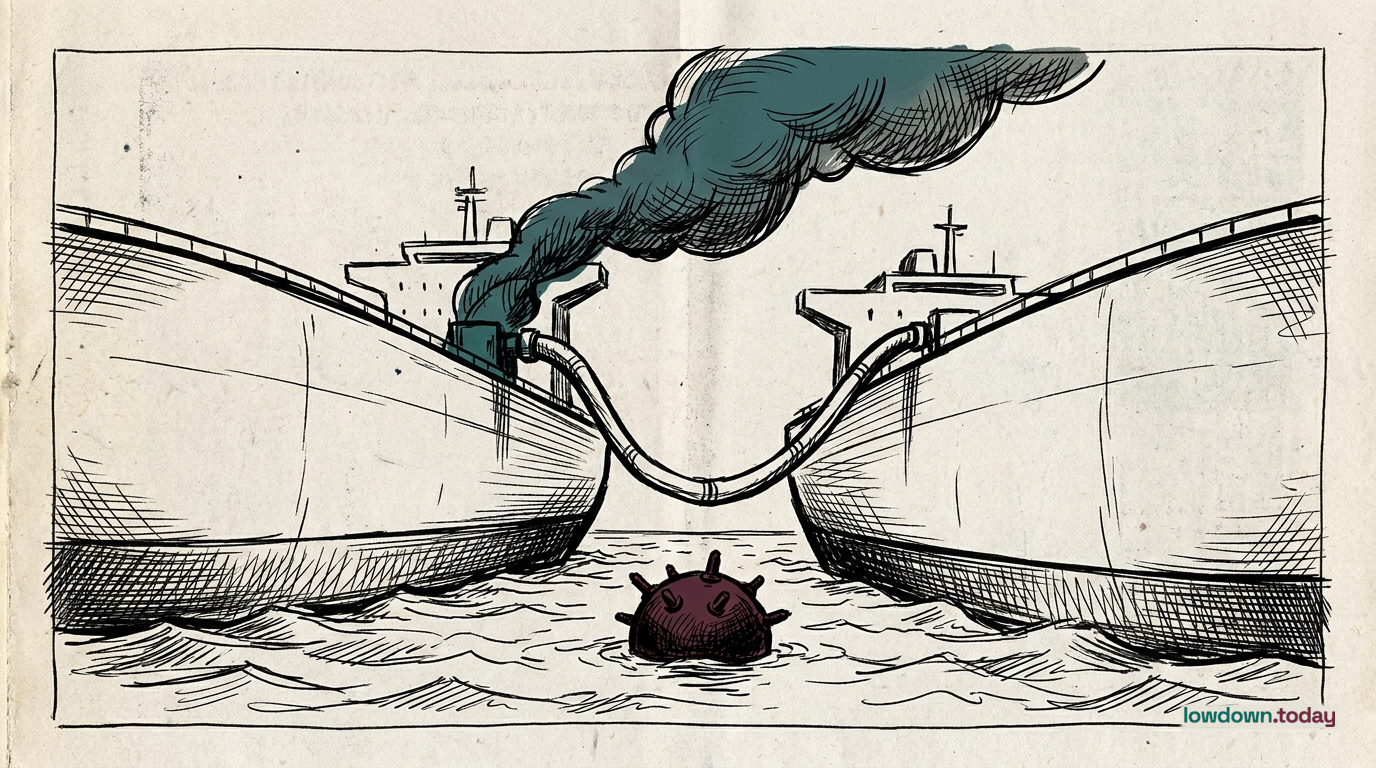
Forty-eight hours after Trump demanded allied warships for the Strait of Hormuz, not a single country has pledged a vessel — not even Japan, which routes roughly 90% of its crude oil imports through the waterway.

Sources profile:This story draws on centre-left-leaning sources from United Kingdom and Qatar (includes United Kingdom state media)
QatarUnited Kingdom

No country committed warships to Trump's Hormuz escort Coalition 48 hours after his call. Germany's FM Johann Wadephul called the proposal 'sceptical.' France offered Paris as a venue for Lebanon talks, not frigates for tankers. The UK 'discussed importance' on a Saturday call without committing ships. Japan and South Korea said nothing.

The United States has acknowledged it cannot secure the strait of Hormuz while prosecuting the air campaign against Iran. No ally will fill the gap. More than 300 commercial ships remain stranded, oil prices are above $100, and the maritime dimension of this war has no solution in view. 

Iran's foreign minister flatly denied ever seeking a ceasefire, contradicting Trump and exposing the unresolved fracture between Tehran's civilian government and its revolutionary command.

Sources profile:This story draws on centre-left-leaning sources from Qatar, United States and 1 more
QatarUnited StatesIsrael

Iranian FM Abbas Araghchi told CBS Face the Nation: 'No, we never asked for a ceasefire, and we have never asked even for negotiation' — directly contradicting Trump's claim from last week that Tehran 'wants to make a deal.' Whether Araghchi speaks for the IRGC or only for Pezeshkian's civilian government is unresolved; the two have issued contradictory positions since the war's first week.

Eliminates the only diplomatic off-ramp Trump publicly claimed existed. With Iran's foreign minister categorically denying interest in talks, and the civilian-IRGC split producing contradictory signals on whether Iran even has a unified negotiating position, no visible pathway to negotiation exists as the war enters its third week. 

Trump threatened to postpone his summit with Xi Jinping unless China helps open the Strait of Hormuz — but China is the one country whose oil supply the blockade has not disrupted.

Sources profile:This story draws on centre-left-leaning sources from United States
United States

Trump threatened to delay his summit with Xi Jinping (scheduled 31 March–2 April) unless China helps secure passage through the strait of Hormuz. China imports roughly 11 million barrels per day through the strait. US officials have described Hormuz as an Iranian 'Kill box' with more than 300 ships stranded.

China is the primary beneficiary of the Hormuz disruption — receiving discounted Iranian crude, collecting intelligence on US naval operations, and building diplomatic leverage in Tehran. Threatening a summit Beijing accepted reluctantly is unlikely to alter that calculus and risks accelerating Chinese-Iranian alignment at the moment Washington most needs Chinese cooperation. 

Sources:Bloomberg·CNBC

Zelenskyy claims Russian factories are manufacturing Shahed drones under Iranian licence and shipping them back to Tehran — the same weapon, two wars, reversed direction.

Sources profile:This story draws on centre-left-leaning sources from France, Ukraine and 2 more
FranceUkraineUnited KingdomUnited States
LeftRight

Zelenskyy told CNN that Russia is supplying Iran with Shahed drones, claiming '100% facts' citing Ukrainian intelligence. He characterised this as hardware-level transfer: Russian manufacture of Shaheds under licence at Alabuga in Tatarstan, shipped back to Iran for use against US forces — closing a supply chain circle where Iran designed the weapon, transferred production to Russia for Ukraine, and Russia now sends finished drones back for a different war.

If confirmed, the Shahed supply chain has closed a loop: Iran designed the weapon, transferred production to Russia for use in Ukraine, and Russia now manufactures and returns the drone for Iran's war against US forces — raising the question of whether drones intercepted over The Gulf were built in Tatarstan, not Isfahan. 

More than 200 targets struck in Hamedan province, including the air base from which Iran launched its first direct attack on Israel in April 2024.

Sources profile:This story draws on mixed-leaning sources from Israel, United States and 1 more
United StatesIsraelQatar
LeftRight

IDF concentrated strikes over the past 24 hours on Hamedan province in western Iran — the first sustained IDF focus on western Iran. More than 200 targets struck including command centres, air defence systems, weapons storage and production sites. Hamedan hosts Shahid Nojeh Air Base, a major Iranian Air Force facility and one of the launch sites for Iran's April 2024 attack on Israel.

The first sustained IDF strikes on western Iran open a third geographic axis in the campaign, forcing Tehran to defend a wider perimeter at a time when its central air defences are already degraded. 

Hezbollah fighters engaged Israeli forces with RPGs and small arms in Khiam — the town whose detention facility became synonymous with Israel's 18-year occupation of southern Lebanon.

Sources profile:This story draws on mixed-leaning sources from Israel
Israel
LeftRight

Hezbollah reported direct ground clashes with Israeli forces in Khiam on Saturday at 19:20 GMT using RPGs and light and medium weapons. Khiam hosted an Israeli-backed detention centre from 1985 to 2000; its liberation became a founding Hezbollah narrative.

RPGs and close-quarters combat are precisely where Hezbollah's 2-decade prepared defence is strongest. Israel's campaign was built around 1,100 air strikes; infantry warfare in tunnel-networked terrain against 30,000 fighters is a different war. 

Seven Iranian missile volleys hit greater Tel Aviv overnight. Cluster bomblets — the munition that first penetrated Israeli defences five days ago — wounded civilians in Bnei Brak and Ramat Gan.

Sources profile:This story draws on centre-left-leaning sources from Israel, United States and 1 more
IsraelUnited StatesQatar
LeftRight

Iran fired at least seven missile volleys at Israel from Saturday night into Sunday using cluster munitions. A man in his 60s was moderately hurt in Bnei Brak by a suspected cluster bomblet that struck an apartment building. A man in his 70s was lightly injured in Ramat Gan. Two men in their 50s were wounded in a separate cluster attack. Four more were hurt running to shelters.

Iran's sustained use of cluster munitions against Israel's most densely populated metropolitan corridor demonstrates a weapon that inflicts casualties even when most of a salvo is intercepted. Each warhead that penetrates scatters dozens of submunitions across residential areas, rendering traditional intercept-rate metrics incomplete as a measure of civilian protection. 

A 30-day reprieve on Russian oil sanctions aims to cool crude prices past $100 — but six G7 members called it the wrong signal, and Zelenskyy warned the waiver hands Moscow $10 billion.

Sources profile:This story draws on centre-left-leaning sources from United States and Qatar
United StatesQatar

Trump issued a 30-day waiver on Russian oil sanctions to ease prices raised by US operations against Iran. 6 of 7 G7 members publicly objected; Zelenskyy estimated it could deliver $10 billion to Moscow.

Ukrainian intelligence asserts Russia manufactures Shahed drones at Alabuga and ships them to Iran. If accurate, the waiver eases pressure on a state arming the US's current battlefield adversary — Washington is financing both sides of its own war. 

163 more killed in five days, the total past 850 with more than 100 children among the dead, and 831,000 displaced — matching the entire 2006 war's displacement in half the time.

Sources profile:This story draws on mixed-leaning sources from Israel, Qatar and 2 more (includes China state media)
IsraelQatarChinaUnited Kingdom
LeftRight

Lebanon's Health Ministry reported 850 killed — more than 100 children — 2,105 wounded, and 831,000 displaced since 2 March. That is 163 deaths in 5 days since the previous toll of 687 . The 2006 war killed roughly 1,200 Lebanese in 34 days; this campaign approaches that in 15.

Lebanon's hospitals were critically under-resourced after its 2019-2022 financial collapse. Displacement causes cascading deaths at lower thresholds than any prior Lebanon conflict. 

Israel denies running low on missile interceptors, but its cabinet approved $826 million in 'urgent and essential' defence procurement the same weekend.

Sources profile:This story draws on mixed-leaning sources from United States, Israel and 1 more
IsraelUnited StatesUnited Kingdom
LeftRight

Semafor reported, citing US officials, that Israel has informed Washington it is running critically low on Ballistic missile interceptors. Israel entered the war depleted from last summer's Twelve-Day War. The IDF denied the report, stating it is using fewer interceptors than anticipated. Israeli FM Sa'ar said 'The answer is no.' Israel Hayom reported the IDF suspects Iranian disinformation behind the Semafor report.

The contradiction between Israel's denial and its emergency procurement raises questions about air defence sustainability at a time when Iran's heavy warheads, cluster munitions, and Hezbollah's rocket barrages test Israeli defences on three axes simultaneously. 

An Israeli strike killed a Hamas official in Lebanon — one day after Hamas publicly urged Iran to stop striking Gulf neighbours, the first wartime break between Tehran and its closest Palestinian ally.

Sources profile:This story draws on centre-leaning sources from Saudi Arabia
Saudi Arabia
LeftRight

Israel killed a Hamas official in Lebanon on Sunday, 1 day after Hamas publicly urged Iran to stop attacking Gulf neighbours. Hamas broke with Tehran's strategy under Qatari pressure following missile strikes on Doha .

Hamas cannot return to full Iranian alignment without losing Qatari support and funding. It cannot cut ties with Tehran without losing its weapons supply. The strike exposed both halves of that bind within 24 hours of the public break. 

Israel's cumulative toll reveals a war of attrition against its civil defence: 15 killed but 3,138 wounded — a ratio that shows what missile defences can and cannot prevent over weeks of sustained fire.

Sources profile:This story draws on mixed-leaning sources from Israel and United States
IsraelUnited States
LeftRight

Cumulative Israeli toll since 28 February reached 15 killed and more than 3,138 wounded.

The wound-to-kill ratio of roughly 209:1 — far beyond conventional conflict benchmarks — shows that Israel's layered air defences and shelter systems prevent mass fatalities but cannot prevent the accumulation of injuries from cluster munitions, shrapnel, and nightly shelter runs. At 174 wounded per day, the medical burden compounds over the weeks-long campaign the IDF now envisions. 

Brent crude futures pushed past $105 on Monday, settling into the war's highest sustained range as the market prices in a Hormuz closure measured in weeks, not days.

Sources profile:This story draws on neutral-leaning sources from Israel
Israel

Brent Crude closed Friday at $103.14; Monday futures indicated $104.89-106.44, the war's highest sustained range. Gulf transits have dropped to single digits against a pre-war average of 138 per day. The IEA's record 400-million-barrel reserve release failed to hold prices below $100.

Markets now price Hormuz closure as structural for weeks. Import-dependent economies in Europe, Japan, and South Korea face compounding inflation daily. Deutsche Bank and Oxford Economics both issued recession warnings for Q2-Q3 2026. 

Sources:FX Leaders
Closing comments

Three vectors point toward widening. First, ground fighting at Khiam indicates Hezbollah is imposing infantry combat on an IDF campaign designed for air operations; the 30,000 fighters Qassem committed include Radwan elite units. Second, the 5,000-strong Marine Expeditionary Unit arriving around 27 March coincides with the start of Israel's 'deeper plans' — its core capabilities are amphibious assault and shore operations, the profile for a ground component not yet acknowledged. Third, Trump's Xi summit threat (31 March deadline, 15 days away) risks accelerating China's parallel maritime corridor with Iran rather than producing concessions, given Beijing's 11 million bpd Hormuz dependency and its existing selective transit arrangement.

Emerging patterns

  • Israeli operational timelines expanding beyond initial US political framing
  • Emergency procurement signaling interceptor consumption rates exceeding public acknowledgment
  • International reluctance to participate in US-led military coalitions for the Iran war
  • Iranian diplomatic positions hardening as military campaign continues
  • US leveraging unrelated bilateral relationships for Iran war objectives
  • Circular weapons supply chains linking Ukraine and Iran conflict theatres
  • Geographic expansion of Israeli air campaign from central to western Iran
  • Ground warfare dimension opening alongside air campaign in Lebanon
  • Iranian shift to cluster munitions as systematic tactic against Israeli civilian areas
  • Contradictory US sanctions policy: relaxing Russia sanctions while fighting Russian-armed Iran
Different Perspectives
Iranian FM Abbas Araghchi
Denied Iran has ever sought a ceasefire or negotiation — a departure from the ambiguity maintained since Pezeshkian outlined ceasefire conditions to Pakistan and Russia on 11 March.
IDF Brig. Gen. Effie Defrin
Stated 'no stopwatch or timetable' — the first explicit Israeli military rejection of Trump's implied four-week timeline for the conflict.
G7 majority (six of seven members)
Told Trump his 30-day Russian oil sanctions waiver is 'not the right signal' — a collective rebuke on sanctions policy during wartime from the US's closest economic allies.

