Skip to content
Briefings are running a touch slower this week while we rebuild the foundations.See roadmap
Iran Conflict 2026
21APR

Northwood drafts Hormuz rules without Gulf signatures

3 min read
10:51UTC

UK-hosted planners at Permanent Joint Headquarters opened the summit to draft rules of engagement for the 51-nation Hormuz initiative on 20 April. The United States is not at the table, and no Gulf state has signed on.

ConflictDeveloping
Key takeaway

Northwood is drafting Hormuz rules of engagement that no Gulf state has signed and no US seat endorses.

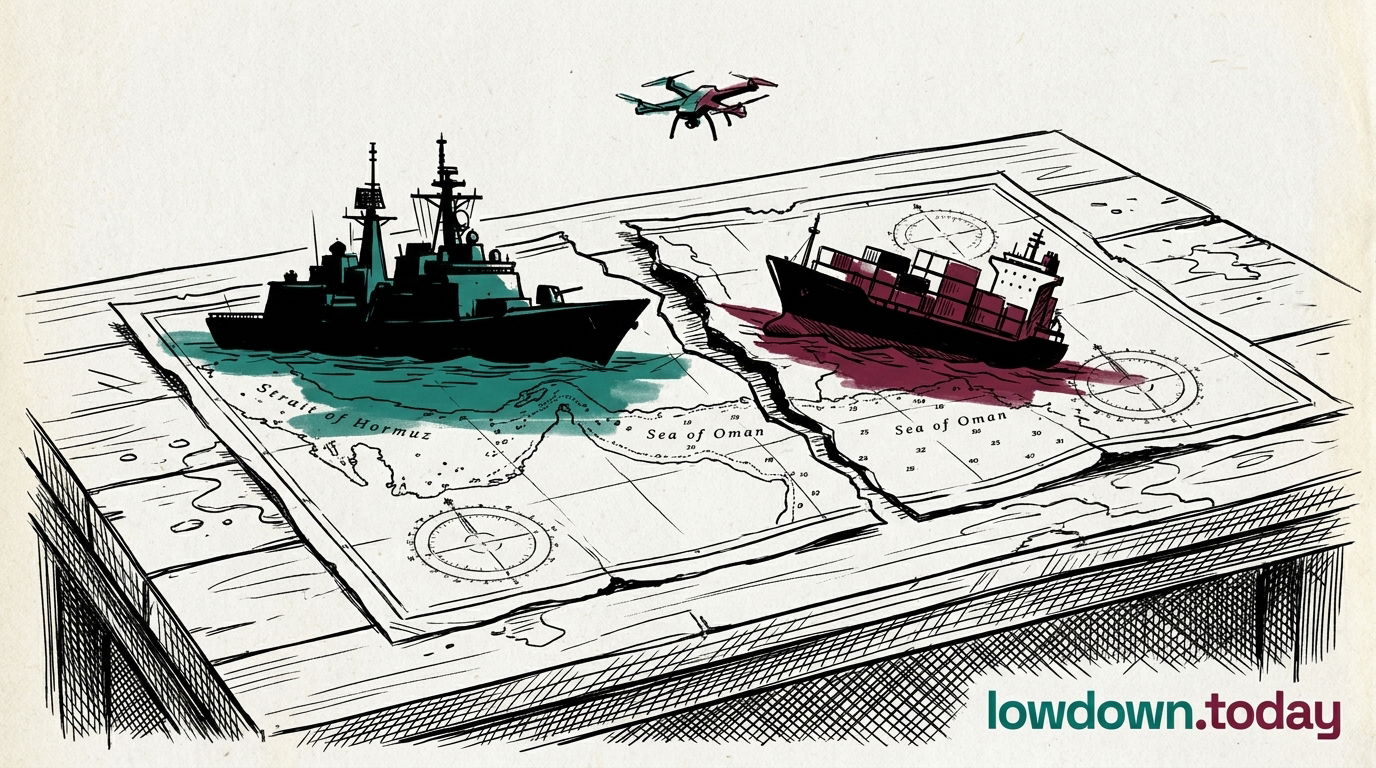
Planners convened at Northwood, the UK Permanent Joint Headquarters, on 20 April to draft rules of engagement for the 51-nation Hormuz freedom-of-navigation coalition . Washington declined a seat at the table, and Saudi Arabia and the wider Gulf Cooperation Council (GCC) have not signed on.

Both constraints have already been set elsewhere. The Paris posture tied operational activation to whatever ceasefire architecture eventually emerges, with deployment conditional on ceasefire conditions being met. IMO Secretary-General Dominguez's 17 April statement anchored the legal position by surfacing the 1968 tripartite framework the new rules would have to either inherit or override. The Grossi principle from the nuclear track applies equally at sea : enforcement without coastal signatures is rules a boarded vessel's flag-state lawyer can challenge on the Dominguez statement alone.

The practical question Northwood faces is whether a British or French warship can stop a vessel under the new rules without a Gulf coastguard coordinating the stop. Without Gulf signatures the coordination is missing, which means every boarding becomes a bilateral diplomatic event between the flag state and the stopping state. Underwriters will price that friction into hull risk; commercial operators will route around it.

A dissenting read inside European defence ministries is that the absence of US participation is a feature rather than a flaw, because a mission without American framing preserves the European diplomatic space to negotiate with Tehran in parallel. That argument has merit; it also leaves a draft rulebook whose citable authority is currently thinner than the political ambition behind it.

Deep Analysis

In plain English

Britain and France are running a summit at Northwood (the UK's military command headquarters) to write the rules for a 51-nation maritime mission in the Strait of Hormuz, with the goal of protecting ships passing through the strait. Two significant gaps constrain its authority. Washington chose not to join the Macron-Starmer maritime initiative, so the US Navy operates outside the framework it will enforce. Saudi Arabia and the other Gulf Arab states, which depend heavily on the strait for their own oil exports, have not signed on either. Perhaps most constraining: the rules Northwood writes this week must work alongside a 58-year-old agreement between Iran, Oman and the United Nations that governs Hormuz traffic, and nobody can simply override it.

Deep Analysis
Root Causes

The Paris posture's 'when conditions are met' language bound the Northwood mission to whatever ceasefire architecture emerges from the Munir-Tehran channel. Northwood planners are therefore writing rules of engagement for a ceasefire-contingent mission without knowing whether the ceasefire will hold past 22 April.

The US absence is both structural (Washington chose not to participate in the Macron-Starmer maritime format) and practical: any US seat would make the initiative look like a NATO operation, reducing its credibility with non-aligned states that the 51-nation coalition needs to sustain legitimacy in post-ceasefire Hormuz governance.

What could happen next?
  • Consequence

    Northwood's rules-of-engagement text, if it writes around rather than through the 1968 Traffic Separation Scheme, will lack the legal backing of the only extant signed tripartite Hormuz instrument.

  • Opportunity

    If the ceasefire holds past 22 April, the Northwood framework becomes the starting point for permanent Hormuz governance negotiations, giving the UK and France disproportionate influence over the post-war maritime architecture.

First Reported In

Update #74 · Two unsigned rulebooks collide at Hormuz

International Maritime Organization· 20 Apr 2026
Read original
Causes and effects
This Event
Northwood drafts Hormuz rules without Gulf signatures
Rules of engagement written without littoral signatures are rules a warship cannot cite when challenged. Northwood's output will inherit a political ceiling set in Paris and a legal ceiling set at the IMO before any operational decisions are taken.
Different Perspectives
Israel
Israel
IDF Chief Eyal Zamir declared on 3 June there was no ceasefire for his forces, and strikes killed at least 10 civilians and one Israeli soldier on 4 June. The IDF killed Hezbollah's chief engineer and warned three south Lebanon villages to evacuate on 5 June, advancing into ground the unsigned Washington framework has not caught.
Hezbollah / Lebanon
Hezbollah / Lebanon
Naim Qassem rejected the Washington Lebanon framework on 4 June as "absurd, humiliating and insulting", blocking a ceasefire instrument that required Hezbollah to withdraw north of the Litani before any Israeli withdrawal. Over one million Lebanese remain displaced; the framework's collapse prolongs that toll.
Iran
Iran
Foreign Minister Araghchi publicly coupled the Lebanon ceasefire to the Iran-US nuclear track on 4 June, carrying IRGC authority rather than his own civilian mandate. The IRGC delegation has sent no HEU counter-proposal since Araghchi confirmed no progress that same day; Mojtaba Khamenei's 21 May order to keep the 440.9 kg stockpile inside Iran remains operative.
United States
United States
Rubio placed the Iran-US deal at 95 per cent complete on 4 June while the administration signed no Iran instrument and OFAC designated only Cuban targets. Trump separately disclosed and rejected an airlift plan to collect Iran's HEU stockpile, claiming the material is "entombed", a claim the IAEA cannot verify.
China
China
Beijing's MOFCOM Blocking Rules constrain OFAC enforcement on the mainland; China has not corroborated Trump's verbal account of any bilateral summit, and the rial's failure to hold its Rubio bounce, combined with the IRGC's stablecoin rail closure, increases Chinese yuan-denominated oil-payment exposure through Hormuz.
Bahrain
Bahrain
The IRGC struck Bahrain on 3 June as its sirens sounded and its PAC-3 magazine neared exhaustion; excluded from Rubio's 2 May emergency resupply, Bahrain received a 50-round Federal Register notice on 1 June on an 18-month delivery timeline, meaning it is defending the US Fifth Fleet headquarters on the last rounds it has.