Skip to content
Briefings are running a touch slower this week while we rebuild the foundations.See roadmap
Iran Conflict 2026
21APR

Northwood plan leaves allied ships exposed

2 min read
10:51UTC

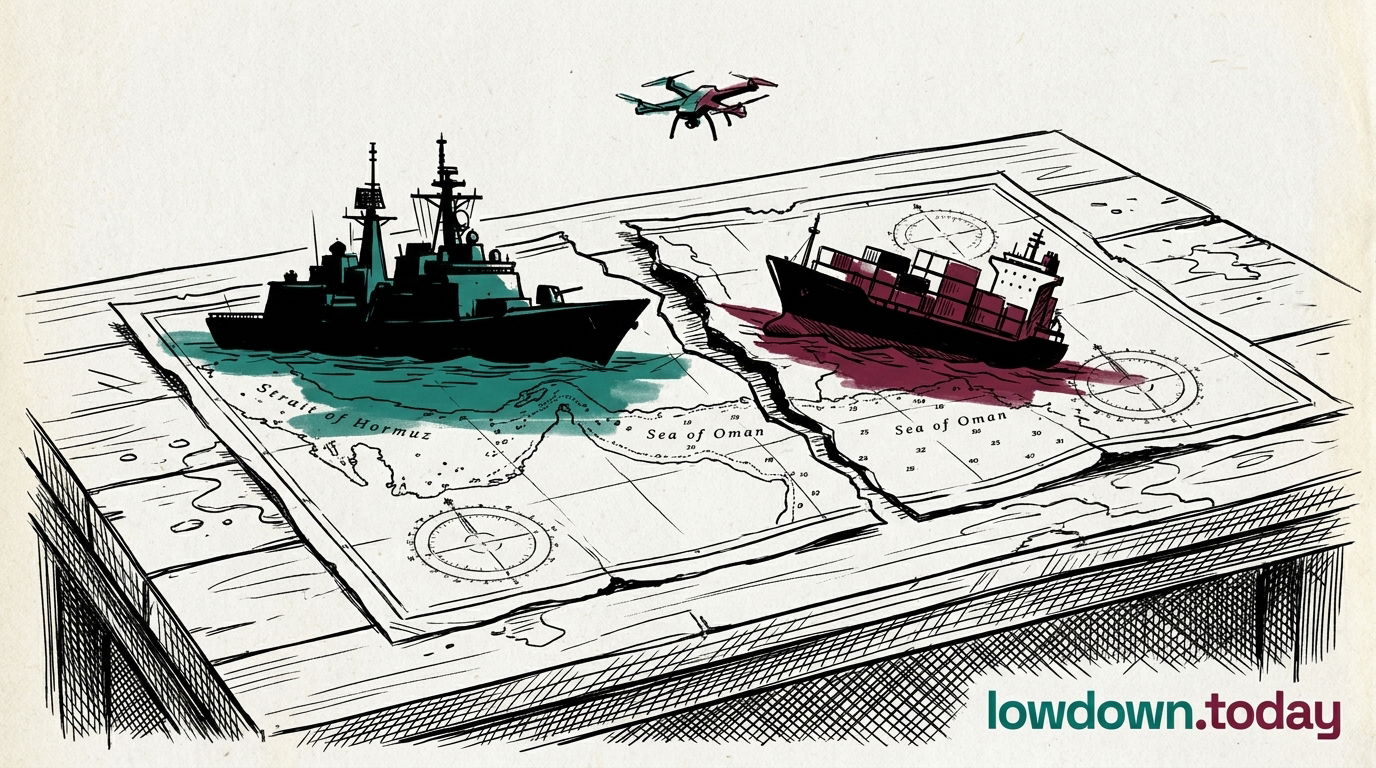
Thirty nations produced an operational Hormuz plan at UK Permanent Joint Headquarters Northwood on 22-23 April. The White House's two-tier ceasefire leaves European, Asian and Gulf-flagged shipping outside the cover.

ConflictDeveloping
Key takeaway

Coalition plan is ready; ceasefire cover is not, and Europe's flagged hulls carry the exposure.

Thirty nations sent military planners to the UK Permanent Joint Headquarters at Northwood on 22-23 April 2026 to translate the 51-nation Paris posture into an operational Strait of Hormuz plan covering warships, armed convoy escorts, mine-hunting drones, radar coverage and intelligence-sharing 1. The Northwood summit itself opened on 22 April . No participating nation published rules of engagement, and the deployment trigger remains "as soon as conditions permit, following a sustainable ceasefire."

The White House confirmed a two-tier ceasefire ruling that explicitly excludes European, Asian and Gulf-flagged shipping from ceasefire cover regardless of escort architecture. Saudi Arabia and the Gulf Cooperation Council (GCC) still sit off the Coalition paper despite Riyadh's welcome of the 21 April ceasefire extension. Every European, Asian or Gulf-flagged vessel in the strait operates without the umbrella the paper would otherwise extend, even when sailing inside a Coalition convoy.

Allied exclusion makes the Northwood architecture coercive of allies as much as of Iran. The Hormuz plan exists on paper at Northwood; the ceasefire that would activate it does not. France, the United Kingdom and the other 28 participants have committed hulls and radar to a framework the United States controls the trigger on, and US reading of ceasefire cover decides which of their hulls are covered when a mine-layer breaks for open water.

The Pentagon email leaked on 24 April closes the loop. European capitals that declined the Iran-campaign ABO request are the same capitals that now watch their flagged shipping sit outside the ceasefire bubble. Article 42.7 of the EU treaty, the mutual-defence clause raised at the Cyprus summit, is the institutional counterweight, but it reaches the flag rather than the cargo, and the cargoes are already at sea.

Deep Analysis

In plain English

Thirty countries sent military planners to Northwood, the UK's military command headquarters outside London, to turn the paper promise from the 51-nation Paris conference into an actual military plan: which warships, which drone mine-hunters, which radar systems, and who shares intelligence with whom. Activation requires a 'sustainable ceasefire': no government or coalition has published a definition of that term, and the US attended neither the Paris conference nor the Northwood summit. Thirty countries have agreed on paper how to police Hormuz after the war, but the deployment clock cannot start until someone else writes the ceasefire text that triggers it, using a legal framework Washington did not help draft.

What could happen next?
  • Precedent

    Rules of engagement drafted at Northwood by UK and French officers under UNCLOS transit-passage doctrine will form the legal baseline for Hormuz management post-war, creating a multilateral framework any subsequent US arrangement must negotiate against rather than replace unilaterally.

First Reported In

Update #78 · Allies flagged, adversaries listed, nothing signed

GOV.UK· 24 Apr 2026
Read original
Different Perspectives
Israel
Israel
IDF Chief Eyal Zamir declared on 3 June there was no ceasefire for his forces, and strikes killed at least 10 civilians and one Israeli soldier on 4 June. The IDF killed Hezbollah's chief engineer and warned three south Lebanon villages to evacuate on 5 June, advancing into ground the unsigned Washington framework has not caught.
Hezbollah / Lebanon
Hezbollah / Lebanon
Naim Qassem rejected the Washington Lebanon framework on 4 June as "absurd, humiliating and insulting", blocking a ceasefire instrument that required Hezbollah to withdraw north of the Litani before any Israeli withdrawal. Over one million Lebanese remain displaced; the framework's collapse prolongs that toll.
Iran
Iran
Foreign Minister Araghchi publicly coupled the Lebanon ceasefire to the Iran-US nuclear track on 4 June, carrying IRGC authority rather than his own civilian mandate. The IRGC delegation has sent no HEU counter-proposal since Araghchi confirmed no progress that same day; Mojtaba Khamenei's 21 May order to keep the 440.9 kg stockpile inside Iran remains operative.
United States
United States
Rubio placed the Iran-US deal at 95 per cent complete on 4 June while the administration signed no Iran instrument and OFAC designated only Cuban targets. Trump separately disclosed and rejected an airlift plan to collect Iran's HEU stockpile, claiming the material is "entombed", a claim the IAEA cannot verify.
China
China
Beijing's MOFCOM Blocking Rules constrain OFAC enforcement on the mainland; China has not corroborated Trump's verbal account of any bilateral summit, and the rial's failure to hold its Rubio bounce, combined with the IRGC's stablecoin rail closure, increases Chinese yuan-denominated oil-payment exposure through Hormuz.
Bahrain
Bahrain
The IRGC struck Bahrain on 3 June as its sirens sounded and its PAC-3 magazine neared exhaustion; excluded from Rubio's 2 May emergency resupply, Bahrain received a 50-round Federal Register notice on 1 June on an 18-month delivery timeline, meaning it is defending the US Fifth Fleet headquarters on the last rounds it has.