Skip to content
Welcome, thoughtbot's Giant Robots listeners!Start here
Iran Conflict 2026
21APR

Araghchi denies Hormuz obstruction at BRICS Delhi

3 min read
10:51UTC

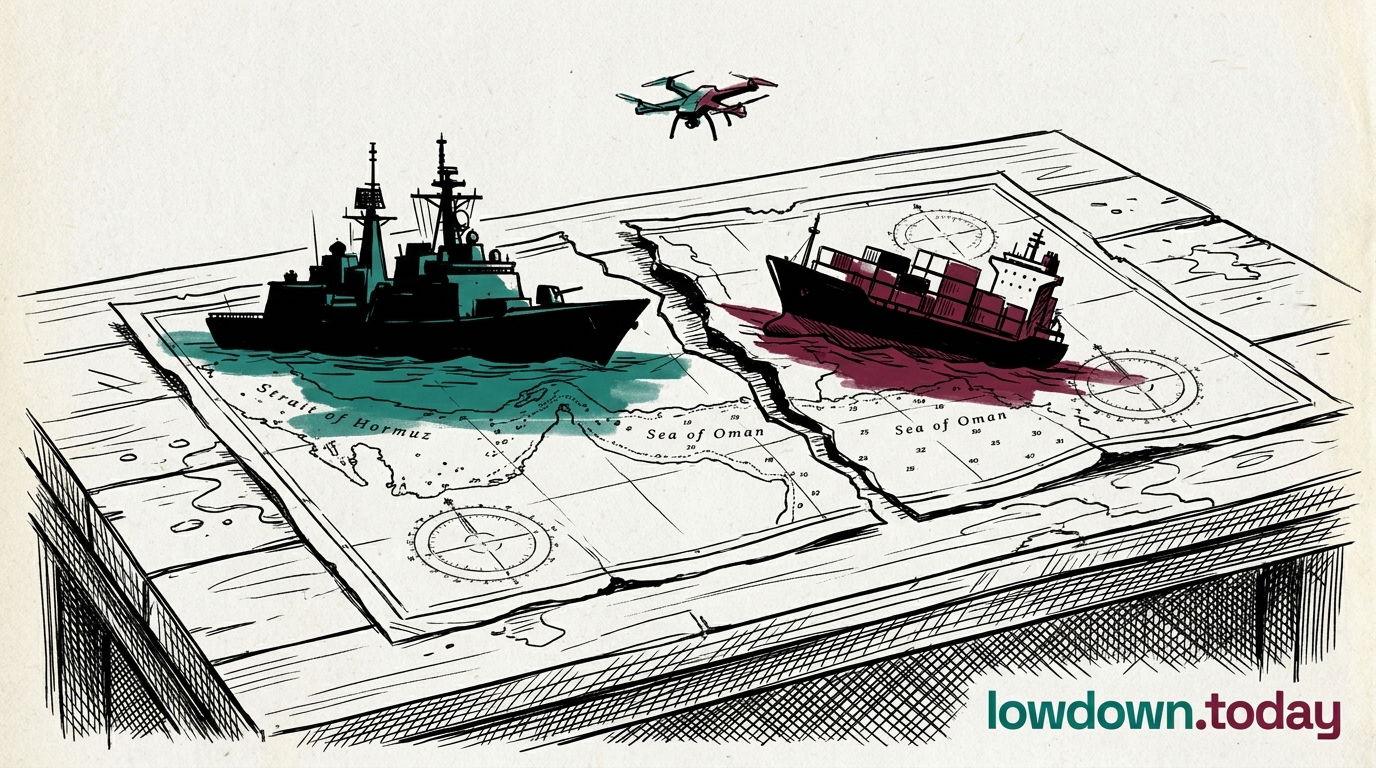
Iranian Foreign Minister Abbas Araghchi told BRICS foreign ministers in New Delhi on 14 May that Iran has not created any obstacles in the Strait of Hormuz, one day after Iran's Supreme National Security Council finalised a formal Hormuz security plan.

ConflictDeveloping
Key takeaway

Araghchi denied Hormuz obstruction at BRICS the day after Iran's SNSC finalised a formal control architecture for the strait.

Abbas Araghchi, Iran's Foreign Minister, arrived in New Delhi on 14 May having announced his attendance at the BRICS (the Brazil-Russia-India-China-South Africa grouping, a multilateral forum for non-Western powers) foreign ministers meeting the previous day. In his address, he told the assembled ministers that Iran "has not created any obstacles in the strait of Hormuz"⁠1. The claim was structured for a non-Western audience and delivered one day after Iran's Supreme National Security Council finalised a formal Hormuz security plan that operationalises the transit toll and corridor regime.

Deputy Foreign Minister Ali Bagheri Kani, accompanying Araghchi in Delhi, called on BRICS states to act "against US aggression." South China Morning Post reported Iran's anti-American rhetoric was testing India's balancing posture⁠2. India is the largest non-Chinese user of Iranian-routed crude, with domestic political constraints that make open endorsement of Araghchi's framing costly; Delhi is expected to prioritise de-escalation language over bloc confrontation in the final communique.

The Persian Gulf Strait Authority (PGSA), established on 5 May, requires vessels to register, pay a transit toll in Chinese yuan, and adhere to a designated corridor. Tehran frames those requirements as regulatory, not obstructive; Araghchi's Delhi statement carries that framing to a non-Western audience that has not signed up to Washington's counter-position. The denial is designed to hold simultaneously with the operational architecture. Iran had also declared no US weapons may transit Hormuz into regional bases, announced the same day as Araghchi's denial, adding a new operational constraint while the Foreign Minister described a strait without obstacles.

The BRICS stage gives Tehran a non-Western readership that is both sympathetic and practically important. Whether the BRICS communique adopts Araghchi's "no obstacles" framing or remains neutral on the transit regime question is one of the key diplomatic tests of the Delhi meeting.

Deep Analysis

In plain English

The BRICS group, which includes Brazil, Russia, India, China, and South Africa, is a forum where non-Western countries coordinate positions. Iran's foreign minister went to their meeting in New Delhi on 14 May and told them Iran was not blocking the strait of Hormuz. The day before, Iran's own security council had approved a formal plan to control the strait with tolls and corridors. Iran told the BRICS audience one thing and did another thing at home. The key question now is whether India, which chairs BRICS and buys a lot of Iranian oil, will back Iran's framing or stay neutral.

Deep Analysis
Root Causes

Iran's need to maintain non-Western alignment while the bilateral US-Iran track operates through Pakistan reflects a domestic constraint: Mojtaba Khamenei's government cannot be seen to negotiate with Washington without simultaneously demonstrating non-Western solidarity. The BRICS presence is a legitimacy-maintenance exercise for the domestic audience, not a negotiating move directed at Washington.

The structural tension between Araghchi's "no obstacles" claim at BRICS and the SNSC's written Hormuz security plan produced one day earlier is resolved by audience separation: the denial is for BRICS consumption, the written architecture is for operational and legal purposes. Both can coexist because they address different audiences on different registers.

What could happen next?
  • Consequence

    BRICS communique language on Hormuz will reveal India's positioning: adoption of Iran's 'no obstacles' framing would give the PGSA toll regime non-Western multilateral cover; de-escalation language would leave Iran's regulatory framing without BRICS endorsement.

  • Risk

    Bagheri Kani's call for BRICS states to act against US aggression tests India's chair neutrality at a time when Delhi has maintained public silence on US Iran sanctions targeting Indian firms in the Shamkhani network.

First Reported In

Update #97 · Chips for Beijing, no paper for Iran

South China Morning Post· 14 May 2026
Read original →
Different Perspectives
International Energy Agency
G7 members agreed on 2 October to release up to 100 million barrels through the IEA over four months, front-loading diesel.
China
China
China signed the 15 October text reaffirming the Resolution 2216 arms embargo on the Houthis. The Wall Street Journal reported that Conflict Armament Research found Chinese parts in a Houthi copy of Iran's Kheibarshekan missile.
Russia
Russia
Russia joined the 15 October consensus condemning the Houthis, a month after vetoing a mandate for a UN panel of experts on Iran sanctions on 17 September. One Western official told Bloomberg that Moscow is providing Iran with missiles, and the White House rejected the assessment.
India
India
National Security Adviser Ajit Doval raised seafarer safety with Mohsen Rezaei on 12 October, after a drone hit the Petro Dolphin with 11 Indians aboard at Sohar. External Affairs Minister S. Jaishankar urged that attacks on commercial shipping and seafarers be avoided.
Lebanon
Lebanon
President Joseph Aoun met UN peacekeeping chief Jean-Pierre Lacroix in Beirut on 14 October as UNIFIL winds down before its mandate ends on 31 December. Two days later Qatar's prime minister pledged in Beirut to fund a solar plant for Lebanon.
Kataib Hezbollah
Kataib Hezbollah
The militia announced a halt to operations except against "hostile aircraft" and denied any disarmament deal with Prime Minister Ali al-Zaidi. A day later Quds Force chief Esmail Qaani urged eliminating "remaining traces of the US presence in other arenas".

Written with AI from Lowdown's published reporting. Not individually reviewed by an editor. Editorial standards.