Skip to content
Briefings are running a touch slower this week while we rebuild the foundations.See roadmap
Iran Conflict 2026
20APR

Iran's SNSC finalises Hormuz security plan; US weapons transit barred

3 min read
10:10UTC

Iran's Supreme National Security Council finalised a formal Hormuz security architecture on 13 May, formalising the Persian Gulf Strait Authority's transit regime and declaring that no US weapons may pass through the strait into regional bases.

ConflictDeveloping
Key takeaway

Iran's SNSC produced written Hormuz architecture on 13 May while Trump's Beijing summit generated only verbal Iran statements.

Iran's Supreme National Security Council (SNSC, Iran's principal national security decision-making body chaired by the President) finalised a formal Hormuz security plan on 13 May, formalising the architecture Tehran began when it established the Persian Gulf Strait Authority (PGSA) in early May 1. The PGSA has required vessels to register, pay a transit toll of up to $2 million per ship in Chinese yuan, and adhere to a designated corridor since vessels began paying on 6 May . The SNSC plan converts that operational practice into a codified security framework.

The same day, Iran declared that no US weapons may transit the Strait of Hormuz (the 33 km chokepoint through which roughly 20% of global oil passes) into regional bases. This is a new operational constraint announced while Abbas Araghchi was simultaneously telling the BRICS meeting in Delhi that Iran had created no obstacles. Iran's Vice President Mokhber, First Vice President Aref, and Foreign Ministry spokesman Baqaei had declared Hormuz Iran's nuclear-equivalent strategic deterrent on 9 May , establishing the doctrinal framework the SNSC plan now operationalises.

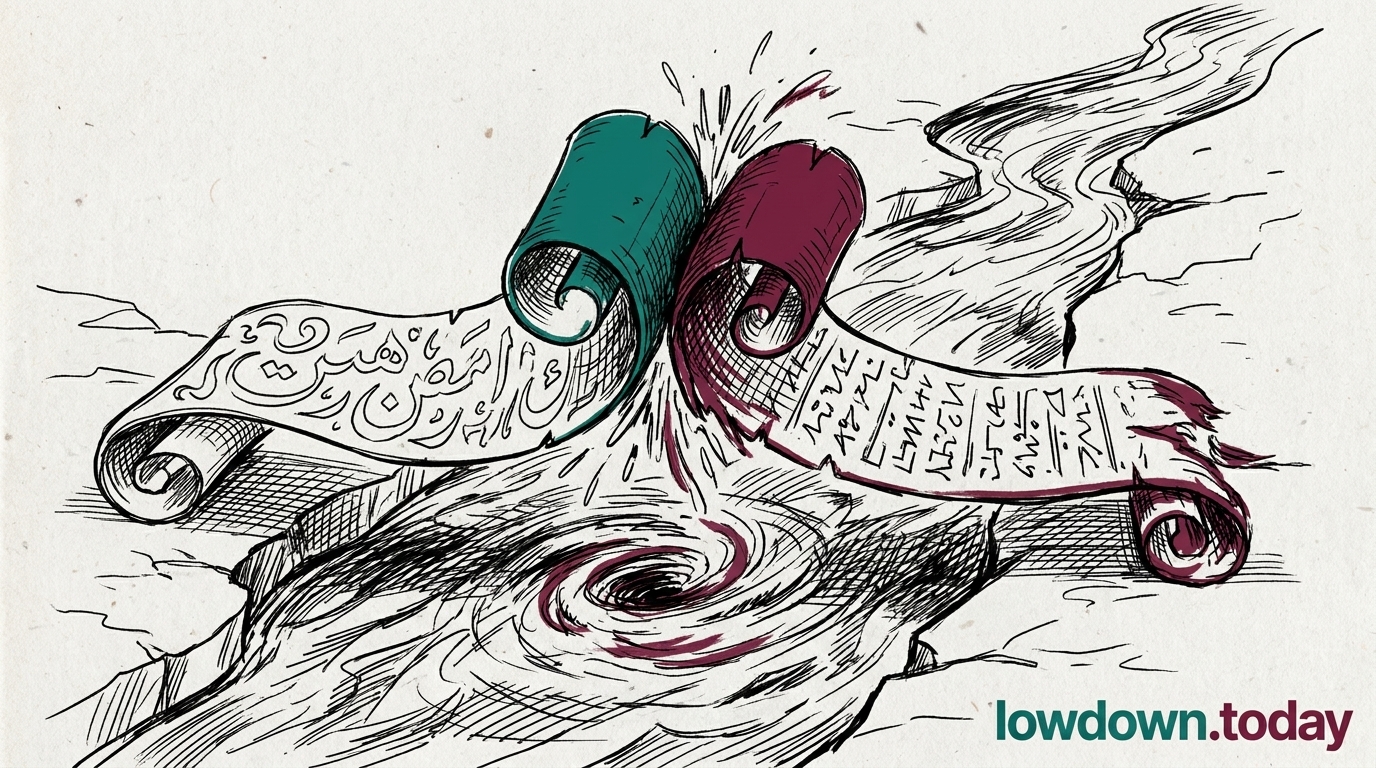
The contrast with the US output on 13-14 May is structural. Trump's delegation in Beijing produced a Commerce Department chip clearance and verbal statements on Iran. Iran's SNSC produced written security architecture with an operational component. Tehran has been consistently generating institutional written output since the PGSA registration opened ; the US presidential-actions index remains at zero Iran instruments across 76 days. Iran's diplomatic initiative belongs to the written register; America's Iran policy continues to operate in the verbal one.

Deep Analysis

In plain English

Iran's top security council took its informal Hormuz toll operation and turned it into a formal government body with written rules on 13 May. This matters because informal wartime practices can be stopped informally; a formal government institution with published rules requires a formal legal agreement to dismantle. Iran also declared it now has a law banning US weapons from passing through the strait. Both moves convert temporary war measures into permanent legal structures that will survive any ceasefire.

Deep Analysis
Root Causes

The SNSC codification serves three simultaneous purposes. First, converting a practice requiring continuous IRGC operational authority into a legal rule requiring only administrative enforcement reduces the cost of maintaining the toll regime indefinitely. Second, establishing a written legal claim against which any future ceasefire instrument must negotiate means a state body with statutory authority cannot be suspended by a verbal agreement alone.

Third, the US weapons transit ban added the same day converts a military policy into a regulatory declaration: any resumption of US weapons deliveries through the strait now constitutes a formal legal violation under Iranian domestic law, giving Tehran a codified interdiction pretext for use at a time of its choosing.

What could happen next?
  • Consequence

    Any ceasefire agreement that does not specifically address the Persian Gulf Strait Authority's legal status leaves Iran with a permanent toll-collecting institution and a legal basis for resuming the toll at any time, making the strait's reopening conditional on future Iranian administrative discretion rather than treaty obligation.

  • Risk

    The US weapons transit ban, now codified as domestic law, creates a legal tripwire: any US attempt to resupply Israeli or Gulf state military bases through the strait triggers an Iranian domestic law violation, providing Tehran with a formal legal pretext for interdiction.

First Reported In

Update #97 · Chips for Beijing, no paper for Iran

Mehr News· 14 May 2026
Read original
Causes and effects
This Event
Iran's SNSC finalises Hormuz security plan; US weapons transit barred
While the Trump administration produced verbal statements at the Beijing summit, Iran produced a written institutional security architecture on the same day, extending a pattern of Tehran outpacing Washington on formal written output that has held since the PGSA registration opened on 6 May.
Different Perspectives
Israel
Israel
IDF Chief Eyal Zamir declared on 3 June there was no ceasefire for his forces, and strikes killed at least 10 civilians and one Israeli soldier on 4 June. The IDF killed Hezbollah's chief engineer and warned three south Lebanon villages to evacuate on 5 June, advancing into ground the unsigned Washington framework has not caught.
Hezbollah / Lebanon
Hezbollah / Lebanon
Naim Qassem rejected the Washington Lebanon framework on 4 June as "absurd, humiliating and insulting", blocking a ceasefire instrument that required Hezbollah to withdraw north of the Litani before any Israeli withdrawal. Over one million Lebanese remain displaced; the framework's collapse prolongs that toll.
Iran
Iran
Foreign Minister Araghchi publicly coupled the Lebanon ceasefire to the Iran-US nuclear track on 4 June, carrying IRGC authority rather than his own civilian mandate. The IRGC delegation has sent no HEU counter-proposal since Araghchi confirmed no progress that same day; Mojtaba Khamenei's 21 May order to keep the 440.9 kg stockpile inside Iran remains operative.
United States
United States
Rubio placed the Iran-US deal at 95 per cent complete on 4 June while the administration signed no Iran instrument and OFAC designated only Cuban targets. Trump separately disclosed and rejected an airlift plan to collect Iran's HEU stockpile, claiming the material is "entombed", a claim the IAEA cannot verify.
China
China
Beijing's MOFCOM Blocking Rules constrain OFAC enforcement on the mainland; China has not corroborated Trump's verbal account of any bilateral summit, and the rial's failure to hold its Rubio bounce, combined with the IRGC's stablecoin rail closure, increases Chinese yuan-denominated oil-payment exposure through Hormuz.
Bahrain
Bahrain
The IRGC struck Bahrain on 3 June as its sirens sounded and its PAC-3 magazine neared exhaustion; excluded from Rubio's 2 May emergency resupply, Bahrain received a 50-round Federal Register notice on 1 June on an 18-month delivery timeline, meaning it is defending the US Fifth Fleet headquarters on the last rounds it has.