
Skip to content
Briefings are running a touch slower this week while we rebuild the foundations.See roadmap
Iran Conflict 2026
10MAR

Day 11: Iran moves to heavy warheads; China deploys

10 min read
04:55UTC

Iran declared it will fire only missiles with warheads exceeding one tonne — a doctrinal shift from saturation to concentration — while China deployed a naval fleet including a 30,000-tonne signals intelligence vessel to the Strait of Hormuz. Oil whipsawed from $119.50 to below $90 in a single session, Trump called the war a 'little excursion' hours before telling Congress the US 'hasn't won enough,' and Lebanon's daily attacks on Israel now exceed Iran's own.

Key takeaway

The war can degrade both sides' military capacity indefinitely but has no defined political endpoint — every actor's stated demands are structurally undeliverable to no identifiable counterpart.

This briefing mapped
Loading map…
Military
Diplomatic
Humanitarian

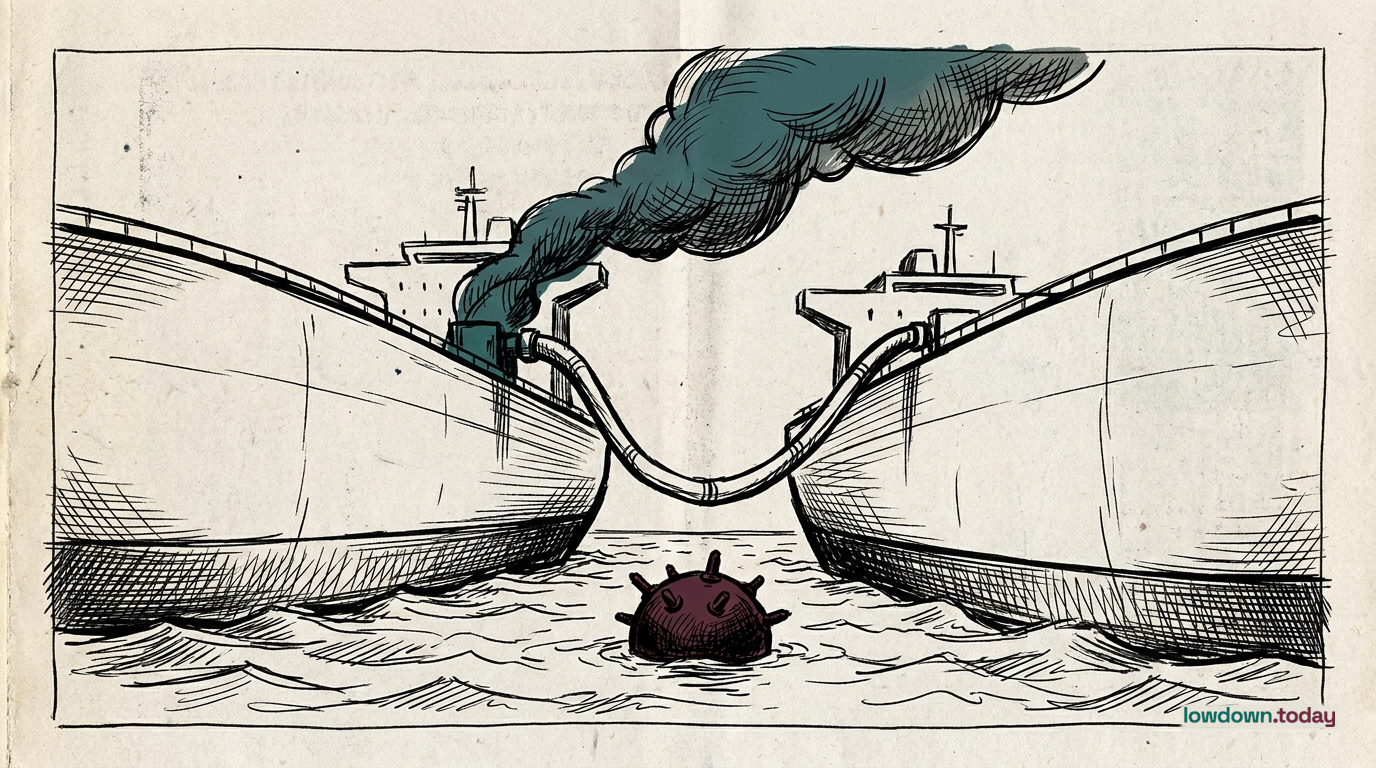
Fortune reported that vessels claiming Chinese or Muslim ownership receive de facto IRGC protection through the Strait of Hormuz while all others face interdiction or attack — formalising a two-tier passage system in the world's most important oil chokepoint.

Sources profile:This story draws on centre-leaning sources from United States
United States
LeftRight

Fortune reported ships claiming Chinese or 'Muslim' ownership were receiving de facto IRGC protection from interdiction in the strait of Hormuz — creating a two-tier passage system: open for Chinese-linked and Muslim-flagged commerce, closed to others.

The selective passage regime transforms Hormuz from a contested waterway into a geopolitically partitioned one, giving China preferential access to Gulf energy while import-dependent economies in Europe and East Asia face sustained supply disruption. 

Sources:Fortune
Briefing analysis

The final phase of the Iran-Iraq War saw Iran attack neutral shipping while the US Navy escorted reflagged Kuwaiti tankers through Hormuz under Operation Earnest Will. China's current naval deployment and the de facto IRGC protection for Chinese-linked vessels reverses this pattern: the power guaranteeing passage is Beijing, and the two-tier transit system formalises what Earnest Will improvised.

The 1973 Arab oil embargo, triggered by the Yom Kippur War, quadrupled crude over six months through administered production cuts. This conflict achieved a 77% price rise in ten trading days, but with far greater intraday volatility — $30 swings versus the 1973 embargo's administered adjustments — reflecting the difference between a deliberate supply reduction and a chokepoint disruption with no resolution mechanism.

Iran's Foreign Ministry warned all tankers to be 'very careful' — the first time the strait threat has escalated from military operations to sovereign diplomatic messaging.

Sources profile:This story draws on mixed-leaning sources from United States
United States
LeftRight

Iran's Foreign Ministry warned all tankers passing through Hormuz 'must be very careful' while the situation remains insecure — the first FM-level Hormuz threat of the war, escalating from IRGC operational warnings to formal diplomatic-level messaging.

Elevating Hormuz threats from IRGC operational warnings to Foreign Ministry communication implicates Iran's sovereign authority and transforms ad hoc interdiction into stated government policy, with consequences for international maritime law, insurance markets, and flag-state liability. 

Sources:Fortune·CNBC

China deployed a full naval task group including a 30,000-tonne signals intelligence vessel to the Strait of Hormuz — the first time Beijing has placed military intelligence-collection assets inside an active US combat theatre.

Sources profile:This story draws on mixed-leaning sources from Belgium and United States
BelgiumUnited States

China deployed the 48th PLA Navy fleet to The Gulf: Destroyer Tangshan, Frigate Daqing, Supply ship Taihu, and the Liaowang-1 — a 30,000-tonne signals intelligence vessel under naval escort. The SIGINT vessel gives Beijing real-time situational awareness of US and Israeli naval operations in the war's maritime theatre.

China's naval deployment transforms its Hormuz strategy from commercial negotiation to military presence, creating a physical tripwire that constrains US operational freedom in the strait without firing a shot. 

Chinese, Russian, and Iranian warships conducted joint Maritime Security Belt 2026 exercises in the Strait of Hormuz while US and Israeli forces struck Iranian targets — the first time trilateral naval drills have overlapped with active combat operations in the same waterway.

Sources profile:This story draws on neutral-leaning sources from Belgium
Belgium

Chinese, Russian, and Iranian naval forces conducting Maritime Security Belt 2026 exercises in the strait of Hormuz, operating alongside the newly deployed Chinese fleet.

The exercises provide a multilateral military framework for Chinese and Russian naval presence in Hormuz during hostilities, blurring the line between routine cooperation and wartime coordination in the world's most contested chokepoint. 

The IRGC announced it will fire only missiles carrying 1,000kg-plus warheads — a doctrinal shift from overwhelming volume to concentrated destructive power, made hours after Israel struck its command headquarters.

Sources profile:This story draws on centre-right-leaning sources from Israel and United Kingdom
IsraelUnited Kingdom

IRGC Air and Space Force commander Majid Mousavi declared Iran will no longer launch missiles with warheads under one tonne. All future strikes will carry 1,000kg-plus warheads with increased 'intensity and frequency' of fire — a doctrinal shift from saturation to concentration.

Iran's shift from missile saturation to concentrated one-tonne strikes changes the defensive calculus for Israeli air defences and signals adaptation to stockpile depletion, but the doctrine's sustainability depends entirely on warhead inventory that remains unknown. 

Iran aimed its first missile wave under the new Supreme Leader at Israel's primary international airport, claiming one-tonne warheads — the opening act of a doctrine built on destructive weight over volume.

Sources profile:This story draws on mixed-leaning sources from Israel
Israel

Iran launched its first missile wave under Mojtaba Khamenei's authority, claiming launches of one-tonne warheads at Ben Gurion Airport.

The first military operation under Mojtaba Khamenei's authority establishes the new Supreme Leader's tenure through escalation and tests Israeli air defences against heavier payloads under a new Iranian strike doctrine. 

The IDF struck both command centres directing Iran's missile and drone war — but Iran escalated its doctrine hours later, raising the question of what central command still controlled.

Sources profile:This story draws on centre-left-leaning sources from Israel and Qatar
IsraelQatar

IDF struck the IRGC Aerospace Force headquarters in Tehran — the nerve centre for all missile and drone fire at Israel and The Gulf — and the IRGC drone headquarters, a separate central command for UAV operations.

Israel targeted the organisational core of Iran's offensive campaign, but the IRGC had already devolved launch authority to 31 autonomous provincial commands — the strikes test whether command decapitation retains value against a force that dispersed four days earlier. 

Israel hit 50 dispersed storage sites in a single day, targeting the stockpiles feeding Iran's provincial launch networks as the IRGC's shift to heavier warheads raises the question of what lighter munitions remain.

Sources profile:This story draws on centre-left-leaning sources from Israel, Qatar and 1 more
IsraelQatarUnited Arab Emirates
LeftRight

IDF struck 50 ammunition storage shelters across Iran as part of Day 10 operations targeting Iran's missile and drone campaign infrastructure.

The largest single-day strike on dispersed ammunition infrastructure targets the logistics sustaining Iran's continued offensive, and the timing alongside Iran's shift to one-tonne-only warheads suggests lighter munition stocks may be forcing the doctrinal change as much as strategic choice. 

Ten days in, the war's heaviest daily fire on Israel comes not from Tehran but from across the Lebanese border — and Israeli leadership losses have not slowed it.

Sources profile:This story draws on mixed-leaning sources from United States, Qatar and 1 more
United StatesQatarUnited Arab Emirates
LeftRight

Israel stated on Monday that Lebanon now launches more attacks on Israel per day than Iran itself — a reversal from the war's first week when Tehran was the primary source of missile and drone fire. Hezbollah's rocket and anti-tank fire from southern Lebanon has been continuous.

Lebanon replacing Iran as the primary source of daily attacks shifts the war's operational geography and forces Israel's layered air defences to engage two simultaneous, fundamentally different threat profiles: long-range ballistic warheads from Iran and short-range rockets from Hezbollah positions as close as ten kilometres from the border. 

In ten days, Lebanon has matched the displacement toll of the entire 33-day 2006 war — with shelters at capacity, the economy already broken, and no ceasefire mechanism in sight.

Sources profile:This story draws on mixed-leaning sources from United States, Türkiye and 1 more
United StatesTürkiyeQatar
LeftRight

Lebanon's cumulative toll reached 486 killed and nearly 700,000 displaced in ten days of conflict. Displacement grew by approximately 250,000 in roughly 48 hours from Saturday's 454,000 figure. The ten-day displacement matches the entirety of the 33-day 2006 war.

Lebanon's displacement rate — 700,000 in ten days compared to roughly one million over 34 days in 2006 — has outpaced the country's capacity to shelter its own population, and no UN Security Council mechanism exists to deliver a ceasefire as Resolution 1701 did in 2006. 

Lebanon's president accused Hezbollah of dragging the state into war and called for immediate negotiations with Israel — the first diplomatic opening of the conflict, and the sharpest break between Beirut and Hezbollah in a decade.

Sources profile:This story draws on mixed-leaning sources from Türkiye and Qatar
TürkiyeQatar
LeftRight

Lebanese President Joseph Aoun called for immediate talks with Israel to end the fighting, characterising Hezbollah's attacks as an attempt to draw Israel into direct confrontation with Lebanon — signalling a fracture between Beirut's formal government and Hezbollah's parallel command structure.

The first call for direct Lebanese-Israeli talks since hostilities began, testing whether Israel will engage Lebanon as a negotiating partner distinct from the militia it is fighting on Lebanese soil — and whether Beirut can deliver anything without Hezbollah's consent. 

In a single afternoon at Doral, Trump called the war a 'little excursion,' declared the US had 'already won,' and deferred securing Iran's nuclear stockpile — the war's original justification — to a later date.

Sources profile:This story draws on mixed-leaning sources from United States
United States
LeftRight

President Trump at Doral press conference called the war a 'little excursion,' predicted it would end 'very soon,' declared the US had 'already won in many ways,' listing Iran's navy, air force, air defences, and radar as destroyed and its leadership 'decimated.' On ending the war this week: 'No. But very soon.' On troops to secure Iran's nuclear stockpile: 'Something we could do later on. We wouldn't do it now.' On Mojtaba Khamenei: 'I think they made a big mistake.' On Iran's future: 'It's the beginning of building a new country.'

Trump's public statements redefine war aims downward while deferring the nuclear stockpile question that provided the original casus belli, raising the question of what victory means if the stated reason for the war remains unresolved. 

Hours after calling the war a 'little excursion' for the cameras, Trump told House Republicans behind closed doors: 'We haven't won enough.'

Sources profile:This story draws on left-leaning sources from United States
United States
LeftRight

Trump told House Republicans at their Florida policy retreat behind closed doors 'We haven't won enough' — directly contradicting his public 'little excursion' and 'already won' framing from hours earlier the same afternoon.

The contradiction between public and private messaging reveals dual audience management — calming markets and voters with one message while seeking continued congressional funding with the opposite — a structure that becomes unsustainable as unbudgeted costs exceed $3.5 billion. 

Sources:CNN·Axios

Brent hit $119.50 — the highest since 2012 — then crashed below $90 on a single presidential comment. The most volatile crude session in decades reveals a market trading on words, not barrels.

Sources profile:This story draws on mixed-leaning sources from France, United States and 1 more
United StatesFranceCanada
LeftRight

Brent Crude hit $119.50 per barrel — the highest since 2012 and a 77% rise from $67.41 on 27 February. WTI reached $119.48. By US close, Brent settled at $98.96, sinking below $90 in after-hours trading. WTI settled at $94.77. The $30 intraday reversal was driven by Trump's 'very soon' language and profit-taking on overcrowded long positions.

The $30 intraday reversal demonstrates a market pricing political rhetoric rather than supply fundamentals; with 3.5 million barrels per day shut in and tanker traffic down 70%, the underlying disruption is unchanged. 

The S&P 500 recovered from a 1.5% drop to close up 0.8%. European indices closed sharply lower — a transatlantic split driven by timing, energy dependence, and a bet on how long the war lasts.

Sources profile:This story draws on mixed-leaning sources from United States and Canada
United StatesCanada
LeftRight

S&P 500 fell 1.5% at the open then closed +0.8%. Dow dropped 900 points early, closed +239 points (+0.5%). Nasdaq closed +1.4%. US markets recovered on Trump's 'very soon' language.

The US-European divergence exposes a structural asymmetry: American equities repriced on Trump's 'very soon' language; European markets, which closed earlier and depend on imported energy, absorbed the full weight of the oil shock without relief. 

The FTSE fell 2% and the DAX 3% — and unlike US markets, neither recovered, exposing the cost of energy dependence when Gulf supply is shut in.

Sources profile:This story draws on centre-leaning sources from Canada
Canada
LeftRight

FTSE 100 closed -2%. DAX closed -3%. European markets did not recover, having closed before Trump's 'very soon' comments. The divergence reflects both timing and structure — Europe imports energy it cannot replace from domestic reserves.

The transatlantic market divergence exposes Europe's structural energy vulnerability. Import-dependent economies face compressed industrial margins at sustained oil prices above $100 — a burden verbal reassurances from Washington cannot offset. 

Defence Secretary Healey disclosed to Parliament that British personnel at a US facility in Bahrain came within a few hundred yards of an Iranian strike — the narrowest margin yet between coalition support and British casualties.

Sources profile:This story draws on mixed-leaning sources from United Kingdom and United States (includes United Kingdom state media)
United KingdomUnited States
LeftRight

UK Defence Secretary John Healey told Parliament that British troops at a US base in Bahrain were within a few hundred yards of an Iranian strike.

British casualties would transform the UK's political posture from supporting partner to co-belligerent. The margin between those two positions is measured in hundreds of yards and zero British fatalities. 

Sources:Gov.uk·Newsweek

A small drone struck RAF Akrotiri in Cyprus — legally British sovereign territory — the first confirmed impact on the base after repeated drone fire since Day 3.

Sources profile:This story draws predominantly on United Kingdom state media, with sources from United Kingdom
United Kingdom

Healey confirmed a small drone hit RAF Akrotiri — the sovereign base in Cyprus hosting RAF Typhoons — the first confirmation of actual impact on the base. Akrotiri had come under drone fire as early as Day 3.

A drone of Iranian origin striking Akrotiri is, in legal terms, a strike on the United Kingdom itself. Each confirmed impact on British sovereign territory narrows the distance between the UK's calibrated support role and the domestic and legal pressure to respond as a direct party to the conflict. 

Sources:Gov.uk

Defence Secretary Healey disclosed UK forces were prepositioned across the Middle East from January — a full month before the first strike — revealing London's intelligence services assessed conflict as inevitable.

Sources profile:This story draws predominantly on United Kingdom state media, with sources from United Kingdom
United Kingdom

UK disclosed it had prepositioned Typhoons, F-35s, counter-drone teams, radars, and defences across the region from January — before the war began on 28 February.

The January prepositioning timeline shows Britain committed to the war footing weeks before the public trigger, raising questions about parliamentary oversight and exposing UK assets to Iranian retaliation across a theatre where Akrotiri has already been hit. 

Sources:Gov.uk

Britain demands Iran stop strikes, abandon nuclear weapons, and negotiate — while a UK official pushes back sharply against Trump's dismissal of Royal Navy carriers as unnecessary.

Sources profile:This story draws on mixed-leaning sources from United Kingdom and United States (includes United Kingdom state media)
United KingdomUnited States
LeftRight

UK stated its position: Iran must stop strikes, abandon nuclear ambitions, and restart negotiations. A UK official pushed back sharply in private against Trump's dismissal of British aircraft carriers as unnecessary.

The UK's stated war aims are the most stable Western diplomatic position articulated in ten days of conflict, but private friction with Washington over force contribution reveals the strain of operating inside a Coalition whose senior partner changes objectives daily. 

Sources:Gov.uk·Newsweek

Russia's president backed Mojtaba Khamenei within hours of his appointment as Supreme Leader — while Russian satellites feed targeting data to Iranian missile crews firing at American positions.

Sources profile:This story draws on centre-left-leaning sources from Qatar
Qatar

Putin pledged 'unwavering support' for Tehran following Mojtaba Khamenei's appointment as Supreme Leader: 'Russia has been and will remain a reliable partner.'

Moscow's immediate recognition, combined with operational intelligence support and China's parallel endorsement, constructs a diplomatic shield around Iran's new leadership that makes the UN Security Council inoperable on the conflict and raises the threshold for any Western attempt to target Mojtaba Khamenei personally. 

Sources:Al Jazeera

China's Foreign Ministry declared Mojtaba Khamenei's appointment constitutional and explicitly opposed any targeting of the new Supreme Leader — a direct counter to the IDF's Farsi-language assassination threat hours earlier.

Sources profile:This story draws on centre-left-leaning sources from Qatar
Qatar

China's Foreign Ministry called Mojtaba Khamenei's appointment constitutional, demanded respect for Iranian sovereignty and an immediate end to the conflict, and stated it opposes any external interference in Iran's internal affairs and any targeting of the new Supreme Leader — a direct response to the IDF's Farsi-language assassination threat.

China's formal recognition of Mojtaba Khamenei, paired with an explicit warning against targeting him, converts a general non-interference principle into specific diplomatic protection for a named individual. Combined with Russia's parallel recognition, this creates a Security Council veto shield around Iran's wartime leadership succession and establishes a Cold War-style bipolar alignment compressed into a single 21-nautical-mile strait. 

Sources:Al Jazeera

Israel dismissed Iran's new Supreme Leader as a continuation of a dynasty it has vowed to destroy — rhetoric that forecloses any diplomatic channel through Mojtaba's government.

Sources profile:This story draws on centre-left-leaning sources from Qatar
Qatar

Israel called Mojtaba Khamenei a 'tyrant' like his father.

Israel's characterisation of Mojtaba as a tyrant, combined with its prior assassination threat and declared Regime change objective, makes explicit that neither the US nor Israel will treat Iran's new leadership as a legitimate negotiating counterpart — narrowing an already closed diplomatic space. 

Sources:Al Jazeera

The Council on Foreign Relations assessed that Iran's new Supreme Leader holds enough institutional loyalty and external backing to sustain the war effort regardless of what happens on the battlefield.

Sources profile:This story draws on mixed-leaning sources from Israel and Qatar
IsraelQatar
LeftRight

The Council on Foreign Relations assessed that with Russian and Chinese diplomatic cover, IRGC institutional loyalty, and no civilian political figure capable of overriding him, Mojtaba Khamenei holds the minimum viable legitimacy base to sustain the war effort regardless of the military outcome.

The CFR assessment identifies that the US-Israeli theory of victory through military degradation and leadership targeting faces a structural mismatch: the political will to continue fighting is sustained by institutional loyalty, external diplomatic backing, and the absence of internal opposition — none of which are addressed by airstrikes on military infrastructure. 

Closing comments

Three escalation vectors converged on Day 10 without any de-escalation pathway opening. First, Iran's one-tonne warhead doctrine trades volume for destructive concentration — a single successful penetration at Ben Gurion or Haifa refinery changes the war's character from attrition to infrastructure denial. Second, China's SIGINT vessel and escort fleet create a zone where US operational freedom is structurally constrained — any incident transforms a regional war into a great-power crisis, and Beijing's intelligence collection has value regardless of the war's outcome. Third, Lebanon's displacement rate (700,000 in ten days, matching the entire 2006 war) and Aoun's public break with Hezbollah create conditions for either the war's first diplomatic opening or a Lebanese state collapse that opens a second ground front. The absence of a de-escalation vector is itself the escalation risk: with no off-ramp, each actor's next move is dictated by operational momentum rather than political strategy.

Emerging patterns

  • De facto selective enforcement of Iran's Hormuz transit ban based on vessel ownership claims; evolution from universal blockade toward discriminatory passage regime.
  • Escalation of Hormuz threat from operational (IRGC warnings and tanker strikes) to diplomatic (Foreign Ministry statement), broadening institutional ownership of the blockade posture.
  • Escalation from ad hoc flag-switching → formal bilateral negotiations with Tehran {{EVREF:/t/iran-conflict-2026/27/reuters-reported-citing-three-diplomatic-sources-that-china/}} → naval deployment. Structural deterrence: US strikes near Chinese naval vessels risk direct US-China incident. China exercises strategic influence without firing.
  • Trilateral naval cooperation during active hostilities creates a de facto great-power naval presence in the conflict's most critical chokepoint.
  • Adaptive doctrinal response to degraded lighter missile stockpiles and CENTCOM-claimed 90% reduction in launches. Shift from overwhelming interceptors with volume to maximising destructive impact per strike. Heavier warheads increase kinetic energy on descent making interception marginally harder and terminal blast radius substantially larger.
  • First military action under new Supreme Leader's authority establishes continuity of command and validates succession by demonstrating operational control over IRGC forces.
  • Continued targeting of centralised command nodes despite IRGC having already decentralised to 31 autonomous provincial commands on Day 6. Iran's one-tonne warhead announcement came hours after these strikes, suggesting either pre-planned doctrine change or sufficient redundant command capacity to absorb loss and escalate same day.
  • Systematic degradation of ammunition stockpiles; whether Iran holds sufficient one-tonne warhead inventory to sustain new doctrine is the key unanswered question.
  • Lebanon/Hezbollah emerging as the primary active front as Iranian direct fire declines — war's centre of gravity shifting from Iran to Lebanon.
  • Displacement rate far exceeding 2006 war; 700,000 in ten days vs equivalent total over 33 days in 2006. Shelter capacity already saturated (357 of 399 shelters full as of Saturday).
Different Perspectives
Lebanese President Joseph Aoun
Publicly blamed Hezbollah for drawing Israel into confrontation with Lebanon and called for immediate bilateral talks with Israel — the first time during this conflict that a Lebanese head of state has characterised Hezbollah's military actions as contrary to Lebanon's national interest.
Iran's Foreign Ministry
Issued the war's first FM-level warning that all tankers passing through Hormuz 'must be very careful' — escalating the Hormuz threat from IRGC operational messaging to formal state diplomatic communication, which under international law carries different implications for state responsibility.
President Trump
President Trump
Reframed the war from 'unconditional surrender' (Day 1) through 'cry uncle' (Day 8) to 'little excursion' (Day 10) in public, while privately contradicting the de-escalation framing to House Republicans. Deferred securing Iran's nuclear stockpile to 'later on.'
UK Defence Secretary John Healey
Disclosed to Parliament that the UK prepositioned Typhoons, F-35s, counter-drone teams, and air defences across the Middle East from January — at least five weeks before the war began — and confirmed a drone struck RAF Akrotiri, the first acknowledged impact on a NATO sovereign base.
