Skip to content
You can now search across every topic, entity and event.What's new
Iran Conflict 2026
23AUG

Pakistan's minister carries dual message to Tehran

3 min read
19:02UTC

Mohsin Naqvi reached Tehran on 6-7 June with written messages from both Pakistan's prime minister and its army chief, the one mediation track Iran's divided command cannot dismiss.

ConflictDeveloping
Key takeaway

Pakistan opened the war's most credible back-channel days before US and Iranian missiles tested it live.

Pakistan's Interior Minister Mohsin Naqvi was in Tehran on 6-7 June carrying written messages from both Prime Minister Shehbaz Sharif and Army Chief Field Marshal Asim Munir to Supreme Leader Mojtaba Khamenei, who has not appeared publicly since 28 February 1. Naqvi met Foreign Minister Abbas Araghchi on the morning of 7 June and coordinated with Qatar, Turkey and Egypt as a collective channel 2. IRNA and ABC News have now confirmed the visit that an earlier briefing flagged as unverified.

The institutional shape gives this track its weight. Pakistan carries both civilian and military buy-in, the prime minister's message and the army chief's running together, which is the one configuration Iran's divided command cannot wave away as a partial offer. Tehran's wartime authority splits between the IRGC, which controls the kinetic posture, and a foreign ministry whose public statements the corps has repeatedly reversed. A channel signed by Munir as well as Sharif speaks to both halves at once.

The timing exposed the track to immediate stress. Naqvi's shuttle and the US-Iran missile exchange ran across the same 72 hours, days after Trump publicly placed a deal in its "final throes" . The only mediation channel with full Pakistani buy-in was therefore stress-tested by live ordnance within hours of opening, before any reply from Khamenei had surfaced. Whether the silence reflects a courier lag or a deliberate hold is the open question Islamabad cannot yet answer.

Deep Analysis

In plain English

Pakistan sent its Interior Minister, Mohsin Naqvi, to Tehran on 6-7 June carrying two separate written letters: one from the elected Prime Minister and one from the army chief. This matters because normally a country speaks with one voice through its foreign ministry. Sending both a civilian and a military message together signals that any deal carried by this channel has broad Pakistani backing and will not be reversed by a change of government. Pakistan has been the main go-between linking the US and Iran since April 2026. It hosted the first direct US-Iran talks in decades and has shuttled proposals back and forth in writing. The visit came just two days before American strikes on Iran, raising questions about whether Tehran knew what was coming.

Deep Analysis
Root Causes

Pakistan's selection as mediator rather than a neutral European or Gulf state reflects three structural conditions that converged in 2026. First, Pakistan is the only nuclear-armed Muslim state with diplomatic relations with both the US and Iran, giving it a credibility with Tehran that neither Qatar nor Turkey possesses: Islamabad understands from its own nuclear programme why Iran regards enrichment as a sovereignty question.

Second, Field Marshal Asim Munir's February 2026 elevation to the rank of Field Marshal gave him a general-officer status that allowed direct peer engagement with IRGC Major General Ahmad Vahidi without Vahidi having to deal through a civilian foreign ministry he distrusts. The Pakistan Army's ISI history of intelligence brokerage with Iranian counterparts since the 1980s Afghan war provided operational familiarity neither Qatar's diplomats nor Turkey's AKP-linked channels could replicate.

Mojtaba Khamenei's public absence since 28 February adds a third condition: a leader who communicates exclusively through handwritten messages requires a mediator with couriers he trusts. Pakistan's documented record of physically moving written messages between Islamabad and Tehran since April made Naqvi the natural carrier for the 6-7 June letters.

First Reported In

Update #123 · Trump orders strikes on Iranian soil

Middle East Monitor· 10 Jun 2026
Read original
Different Perspectives
Hizballah
Hizballah
Has not commented on the US Treasury's 20 August designation of ten people, including named couriers, over a cash network Treasury says moved money to it from the IRGC-Qods Force. ACLED recorded a sharp rise in attacks around it the same day.
Kuwait
Kuwait
Kuwait's Chief of the General Staff, Lieutenant General Khaled al-Shriaan, co-chaired the 16th US-Kuwait Joint Military Commission at the Pentagon on 21 August. Kuwait has not published what was agreed; only a summary of the meeting's existence and attendees is sourced.
Qatar
Qatar
Has not commented publicly on the $4.5bn KC-46A tanker Foreign Military Sale notification the State Department approved on 20 August. The notification opens a sale process; Doha has not confirmed whether it will proceed to a signed transfer.
Mohammad Bagher Ghalibaf
Told a Baghdad business meeting on 20 August that Iran will not endure a hungry population regardless of its military strength, against 87.9% point-to-point inflation and 128.1% food inflation for Tir. His fellow Majlis Economic Committee member Samsami separately warned a petrol price rise would ignite unrest.
US Navy
US Navy
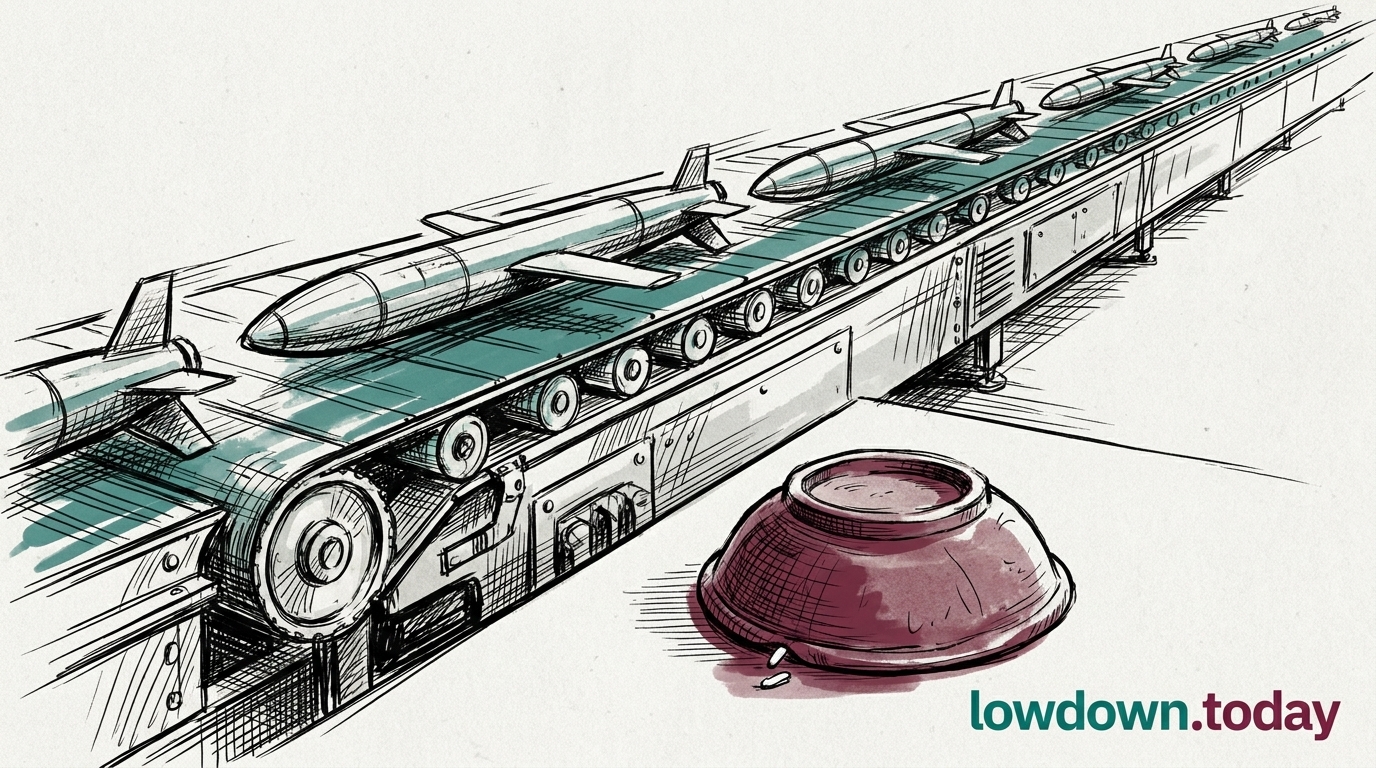
Signed a $22.9bn, seven-year contract with Raytheon on 17 August to raise Tomahawk output from about 60 a year to more than 1,000. The Acting Navy Secretary, quoted via an X post, framed it as the "Arsenal of Freedom" initiative; it replaces the 850 missiles fired by 1 April in about ten months at the new rate.
UK Maritime Trade Operations
UKMTO logged six armed men boarding a tanker 136 nautical miles east of Al Mukalla on 20 August and redirecting it toward Somalia. A vessel steered toward the Somali coast reads as an attempted seizure, a distinct hazard from the stand-off strikes the same lane has seen before.