Skip to content
You can now search across every topic, entity and event.What's new
Iran Conflict 2026
20AUG

Day 174: Seven balance sheets price the strait

2 min read
16:36UTC

Seven companies filed accounts with the SEC on 19 and 20 August and each put its own number on the Gulf conflict, from a 60% jump in BHP's gasoil benchmark to 30 million tonnes of missing Qatari LNG loadings. Most of them measured themselves, not the strait, and named the strait as the cause. Meanwhile Gulf port administrators, Swiss regulators and DP World are all building for a disruption they expect to outlast the quarter.

Key takeaway

Seven SEC filings turned Hormuz's cost from a shipping estimate into an audited-style accounting record this week.

This briefing mapped
Economic
Diplomatic
Regulatory
Infrastructure
Military

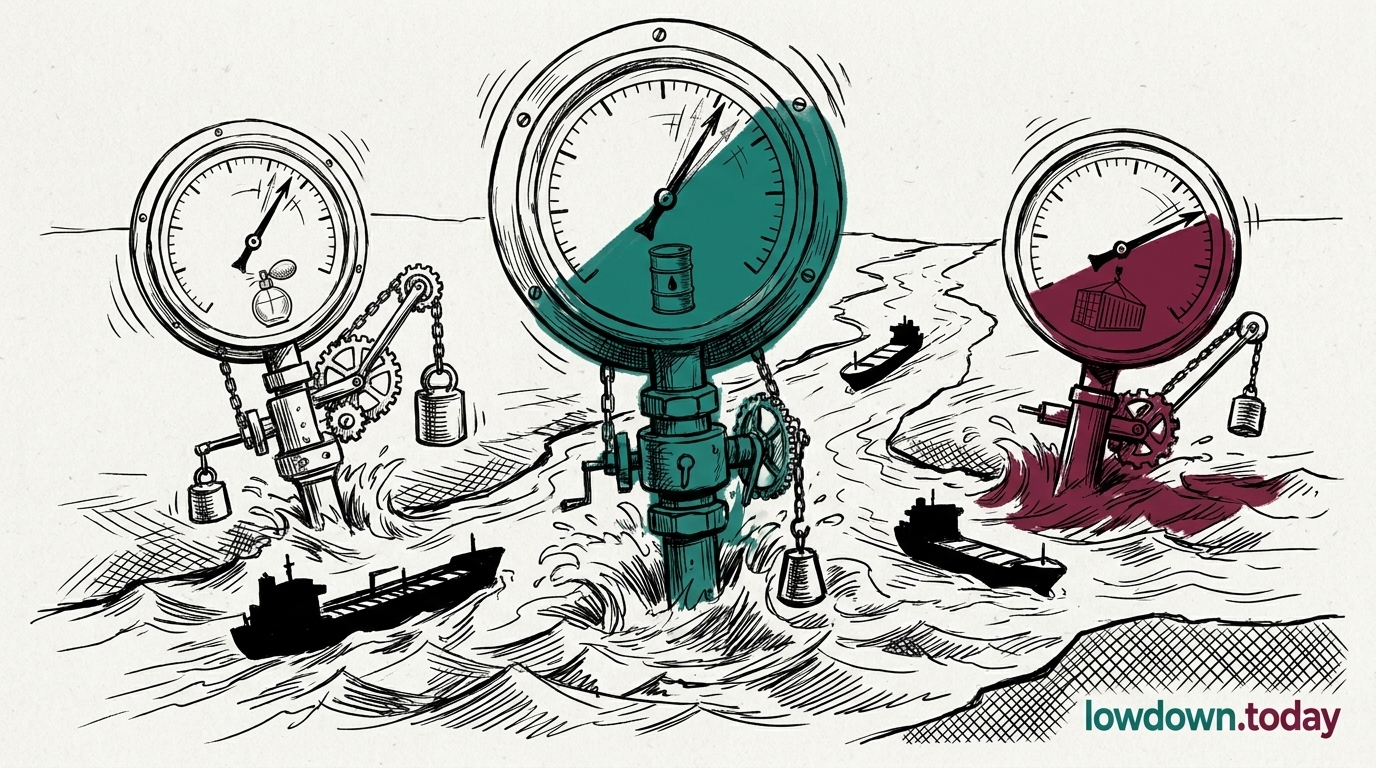
BHP told the SEC that Hormuz disruption drove a 60% jump in its diesel benchmark. Six more companies filed the same week, each naming the same water.

Sources profile:This story draws on neutral-leaning sources

Seven companies, from mining giant BHP to Estée Lauder, told US regulators this week how Hormuz disruption hit their books: a 60% gasoil cost jump, a $529 Iran licence payment, a $9.6m derivatives gain.

These are unaudited management estimates, not one clean measurement. But together they show the wars cost spreading from tankers into diesel, cosmetics and gas, far beyond the strait itself. 

Iraq's parliament speaker asked his Iranian counterpart in Baghdad on 19 August for special treatment for Iraqi oil going through Hormuz. The request concedes what the region has spent months disputing.

Sources profile:This story draws on neutral-leaning sources

Iraqi Parliament Speaker Haibat al-Halbousi asked his Iranian counterpart Mohammad Bagher Ghalibaf, during Ghalibaf's Baghdad visit on 19 August, for special consideration for Iraqi oil exports through the strait of Hormuz.

Iran exempted Iraq from Hormuz restrictions once before, on 5 April. A repeat request suggests that earlier exemption never became a standing arrangement. 

Sources:Anadolu

GCC port administrators met in Riyadh on 19 August and put possible vessel-transit restrictions on a standing committee agenda, alongside satellite-navigation contingencies that take years to procure.

Sources profile:This story draws on neutral-leaning sources

GCC port and maritime officials met in Riyadh on 19 August for their 39th regular committee session and reviewed contingency measures for possible vessel restrictions through Hormuz and Bab el-Mandeb.

It is a standing body's 39th session, not an emergency meeting, but a restriction contingency on its regular agenda shows officials expect elevated Gulf risk to outlast this week. 

DP World is accelerating Fujairah facilities designed to bypass Hormuz, with cargo rerouted through Khor Fakkan, Oman and a Jeddah land bridge. Port concrete has a longer life than a crisis.

Sources profile:This story draws on neutral-leaning sources from United Kingdom
United Kingdom

Badr bin Hamad Al Busaidi and Motegi Toshimitsu stood at a Muscat lectern on 20 August and asked for coordinated action on navigation. Tokyo chose the mediator's capital to ask it in.

Sources profile:This story draws on neutral-leaning sources

Oman's Badr Al Busaidi and Japan's Motegi Toshimitsu called on 20 August, at a joint Muscat press conference, for more international coordination to secure Hormuz and Bab el-Mandeb navigation.

Japan has no warships in the Gulf and no Article 9 route to send any, so this coordination call is diplomatic pressure, not a military commitment. 

Switzerland's economics ministry reissued the notification and authorisation forms for lawful Iran transfers on 19 August. From 26 August the old ones will not be accepted.

Sources profile:This story draws on neutral-leaning sources

Switzerland's Federal Department of Economic Affairs, Education and Research updated its Article 21 forms for Iran money transfers on 19 August. Only the new forms work from 26 August.

Bern's own notice says this is not a new sanction or threshold change, just an administrative reset of the paperwork Iran-linked transfers must clear through Switzerland's neutral compliance channel. 

UKMTO reported that six armed men boarded a tanker 136 nautical miles east of Al Mukalla on 20 August and turned it toward the Somali coast.

Sources profile:This story draws on neutral-leaning sources

Six armed people boarded a tanker 136 nautical miles east of Al Mukalla on 20 August and redirected it toward Somalia, UKMTO reported, without naming the vessel, flag, operator or hijackers.

UKMTO's own account gives no attacker. The pattern, boarding and redirection rather than a missile or drone strike, looks more like piracy than the war's usual projectile attacks. 

Two unnamed US officials told Axios on 19 August that the American military is running a Hormuz oil corridor moving about 10 million barrels a day. The figure rests on their word.

Sources profile:This story draws on centre-left-leaning sources from United States
United States

Two unnamed US officials told Axios on 19 August that the US military had set up a corridor moving about 10 million barrels of oil a day through Hormuz after a two-week campaign against Iranian radar.

Kpler counted only six commodity vessels crossing on the Tuesday named in the report, a figure that cannot confirm or contradict the barrels claim, since the two counts use different, unreconciled units. 

Sources:Axios
Closing comments

Sideways. Every institutional move logged this week, the GCC's procurement cycle, DP World's capital spend, Bern's form cutover taking effect 26 August 2026, treats the strait as durably constrained rather than a crisis to resolve, which lowers the political cost of prolonging it for Tehran. The mechanism that would tip this up is confirmation that the Mukalla boarding was a hijacking for ransom rather than a one-off incident, adding a seizure risk to the Gulf of Aden run. The mechanism that would tip it down is Iran releasing the Iraqi-held reserves it is pressing Baghdad over, which would remove one of the two currency levers Tehran is working at once and reduce its incentive to hold the strait open only conditionally.

Different Perspectives
The seven SEC filers
BHP, Coty, AIR Global, Flex LNG, Golar LNG, Estée Lauder and ASP Isotopes each quantified a Hormuz-linked cost or gain in filings dated 19 and 20 August. The attribution is management's own account, carrying legal consequence under securities law that a shipping tracker's estimate does not.
GCC Ports and Maritime Administrations Committee
Officials met in Riyadh on 19 August for the committee's 39th session and examined transit-restriction measures for Hormuz and Bab el-Mandeb. The committee is now budgeting procurement cycles against a disruption still officially described as temporary.
Badr bin Hamad Al Busaidi
Oman's foreign minister joined Japan's in Muscat on 20 August to call for intensified coordination on Hormuz and Bab el-Mandeb navigation. Oman also runs the mediation track with Tehran, so the appeal travels through the same channel as the negotiation.
Motegi Toshimitsu
Motegi Toshimitsu
Japan's foreign minister said in Muscat on 20 August that Tokyo wants closer coordination with Oman on safe Hormuz and Bab el-Mandeb passage. Japan has no naval presence of its own in the strait, so it is routing the ask through the state negotiating with Iran instead.
Federal Department of Economic Affairs, Education and Research
Switzerland's economics ministry updated the Article 21 forms governing lawful Iran money transfers on 19 August, with only the revised forms accepted from 26 August. Bern operates one of the few remaining legal Iran payment channels and has just set a hard cutover on its control point.
Mohammad Bagher Ghalibaf
Iran's Majlis speaker received Iraq's Hormuz carve-out request in Baghdad on 19 August, a request that treats passage as Tehran's to grant. Ghalibaf's authority over that grant sits alongside the Revolutionary Guard's separate transit rules, which have moved independently of Iran's foreign ministry before.

