Skip to content
You can now search across every topic, entity and event.What's new
Iran Conflict 2026
31JUL

US sanctions the strait it will reopen

5 min read
09:24UTC

On 28 May the US Treasury sanctioned Iran's Persian Gulf Strait Authority hours after negotiators reached a 60-day memorandum promising a toll-free Hormuz. The signed order took effect; the deal sat unsigned.

ConflictDeveloping
Key takeaway

OFAC sanctioned the toll body the MOU promises to dissolve, blocking the deal's own reopening on day one.

On Thursday 28 May, the US Treasury's Office of Foreign Assets Control (OFAC, the bureau that runs American sanctions and keeps the Specially Designated Nationals list) put Iran's Persian Gulf Strait Authority (PGSA, the toll body Tehran stood up on 5 May) on that list under Executive Order 13224, the post-9/11 counterterrorism authority 1. The same day, US and Iranian negotiators reached a tentative 60-day memorandum of understanding (MOU, a non-binding statement of agreed terms) that would reopen the Strait of Hormuz, the chokepoint for roughly 20% of the world's oil, to shipping "unrestricted, no tolls, no harassment" 2. The PGSA is the body that levied tolls of up to $2 million per transit and whose Hormuz controlled-zone coordinates Iran published on 20 May .

OFAC's designation took legal effect the moment Treasury published it on 28 May, while the MOU carried no legal force at all: President Donald Trump received the final-deal briefing and declined to sign, asking for "a few days to think about it" 3, while Vice-President JD Vance called the talks "still TBD" on "a couple of language points" 4. Iran's Tasnim news agency called any Western claim of finalisation "not valid" 5, and Mojtaba Khamenei, Iran's Supreme Leader, has not approved the text 6. The MOU itself reflected the Phase 2 sequencing Iran's state broadcaster aired on 27 May, deferring the disposal of its Highly Enriched Uranium (HEU, material refined close to weapons grade) to the first 60-day negotiation . Trump had narrowed that path a day earlier when he rejected both Russia and China as custodians for Iran's stockpile and told negotiators not to rush .

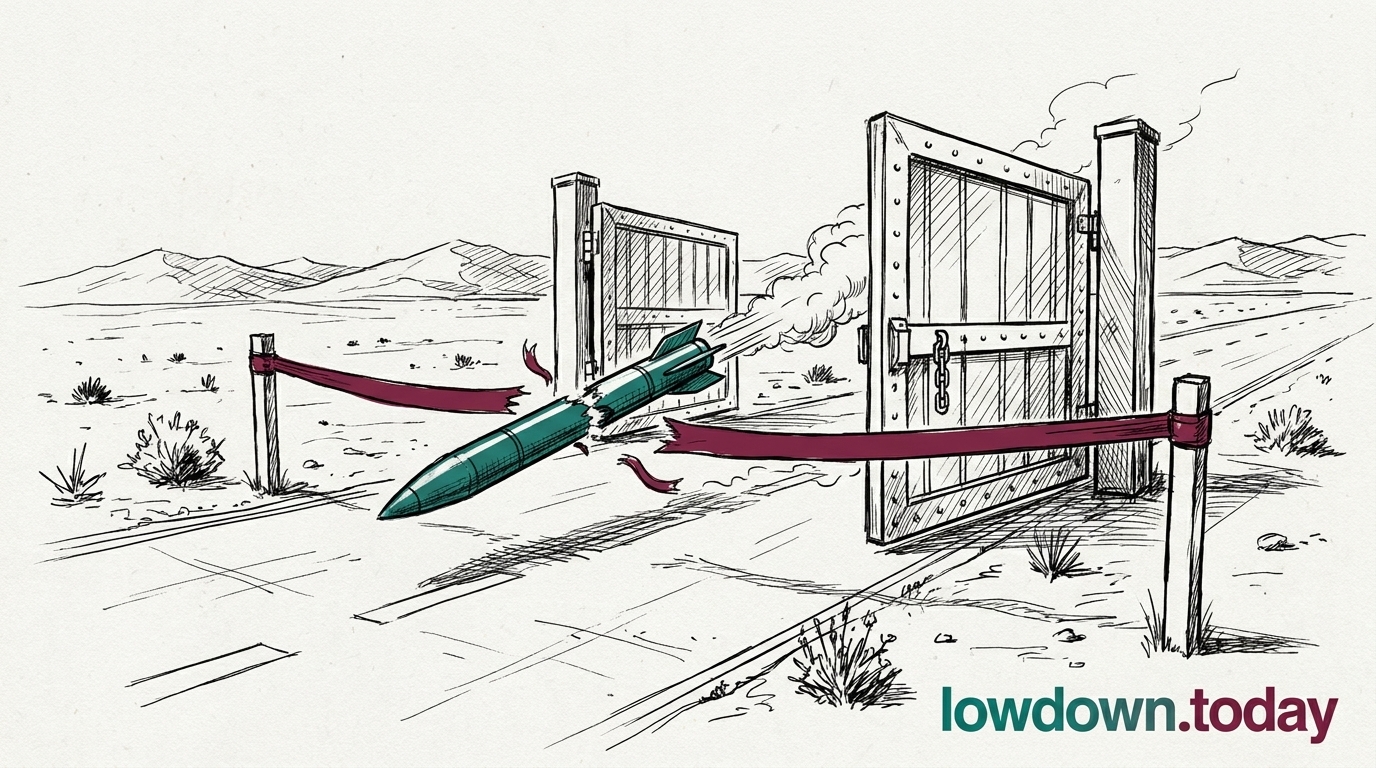
OFAC's order and the MOU collide on one mechanism. The reported MOU promises toll-free passage, yet the PGSA would still coordinate that passage, and the deal text as described carries no clause de-listing it. Any vessel using a reopened strait under PGSA coordination would be transacting with a sanctioned counterparty, so the foreign banks that finance the charter risk secondary sanctions 7. Treasury Secretary Scott Bessent framed the designation as a strike at extortion: "The Iranian military's latest attempt to extort global maritime trade is proof that Economic Fury has left the regime desperate for cash" 8. EO 13224 designations unwind slowly and case by case; the MOU sets a 30-day clock for Iran to clear sea mines but no parallel clock to lift the sanction, so the commercial and legal timelines are mismatched from signature.

The designation may be pre-signature leverage rather than contradiction, maximum pressure held until the ink dries. Either way, unless OFAC de-lists the PGSA or issues a carve-out general licence, the reopened-Hormuz terms are unworkable from the first vessel, with the 1 June War Powers Resolution wind-down due to lapse uncontested days later as the House stays in recess until 2 June .


Deep Analysis

In plain English

On 28 May, US and Iranian negotiators agreed in principle that the Strait of Hormuz, the narrow sea passage through which roughly a fifth of the world's oil flows, could reopen to ships without paying Iran's recently imposed transit tolls. The same day, a separate US government office called OFAC (the Office of Foreign Assets Control, which administers America's financial sanctions) added the Iranian body that collects those tolls, the Persian Gulf Strait Authority, to a terrorism blacklist. That designation means any bank or insurer that handles money connected to that body risks losing access to the US financial system. OFAC's blacklisting means that even if the strait physically reopens, no shipping company's bank will process the payment, and no insurer will cover the voyage, as long as the toll-collecting body sits on the terrorism list. Neither side can fix this quickly. The US President would have to formally remove the terrorism designation, which is a separate, higher-level process than ordinary sanctions relief. Iran's parliament would also have to repeal the law that created the toll body. Both are major political acts that neither government has taken.

Deep Analysis
Root Causes

OFAC's 28 May PGSA designation under EO 13224 reflects a structural feature of the US sanctions architecture: counterterrorism authority designations are maintained by the Treasury's Office of Terrorism and Financial Intelligence (TFI), a separate bureaucratic chain from the Iran-sanctions desk.

A diplomatic track managed by the State Department and the White House NSC cannot instruct TFI to suspend an EO 13224 designation. Only the President can act, and only through a formal revocation or a specific presidential waiver, both of which require documented national-security justification.

The PGSA was established under Iranian domestic legislation passed by the Majlis on 5 May, making it a statutory body whose continued operation is now a matter of Iranian constitutional law, not merely IRGC policy. Tehran cannot dismantle it by executive instruction without a Majlis repeal.

This creates a symmetric lock: the US cannot waive the designation without formal presidential action, and Iran cannot shut the PGSA without parliamentary action, so neither side can unilaterally resolve the contradiction the 28 May events created.

The Lloyd's Joint War Committee's decision to hold its Hormuz war-risk designation unchanged despite the MOU news compounds the commercial lock: hull war-risk cover requires both a political de-escalation signal and a written regulatory framework before the Committee will consider de-listing. The simultaneous PGSA SDN designation removed the second condition on the day it appeared to be within reach.

Escalation

The 28 May legal contradiction pushes the diplomatic track toward stalemate rather than resolution. Trump's refusal to sign and Khamenei's non-approval mean the MOU exists only as a reported structure, not a document. The PGSA designation gives hardliners in both capitals a concrete institutional obstacle to hold up as proof the other side is not serious.

The most likely near-term trajectory is that MOU talks continue in parallel with the designation remaining live, producing a legal stalemate that prevents commercial reopening even if both governments announce agreement.

What could happen next?
  • Consequence

    Commercial shipping insurers cannot resume Hormuz cover while PGSA remains on the SDN list under EO 13224, regardless of MOU status, because dollar-clearing banks have no published safe harbour.

    Immediate · Assessed
  • Risk

    If Trump signs the MOU without first removing the PGSA designation, the agreement will be commercially inoperative, and both sides will be able to blame the other for the breakdown without either having formally walked away.

    Short term · Assessed
  • Precedent

    The simultaneous MOU-and-designation move on 28 May mirrors the January 2020 playbook, when EO 13224 designations outlasted a concurrent diplomatic opening by 14 months; that precedent suggests the PGSA designation will persist well past any notional MOU signing.

    Medium term · Assessed
  • Meaning

    The War Powers Resolution 60-day wind-down expiry on 1 June (ID:3655) means Congress loses its procedural lever on the same week the MOU talks may collapse over the PGSA designation, removing the one domestic check that might have pressured the White House toward a coherent legal framework.

    Short term · Assessed
First Reported In

Update #111 · US sanctions the strait its deal reopens

Axios· 29 May 2026
Read original
Causes and effects
This Event
US sanctions the strait it will reopen
A signed sanctions instrument outranks an unsigned peace memo, and the two land on the same Hormuz mechanism on the same day.
Different Perspectives
Shipping and insurance underwriters
Underwriters can price Houthi strikes because the group announces its targets, but an unclaimed drone at Damietta and a mandatory Iranian insurance scheme both deny them a pattern to price against. War-risk premiums are increasingly being set by the absence of a claimant, not the scale of the damage.
Jordan
Jordan
Azraq absorbed its fourth Iranian strike in seven weeks, again drawing no direct Jordanian retaliation, only an American one. Amman's exposure, hosting US basing without the Patriot density of Gulf allies, has not changed even as the war around it widens.
Houthi movement
Houthi movement
The Houthis' 20 July blockade of Saudi-linked shipping is the injury Riyadh's new 43-nation coalition directly answers, yet the group itself was never asked to join and remains outside every proposal on the table. Sanaa-aligned commentators call the coalition a paper reassurance for insurers rather than a deployable force.
Egypt's Cabinet
Egypt's Cabinet
Egypt confirmed the Damietta blaze was an attack, not an accident, on soil the war had never touched before. Cairo now faces an unclaimed threat to a facility supplying roughly 7% of its domestic gas, with no author to hold accountable and no pattern yet to defend against.
Oman
Oman
Muscat is running the only channel Iran will use, a voluntary Hormuz fee modelled on Malacca, but stayed out of Saudi Arabia's new naval coalition entirely. Oman's mediating leverage depends on treating Hormuz as shared and non-exclusive, the opposite of what Tehran is now demanding of it.
Iraq's Prime Minister
Al-Zaidi cancelled his first official Riyadh visit and convened the Coordination Framework, the coalition that keeps him in power and whose factions sit inside the PMF that Saudi jets just struck. He is caught between a five-year Saudi investment relationship and armed groups inside his own state he does not fully control.



