Skip to content
Briefings are running a touch slower this week while we rebuild the foundations.See roadmap
Iran Conflict 2026
6MAY

Iran names a Hormuz toll authority

4 min read
10:13UTC

Iran created the Persian Gulf Strait Authority on 5 May, requiring vessels to register, document and pay a transit toll before clearance; MARAD's advisory 2026-004 acknowledged the new regime in writing.

ConflictDeveloping
Key takeaway

Pay the toll, breach OFAC; refuse the toll, face Iranian fire. Third-flag vessels have no lawful route.

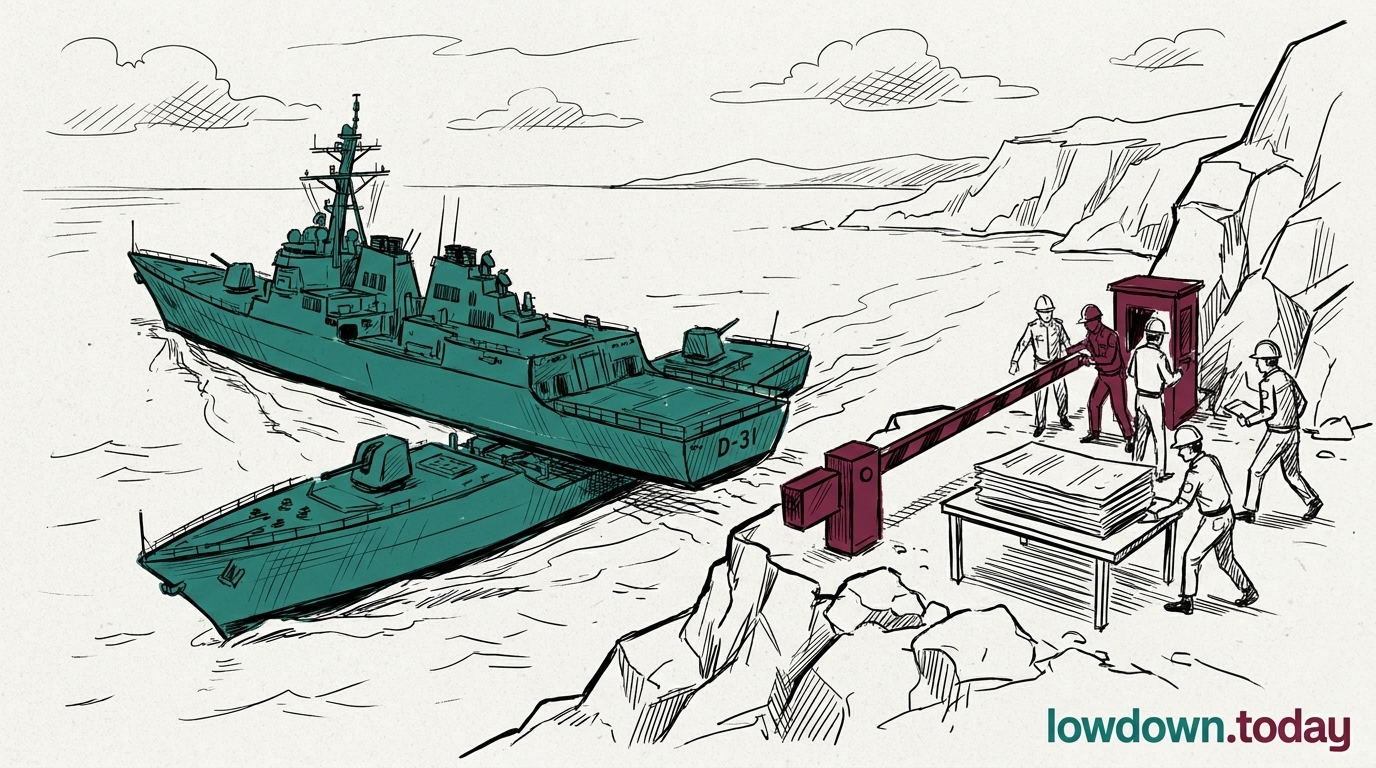
Iran created the Persian Gulf Strait Authority on Tuesday 5 May, a named state body that requires vessels to register, complete documentation and pay a transit toll before receiving clearance to enter a designated corridor through the strait 1. Deviation from the corridor, the authority states, triggers military intervention. MARAD (the US Maritime Administration) issued advisory 2026-004 acknowledging the new authority alongside the pre-existing 2026-001 advisory on Iranian seizures 2. The advisory is the first written US-government recognition that Iran has produced an institution Washington's own posture cannot reconcile with.

Iran named the new body the 'Persian Gulf Strait Authority', not the 'Strait of Hormuz Authority', refusing the international-waterway designation that UNCLOS (United Nations Convention on the Law of the Sea) Article 38 attaches to the strait. Article 38 guarantees transit passage 'without prior authorisation' for ships of all flags. The new authority requires exactly that: a registered email contact, formal documentation, a paid toll, and adherence to a designated corridor before clearance is granted. The institutional architecture rests on the Majlis 12-article sovereignty law and Mojtaba Khamenei's 'new management' written claim .

The legal squeeze runs in both directions. OFAC's General Licence W, issued 1 May , , names the Iranian Red Crescent, Bonyad Mostazafan and Iranian embassy accounts as toll-payment channels that trigger US sanctions exposure. A non-US-flagged tanker that pays the new Iranian toll to clear the corridor exposes itself to OFAC secondary sanctions; a tanker that refuses to pay risks Iranian military intervention. There is no lawful path for a third-flag vessel to comply with both regimes at once. The Northwood mission template, drafted by British and French officers on 22-23 April under UNCLOS transit-passage doctrine, was designed for a permissive strait; it now confronts a counter-instrument with the force of Iranian domestic law and no written US answer to the toll-payment bind.

Deep Analysis

In plain English

On 5 May, Iran created a new government body called the Persian Gulf Strait Authority. Any ship that wants to sail through the Strait of Hormuz must now contact this authority, fill in paperwork, and pay a fee. If a ship enters the strait without permission, Iran says its military will intervene. The problem is that international law, specifically a treaty signed by 170 countries, says ships have the right to sail through international straits without asking anyone's permission. Iran never signed that treaty. The US government acknowledged the new authority in a written maritime warning, which is the first time Washington has formally recognised in writing that Iran has created an institution to control the strait.

Deep Analysis
Root Causes

UNCLOS lacks an enforcement mechanism for transit-passage violations. The International Tribunal for the Law of the Sea can adjudicate disputes, but Iran's non-ratification of UNCLOS means it has no compulsory jurisdiction over Tehran. Iran can violate Article 38's transit-passage guarantee without triggering any automatic legal consequence.

OFAC General License W creates a second structural trap for non-US-flagged vessels: complying with the PGSA by paying the toll violates US sanctions, because PGSA toll payments flow through Bonyad Mostazafan, a designated entity. Refusing to pay the toll exposes the vessel to IRGC interdiction. No lawful path exists for a non-US vessel to satisfy both frameworks simultaneously.

What could happen next?
  • Precedent

    The PGSA's codification of a toll-and-permit regime for an international strait sets a precedent other states (China over Taiwan Strait, Russia over Northern Sea Route) could cite to advance their own sovereign-access claims.

  • Consequence

    Any ceasefire agreement must now explicitly dissolve a named Iranian regulatory body; dissolving the PGSA requires Iranian parliamentary action, raising the domestic political cost of any deal.

First Reported In

Update #89 · Truxtun gets through; Trump pulls back

Maritime Executive· 6 May 2026
Read original
Different Perspectives
Israel
Israel
Israeli strikes on Hezbollah positions in Lebanon continued through the weekend, maintaining the secondary front. The IDF has publicly named Mojtaba Khamenei as an assassination target; his courier-governance mode complicates targeting but does not remove him from the order.
Russia
Russia
Putin told a Moscow press conference that Washington, not Tehran or Moscow, killed the Russia-custody uranium arrangement by demanding US-territory-only storage. Neither Tehran nor Washington has corroborated the account, which appeared in second-tier outlets only, consistent with a trial balloon rather than a formal position.
United Kingdom
United Kingdom
HMS Dragon was redeployed from the Eastern Mediterranean to the Middle East on 9 May, the first physical European platform commitment to the Gulf. The Ministry of Defence called it "prudent planning" while publishing no rules of engagement, no tasking order, and no vessel name, committing a named asset to a conflict zone before the political instrument authorising it exists.
United Arab Emirates
UAE air defences intercepted two Iranian drones over its territory on 10 May, a kinetic escalation six days after the Fujairah oil terminal strike that drew no formal protest. The three-state simultaneous operation, not the severity of individual strikes, appears to have crossed the threshold at which the GCC states collectively began responding.
Saudi Arabia
Saudi Arabia
Riyadh issued the first formal Gulf-state protest of the conflict on 10 May, demanding an "immediate halt to blatant attacks on territories and territorial waters of Gulf states", ending 10 weeks of channelling displeasure through OPEC+ quota discussions. The protest forecloses Saudi Arabia's preferred quiet-channel role and reduces the functioning back-channel architecture to Pakistan alone.
Qatar
Qatar
Doha is simultaneously a strike target, the site of the Safesea Neha attack 23 nautical miles offshore, and an active MOU mediator: Qatar's prime minister met Rubio and Vance in Washington the same weekend. Whether Qatar issues its own formal protest or maintains its dual role is the critical escalation indicator for the week of 11 May.