Skip to content
Briefings are running a touch slower this week while we rebuild the foundations.See roadmap
Iran Conflict 2026
30MAY

Day 92: Treasury opens a second Iran sanctions front

2 min read
10:17UTC

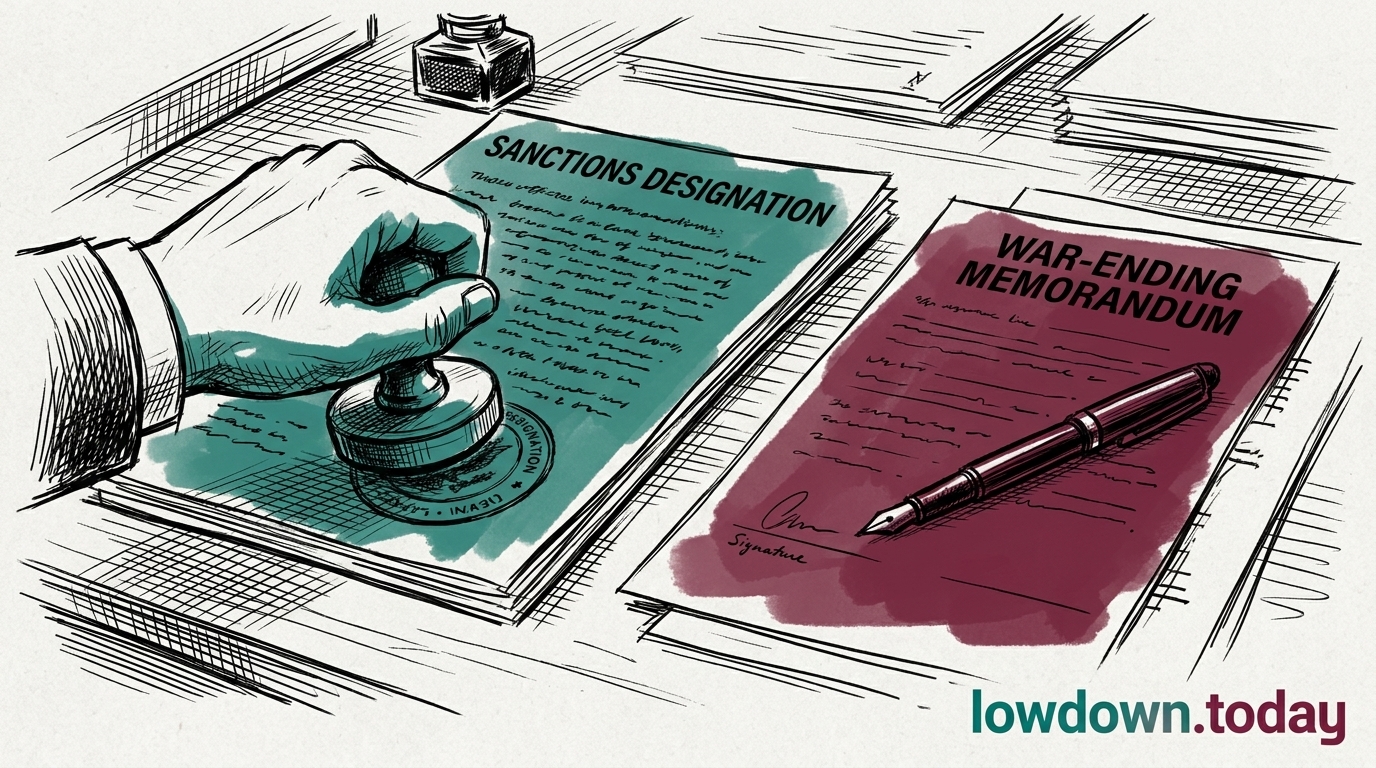
Washington signed an enforcement campaign against an Iranian defence-procurement ring that defrauded US firms, even as the war-ending deal stayed unsigned. Treasury then threatened to sanction Oman, its Iran backchannel since 1981. Kuwait invoked Article 51 after an Iranian strike. Iran and the US published incompatible versions of the same draft accord.

Key takeaway

Both sides sign coercion this week and defer the deal, in opposite directions.

This briefing mapped
Loading map…
Legal
Diplomatic
Military
Humanitarian
Domestic

OFAC designated eight people and five companies on 29 May for impersonating US firms to smuggle bug-detecting hardware to Iran's military, the same week Trump withheld his signature from the war-ending deal.

Sources profile:This story draws on neutral-leaning sources

The US Treasury sanctioned eight people and five firms on 29 May over a scheme that faked US business identities. It tricked American tech vendors into shipping counter-surveillance gear to Iran's defence ministry. Two Dubai fronts moved the goods.

This is the third Iran sanctions track Treasury has opened in two weeks. A $15 million bounty on Revolutionary Guard financial networks runs alongside it. 

Scott Bessent warned Oman on 28 May the US would target any actor facilitating Hormuz tolls, and Muscat backed down within the day, leaving Pakistan as the sole active mediator.

Sources profile:This story draws on mixed-leaning sources from Qatar and United States
QatarUnited States

Kuwait invokes Article 51 after strike

Kuwait made the first formal self-defence claim by a Gulf state in the war after Iran struck Ali Al Salem Air Base on 28 May; CENTCOM struck back near Bandar Abbas and denied a fresh Iranian downing claim.

Sources profile:This story draws on neutral-leaning sources from United States
United States
LeftRight

Iran's security council framed the unsigned memorandum as a 10-point Iranian victory including enrichment rights, while the US text demands Iran surrender its enriched uranium first.

Sources profile:This story draws on mixed-leaning sources from United States and France
United StatesFrance
LeftRight

IRGC forces shot dead Kurdish activist brothers Meysam and Mojtaba Veisi near Dalahu on 28 May, and Faezeh Afshari, aged 30, at Semirom the same day, killings that leave no court record.

Sources profile:This story draws on neutral-leaning sources from Iran
Iran

Revolutionary Guard forces shot dead Kurdish brothers Meysam and Mojtaba Veisi near Dalahu and activist Faezeh Afshari, 30, at Semirom on 28 May. The monitor Hengaw logged the deaths as field killings, not court executions.

Field killings leave no case number, no family notice, and no record monitors can track. That moves the repression off the execution register Amnesty has tallied since February

Sources:Hengaw

Iran's internet reached only 40 per cent of pre-war traffic by 28 May, NetBlocks reported, with Chinese-built hardware for a permanent, switchable blackout already installed.

Sources profile:This story draws on neutral-leaning sources
Sources:TechTimes
Closing comments

Sideways, with an upward tilt. Kuwait's Article 51 invocation on 28 May raises the legal ceiling for allied involvement without yet triggering it; under the 1994 Kuwait-US bilateral defence pact, a second Iranian ballistic-missile strike would land inside a pre-existing self-defence record rather than requiring a fresh legal basis. The IRGC's false aircraft-downing claims, twice denied by CENTCOM within the same week (the MQ-9 claim on 26 May and the Qeshm aircraft claim on 29 May), signal a propaganda tempo that lowers the domestic political cost inside Iran of additional kinetic actions. The 1 June War Powers Resolution wind-down is the nearest hard trigger: it arrives before any House floor vote, and if Congress fails to authorise or restrict the war by that date, the administration's legal exposure under the 1973 WPR hardened and the pressure on Trump to produce a signed Iran instrument increases sharply. The specific mechanism that would tip escalation downward is an OFAC general licence carving the PGSA out of its 28 May SDN designation; none has been issued as of 30 May.

Different Perspectives
US Treasury / Scott Bessent
Bessent designated the PGSA under counterterrorism authority and threatened Oman with sanctions in the same 48-hour window that negotiators reached a tentative Hormuz reopening accord, treating diplomatic leverage and coercive instruments as interchangeable. Both acts are consistent with OFAC's multi-track doctrine: maximum pressure stays in place until paper arrives.
Iran SNSC / Mojtaba Khamenei
The SNSC published a ten-point victory framing of the unsigned MOU on 29 May, naming enrichment as recognised and a US non-aggression guarantee secured; SNSC deputy Ali Bagheri Kani said the HEU stockpile is 'not on the agenda'. The document, issued under the Supreme Leader's implicit authority, cannot be quietly withdrawn without his visible endorsement of a different text.
Oman
Oman
Oman denied any Hormuz toll plan within hours of Bessent's 28 May threat, absorbing a sanctions warning from the country it has brokered for since 1981. The rapid capitulation preserved the channel formally, but Tehran now knows Washington will threaten its own mediator, which changes Muscat's calculus on how far it can lean into any joint-management architecture.
Kuwait
Kuwait
Kuwait invoked Article 51 of the UN Charter after absorbing an Iranian ballistic-missile strike on Ali Al Salem Air Base on 28 May, becoming the first Gulf state to make a formal individual self-defence claim in the war. The invocation creates a legal record enabling a future bilateral defence-pact activation without yet triggering it.
Pakistan
Pakistan
Foreign Minister Ishaq Dar met Rubio in Washington on 29 May, formally inheriting the role of sole active mediator after Oman's forced withdrawal. Pakistan lacks Oman's banking infrastructure for frozen-asset routing and carries its own regional stakes, making it a less structurally neutral broker for the Qatar-held $12 billion sequencing.
China
China
China supplied deep-packet-inspection hardware that caps Iran's internet at 40 per cent and enables an instant on-demand blackout, and was barred by Trump as a potential HEU custodian on 27 May. Beijing gains from Iran's continued non-alignment with the West while the DPI sale extends Chinese surveillance-technology exports as a geopolitical instrument.

