Skip to content
Briefings are running a touch slower this week while we rebuild the foundations.See roadmap
Iran Conflict 2026
30MAY

US hits Iran defence procurement ring

4 min read
10:17UTC

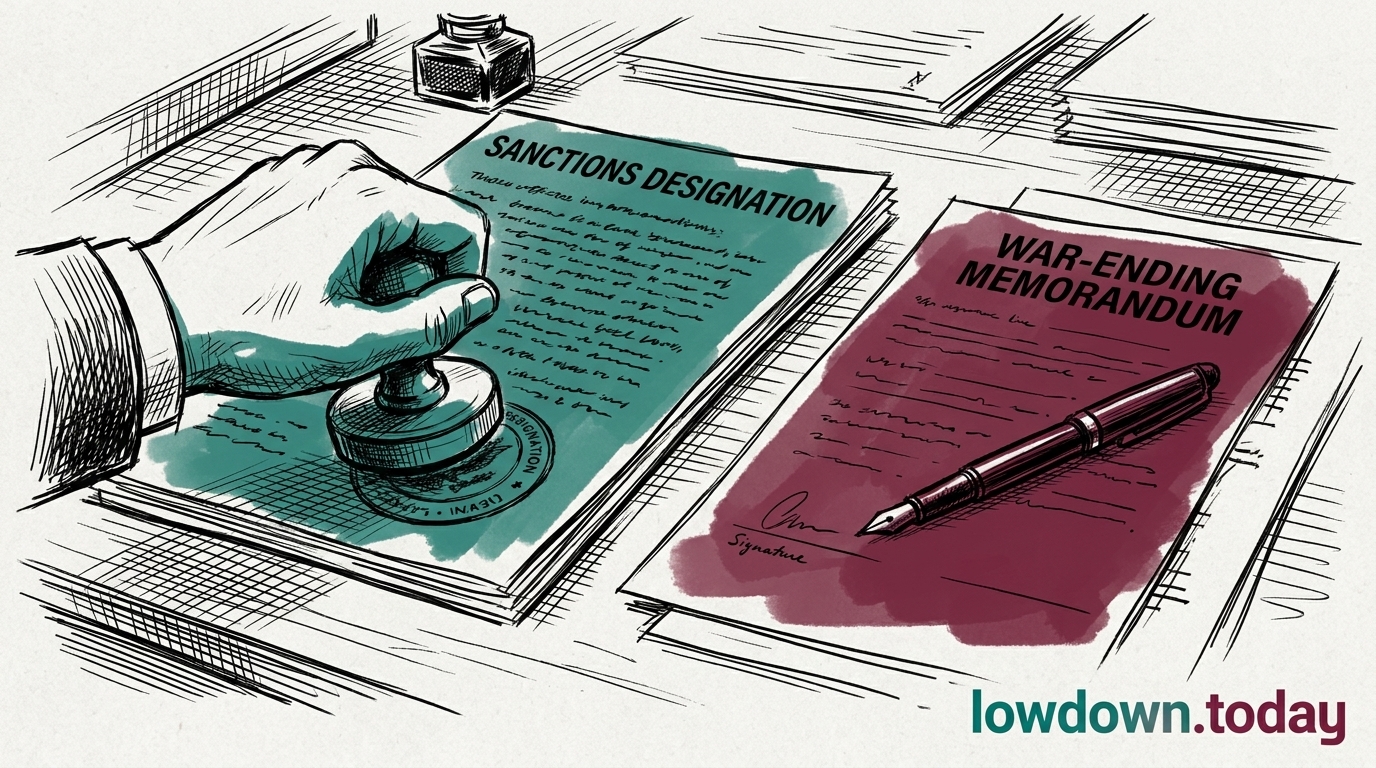
OFAC designated eight people and five companies on 29 May for impersonating US firms to smuggle bug-detecting hardware to Iran's military, the same week Trump withheld his signature from the war-ending deal.

ConflictDeveloping
Key takeaway

Treasury signed coercion against Iran's defence supply chain the same week it withheld the war-ending deal.

OFAC, the US Treasury's Office of Foreign Assets Control, designated eight people and five companies on 29 May for a scheme that impersonated American small businesses to defraud US technology vendors and supply Iran's military. 1 The target was a procurement ring run for SAIRAN, Iran's state-owned military-electronics manufacturer that operates procurement under the SAAFTA trading name, a firm controlled by MODAFL, Iran's Ministry of Defence and Armed Forces Logistics. The goods were spectrum analysers and non-linear junction detectors: the equipment a counter-surveillance unit uses to sweep a room for hidden microphones.

Ali Majd Sepehr set up domains posing as real US companies and tricked dozens of American IT vendors into shipping hardware, then re-routed it through two Dubai fronts, Green Light Computer Co LLC and Al Kawther Neon LLC, into Iran. 2 A Rome-based dual Iranian-Italian national, Saeid Zahedi, ran the money through a US financial account to pay for domain registration. That US account and the vendor fraud move the case from sanctions evasion, an administrative matter, into wire fraud, a federal crime. The FBI Los Angeles field office and the Commerce Department co-ordinated the action, and the State Department posted a $15 million Rewards for Justice bounty on IRGC financial networks. 3

This was OFAC's third distinct Iran track in two weeks. Previous rounds hit the Persian Gulf Strait Authority and more than 50 shipping entities , and the Hengli refinery licence lapsed without guidance . This one reaches the defence-electronics supply chain instead. The non-linear junction detectors named are TSCM-grade tools, the kit a service uses to find listening devices, suggesting MODAFL is hardening internal security after losing senior commanders to strikes inside a single week. A mid-tier procurement designation reads as routine Treasury housekeeping on its own. Paired with Bessent's sanctions threat against Oman the same week, it reads as a maximum-pressure pattern timed to the unsigned memorandum.

Deep Analysis

In plain English

Iran's military wanted specialised scanning equipment that can detect hidden microphones and surveillance bugs. US export law bans selling that equipment to Iran, so a network of people set up fake websites pretending to be American businesses, tricked real US technology companies into shipping the hardware, then rerouted it through Dubai into Iran. America's Treasury Department (OFAC, its sanctions bureau) named eight people and five companies involved in the scheme on 29 May. One of them, Saeid Zahedi, lived in Italy but used a US bank account to pay for the fake domain names, which gives American courts the right to prosecute him under federal wire-fraud law. The FBI's Los Angeles field office is leading the criminal investigation. The US government also offered $15 million to anyone who provides information on IRGC financial networks.

Deep Analysis
Root Causes

MODAFL's requirement for Western-manufactured spectrum analysers and non-linear junction detectors reflects a gap Iran's domestic defence industry cannot close. Spectrum analysers from US vendors (Keysight, Tektronix) operate at sensitivities and frequency ranges that Chinese and Russian equivalents do not match for counter-surveillance applications. SAIRAN's procurement need is therefore structurally locked to Western supply chains, which creates the vulnerability OFAC exploited.

The use of identity impersonation rather than traditional front-company purchase orders reflects a specific adaptation to tightened post-2019 Know Your Customer requirements on US IT vendors.

OFAC's 2019 advisory warned vendors about Iranian end-users; SAIRAN's response was to impersonate the US vendors themselves rather than create new intermediary entities. Saeid Zahedi's Italy-based US-account use is the residual Western financial-system footprint that conventional procurement through UAE fronts alone would have avoided.

What could happen next?
  • Risk

    Federal wire-fraud charges against Saeid Zahedi create extradition exposure for dual nationals with EU residency inside OFAC networks, potentially deterring European-based nodes in future procurement rings.

  • Precedent

    OFAC's simultaneous use of sanctions designation and criminal referral for the same network sets a template for parallel-track enforcement against Iranian procurement rings that US allies may follow.

First Reported In

Update #112 · Treasury opens a second Iran sanctions front

US Department of the Treasury· 30 May 2026
Read original
Different Perspectives
Qatar
Qatar
Qatar holds approximately $12 billion in frozen Iranian assets that Tehran named as the precondition for any Hormuz reopening sequence; with Oman sidelined and no agreed HEU custodian, the asset-routing architecture that any deal requires has no operational channel and no neutral financial intermediary to run it through.
Hengaw and Iranian civilian population
Iranians face an internet capped at 40 per cent by hardware their president cannot dismantle, field killings that leave no court record, and judicial executions running in parallel; Hengaw, based in Norway, is the primary remaining monitor of a repression system the IRGC is deliberately moving beyond auditable records. The real toll is higher than any single monitor's count.
China
China
China supplied deep-packet-inspection hardware that caps Iran's internet at 40 per cent and enables an instant on-demand blackout, and was barred by Trump as a potential HEU custodian on 27 May. Beijing gains from Iran's continued non-alignment with the West while the DPI sale extends Chinese surveillance-technology exports as a geopolitical instrument.
Pakistan
Pakistan
Foreign Minister Ishaq Dar met Rubio in Washington on 29 May, formally inheriting the role of sole active mediator after Oman's forced withdrawal. Pakistan lacks Oman's banking infrastructure for frozen-asset routing and carries its own regional stakes, making it a less structurally neutral broker for the Qatar-held $12 billion sequencing.
Kuwait
Kuwait
Kuwait invoked Article 51 of the UN Charter after absorbing an Iranian ballistic-missile strike on Ali Al Salem Air Base on 28 May, becoming the first Gulf state to make a formal individual self-defence claim in the war. The invocation creates a legal record enabling a future bilateral defence-pact activation without yet triggering it.
Oman
Oman
Oman denied any Hormuz toll plan within hours of Bessent's 28 May threat, absorbing a sanctions warning from the country it has brokered for since 1981. The rapid capitulation preserved the channel formally, but Tehran now knows Washington will threaten its own mediator, which changes Muscat's calculus on how far it can lean into any joint-management architecture.