
Skip to content
Briefings are running a touch slower this week while we rebuild the foundations.See roadmap
Iran Conflict 2026
19MAY

Day 81: Iran signs Hormuz toll; Trump posts a cancelled strike

5 min read
17:44UTC

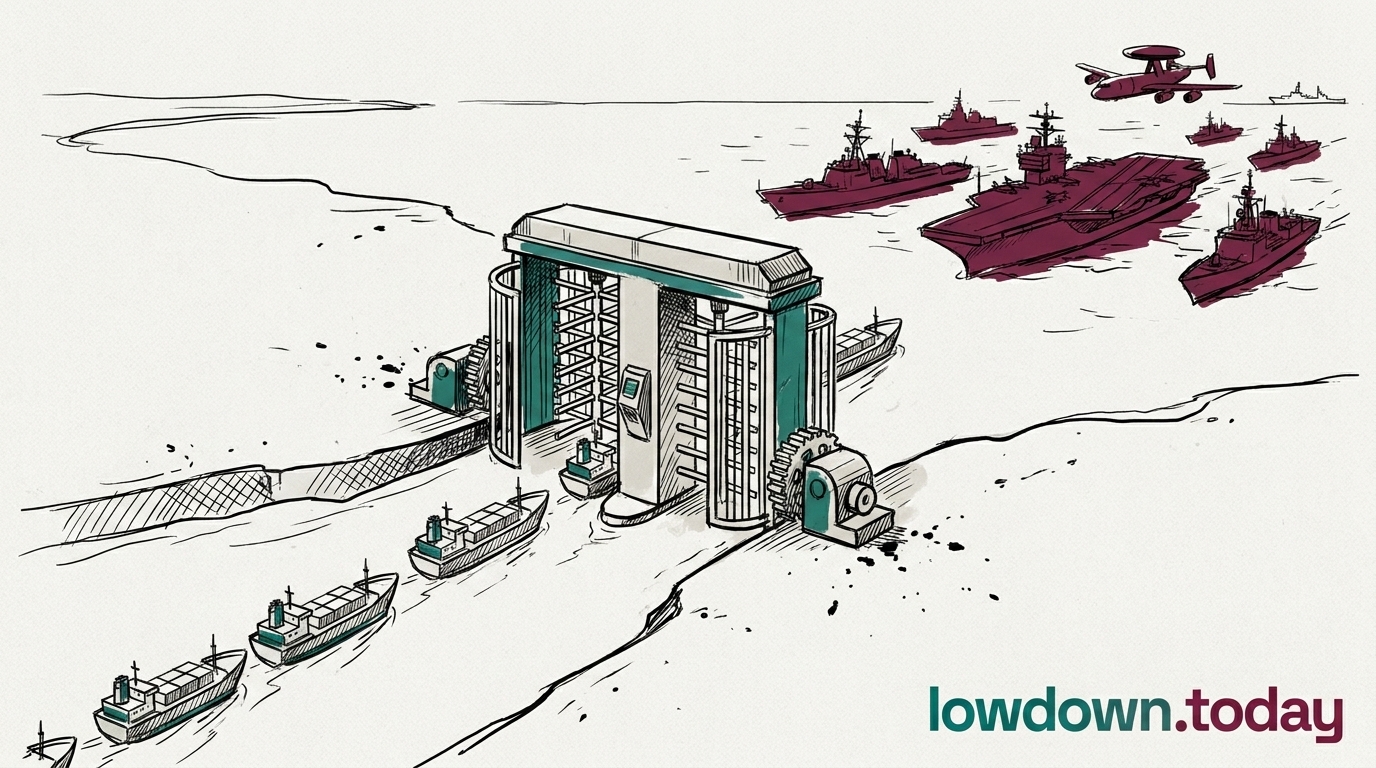
In the 48 hours since Update #101, Iran operationalised its Strait of Hormuz transit authority and named Speaker Ghalibaf its China envoy with rare dual sign-off. The European-led coalition added a Belgian minehunter, two German vessels, an Australian early-warning aircraft and the French carrier Charles de Gaulle. Brent settled $112.10, a conflict high, then slipped to $110.98 as no US-side text appeared.

Key takeaway

Iran is building institutional permanence at Hormuz while the coalition builds hardware without a mandate.

This briefing mapped
Loading map…
Regulatory
Diplomatic
Military
Economic
Legal
Humanitarian

Iran's Persian Gulf Strait Authority launched an official X account and a vessel-submission portal on 18 May, converting the Majlis-backed Hormuz toll from political signalling into an administrative interface ships must engage with.

Sources profile:This story draws on centre-leaning sources from France
France
LeftRight

Iran's Persian Gulf Strait Authority launched a public website and vessel-submission portal on 18 May, turning its Hormuz toll law into a working bureaucracy. Ships can now file ownership documents, cargo details and crew manifests and pay up to $2 million in Chinese yuan for a transit permit.

The portal forces a compliance choice on every shipping company: submit and implicitly accept Iranian jurisdiction, or refuse and absorb unquantified risk a dilemma that persists regardless of whether the ceasefire holds. 

Sources:Euronews

Speaker Mohammad Bagher Ghalibaf was appointed Iran's special representative for China affairs on 18 May with dual sign-off from President Pezeshkian and Supreme Leader Mojtaba Khamenei, the first foreign-policy posting of the war to bridge the civilian-IRGC split.

Sources profile:This story draws on centre-leaning sources from Italy
Italy
LeftRight

Iran appointed parliament speaker Mohammad Bagher Ghalibaf as special envoy to China on 18-19 May, with both President Pezeshkian and Supreme Leader Khamenei signing off. Ghalibaf has IRGC roots and presided over the 221-0 vote that suspended UN nuclear inspections.

The dual civilian-military sign-off is Tehran's answer to a persistent problem: China has been receiving contradictory signals from Iran's divided government. Ghalibaf gives Beijing a single interlocutor with authority across all three power centres. 

Esmaeil Baghaei told his weekly Tehran press conference on 18 May that Iran and Oman were 'in continuous consultations' to design a new bilateral Hormuz transit mechanism, following an expert-level meeting in Muscat the previous week.

Sources profile:This story draws on centre-leaning sources from France
France
LeftRight

Iran's Foreign Ministry confirmed on 18 May that Tehran and Oman are in active talks to build a joint Hormuz transit system, following an expert-level meeting in Muscat the prior week. Oman's waters cover the southern half of the strait's main channel, giving any deal there a legal basis Iran's own permit body lacks.

This is the only Hormuz mechanism the US-led Coalition cannot simply dismiss as a unilateral Iranian claim which is precisely why the consultations matter more than the PGSA's X-account launch. 

Sources:Euronews

Belgium redirected minehunter BNS Primula, Germany committed Fulda and Mosel, Australia committed an E-7A Wedgetail and France committed the carrier Charles de Gaulle to the European Hormuz coalition on 18 May; none of the new assets carries published rules of engagement.

Sources profile:This story draws on centre-right-leaning sources from United States
United States

Belgium, Germany, Australia and France all committed military hardware to the strait of Hormuz Coalition on 18 May. France's contribution is its nuclear-powered aircraft carrier Charles de Gaulle; Germany added a minehunter and supply ship; Australia sent an advanced surveillance aircraft; Belgium rerouted a minehunter from the Baltic.

The Coalition is now carrier-capable and surveillance-equipped but none of the 26 members have published rules of engagement explaining when their commanders can actually act. 

Donald Trump posted on Truth Social on 18 May that he had told Hegseth and Caine to 'hold off' a Tuesday 19 May strike on Iran at the request of the Qatari Emir, the Saudi Crown Prince and the UAE President; no Pentagon read-out, executive order or OFAC general licence has confirmed the strike was scheduled.

Sources profile:This story draws on mixed-leaning sources from France and Iran
FranceIran
LeftRight

Trump posted on Truth Social on 18 May that he had ordered his Defence Secretary and military chief to stand down a planned attack on Iran, crediting the Qatari Emir, Saudi Crown Prince and UAE President with asking him to hold off. No Pentagon statement, executive order, or US government document confirmed the strike was ever scheduled.

This fits the full-conflict pattern: Trump has made dramatic Iran threats and reversals without signing a single executive instrument across 80 days of war. Markets priced the post at face value then reversed it the next morning when nothing official followed. 

Brent crude settled $112.10 on 18 May, the highest conflict-era close, then fell to $110.98 on 19 May as no executive order, OFAC general licence or White House statement followed Tasnim's sanctions-waiver report.

Sources profile:This story draws on neutral-leaning sources

Brent Crude hit $112.10 on 18 May its highest point in the conflict after Trump posted that he had cancelled a planned Iran strike. It fell back to $110.98 the following session when no US executive order or Pentagon statement confirmed the strike had ever been scheduled.

Brent fell $1.12 on 19 May when no executive order, OFAC general licence or Pentagon statement appeared to confirm the strike was ever scheduled. The structural price floor, however, remains well above pre-conflict levels because the International Energy Agency has confirmed more than one billion barrels of cumulative supply loss. 

OFAC's 19 May SDN round designated over a dozen individuals across Gaza, Turkey, Spain, Belgium, Jordan and Iran and over two dozen entities across Hong Kong, the UAE, the Marshall Islands, Panama, Liberia, Nevis, China and the UK, naming vessels BRIGHT GOLD, FEADSHIP, LUNA LUSTER, MIDAS and QUANTUM STAR; zero mainland Chinese refineries were added.

Sources profile:This story draws on centre-left-leaning sources from Israel
Israel

The US Treasury's sanctions bureau designated more than a dozen individuals and two dozen companies on 19 May, targeting ships and shell companies that route Iranian oil. The named vessels include BRIGHT GOLD, MIDAS and QUANTUM STAR. No Chinese oil refinery was named the fourth consecutive round to avoid doing so.

China's MOFCOM law protects five named mainland refineries from complying with Western sanctions. Targeting the middlemen without touching the end-customers means Iranian crude keeps moving, just through marginally more expensive routes. 

Sources:Haaretz

Iran's counter to the US five-point proposal, reported by Haaretz on 18 May, offers domestic uranium dilution and a 10-year moratorium against Washington's 20-year demand, while Bulletin of the Atomic Scientists satellite analysis estimates up to 540 kg of 60%-HEU may already sit at Isfahan, 100 kg above the MOU's surrender figure.

Sources profile:This story draws on mixed-leaning sources from United States
United States

Iran's counter to the US nuclear proposal, reported by Haaretz on 18 May, offers to dilute its near-weapons-grade uranium inside Iran rather than ship it abroad, and proposes a 10-year enrichment freeze against the US demand of 20 years. The same day, the Bulletin of the Atomic Scientists published satellite analysis estimating Iran holds 540 kg of the material at Isfahan 100 kg more than the US deal assumed.

UN inspectors have been locked out of Iran since April, so neither the stockpile figure nor any promised dilution can currently be verified. 

CENTCOM's cumulative vessel redirections at the Strait of Hormuz reached 70, nine more than the 61 logged on 10 May at a rate of roughly 1.5 per day, while Admiral Brad Cooper's 90% mine-stockpile destruction claim remains unrevised and covers warehoused mines rather than in-water clearance.

Sources profile:This story draws on neutral-leaning sources from Iran
Iran

US forces have redirected 70 ships away from the strait of Hormuz since the conflict began nine more than the count eight days ago. Admiral Brad Cooper says 90% of Iran's mine stockpile has been destroyed, but that refers to mines stored on land, not mines already placed in the water.

Clearing in-water mines requires specialised ships, not airstrikes. That is why Italy, Belgium, Germany and France are sending minesweepers. The Coalition is assembling the right hardware, but the job is not done. 

Sources:Hengaw

Hengaw documented on 18-19 May that Iranian authorities have denied the families of secretly executed Kurdish prisoners Naser Bakrzadeh and Mehrab Abdollahzadeh their bodies, and detained Kurdish writer Majid Karimi in Tehran after an intelligence raid on his home.

Sources profile:This story draws on neutral-leaning sources

Iranian authorities denied the bodies of two secretly executed Kurdish prisoners to their families on 18-19 May: Naser Bakrzadeh and Mehrab Abdollahzadeh, both killed on espionage charges. Kurdish writer Majid Karimi was detained in Tehran after an intelligence raid on the same days.

The body-denial practice prevents public funerals that could become protests. The writer-and-lawyer targeting extends a documented wartime pattern that has run continuously through every phase of the military conflict and ceasefire periods. 

IAEA Director-General Rafael Grossi welcomed the UAE's restoration of off-site power to Barakah Nuclear Power Plant Unit 3 on 19 May as an important nuclear-safety step, two days after a drone struck the plant's perimeter generator.

Sources profile:This story draws on centre-left-leaning sources from United States
United States

UN nuclear watchdog chief Rafael Grossi welcomed the UAE's restoration of power to the Barakah nuclear plant's Unit 3 reactor on 19 May, two days after a drone hit a generator on its perimeter. He framed it as a nuclear safety matter, not a weapons-inspection concern keeping those two categories deliberately separate.

The distinction matters: Grossi can address radiation risk without triggering inspection procedures, and doing so keeps the IAEA's relationship with Gulf states intact while the agency remains locked out of Iran

Sources:CBS News

The War Powers Resolution 30-day wind-down expires 1 June, with Pete Hegseth's claim that the ceasefire pauses the 60-day clock having no basis in the 1973 text and Senator Lisa Murkowski's draft Iran AUMF still unfiled behind it.

The War Powers Resolution's 30-day wind-down from the 60-day war deadline expires on 1 June 2026. After that date, US military operations in Iran are running without legal cover under the 1973 statute unless Congress passes an authorisation bill. Defence Secretary Hegseth has claimed the ceasefire pauses the clock, but legal scholars say the law contains no such provision.

Senator Murkowski's draft authorisation bill remains the next institutional option, but the Senate has already failed seven votes to challenge the war. The 1 June cliff is the most significant legal exposure point of the conflict so FAR

Different Perspectives
Iran
Iran
Tehran operationalised the PGSA portal, elevated Ghalibaf to a constitutionally-anchored China brief, and confirmed Muscat consultations on 18 May: three concurrent institutional moves designed to make Hormuz governance durable past any ceasefire. Iran's position is that the strait is closed to adversaries and open to friendly nations under bilateral arrangement, a distinction now backed by four institutions simultaneously.
United States
United States
The administration produced no executive instrument on Iran across 18-19 May: no executive order, no OFAC general licence, no Pentagon read-out confirming a strike or its cancellation. OFAC's 19 May SDN round designated vessels and shells in flag-of-convenience jurisdictions while leaving zero mainland Chinese refineries on the list, extending the pattern across four consecutive rounds.
European coalition (UK, France, Italy, Belgium, Germany)
Four states committed hardware to the Hormuz coalition on 18 May, including the Charles de Gaulle carrier and E-7A Wedgetail surveillance aircraft, giving the 26-nation force an independent carrier-strike envelope without requiring US CENTCOM integration. None of the new platforms carries published rules of engagement; Lloyd's underwriters have informally signalled they will not reopen war-risk cover until written ROE exist.
China
China
Beijing receives Iran's single cross-factional interlocutor with Ghalibaf's appointment, resolving the competing-signals problem that allowed Chinese counterparts to claim uncertainty about which Iranian voice controlled sanctions-evasion logistics. OFAC's fourth consecutive SDN round omitting mainland Chinese refineries sustains the financial architecture that makes the Ghalibaf channel viable for Chinese counterparts.
Gulf Arab states (UAE, Saudi Arabia, Qatar)
Qatar, Saudi Arabia and the UAE are publicly named by Trump as having requested the 19 May strike stand-down, carrying reputational liability if Iran escalates. Oman is simultaneously consulting Tehran on a bilateral Hormuz mechanism that, if signed, would place Muscat closer to Iran's governance architecture, a GCC solidarity test Riyadh and Abu Dhabi have not publicly addressed.
Iraq
Iraq
Iraq is operating under Iran's bilateral state-to-state passage track, having negotiated a VLCC transit without paying yuan tolls, accepting political engagement in lieu. Baghdad protested privately over Israeli covert bases on Iraqi soil revealed the same week, but its Hormuz dependence makes public confrontation with Tehran structurally difficult.
