Skip to content
Briefings are running a touch slower this week while we rebuild the foundations.See roadmap
Iran Conflict 2026
17MAY

Iran hits Doha tanker as Qatar PM meets Rubio

4 min read
10:45UTC

Iran struck a bulk carrier 23 nautical miles north-east of Doha on Sunday 10 May, hours after the first Qatari LNG tanker since 28 February transited the Strait of Hormuz. Qatar's prime minister was sitting in Washington with Marco Rubio at the same hour.

ConflictDeveloping
Key takeaway

Qatar's mediator role between Washington and Tehran cannot survive being the test case for the next sanctions-compliant Gulf hull.

Iran struck a bulk carrier 23 nautical miles north-east of Doha on Sunday 10 May, hours after the first Qatari LNG (liquefied natural gas) tanker since 28 February transited the Strait of Hormuz. Mohammed bin Abdulrahman Al Thani, Qatar's prime minister and foreign minister, was meeting Secretary of State Marco Rubio and Vice President JD Vance in Washington at the same hour to discuss de-escalation 1.

Al Jazeera reported the strike as an "unknown projectile". Jerusalem Post named Iran as the actor and identified the LNG transit as the trigger 2. The vessel name, flag and weapon type have not been confirmed from a primary source; treat the Iran attribution as reported. Al Thani is the linchpin of Washington's back-channel access to Tehran, and the strike landed on a tanker connected to his country while he was in the room with the two officials running the talks. The verbal track that Foreign Ministry spokesperson Esmaeil Baqaei is fronting now sits alongside an operational track that has just hit a Qatari-adjacent hull.

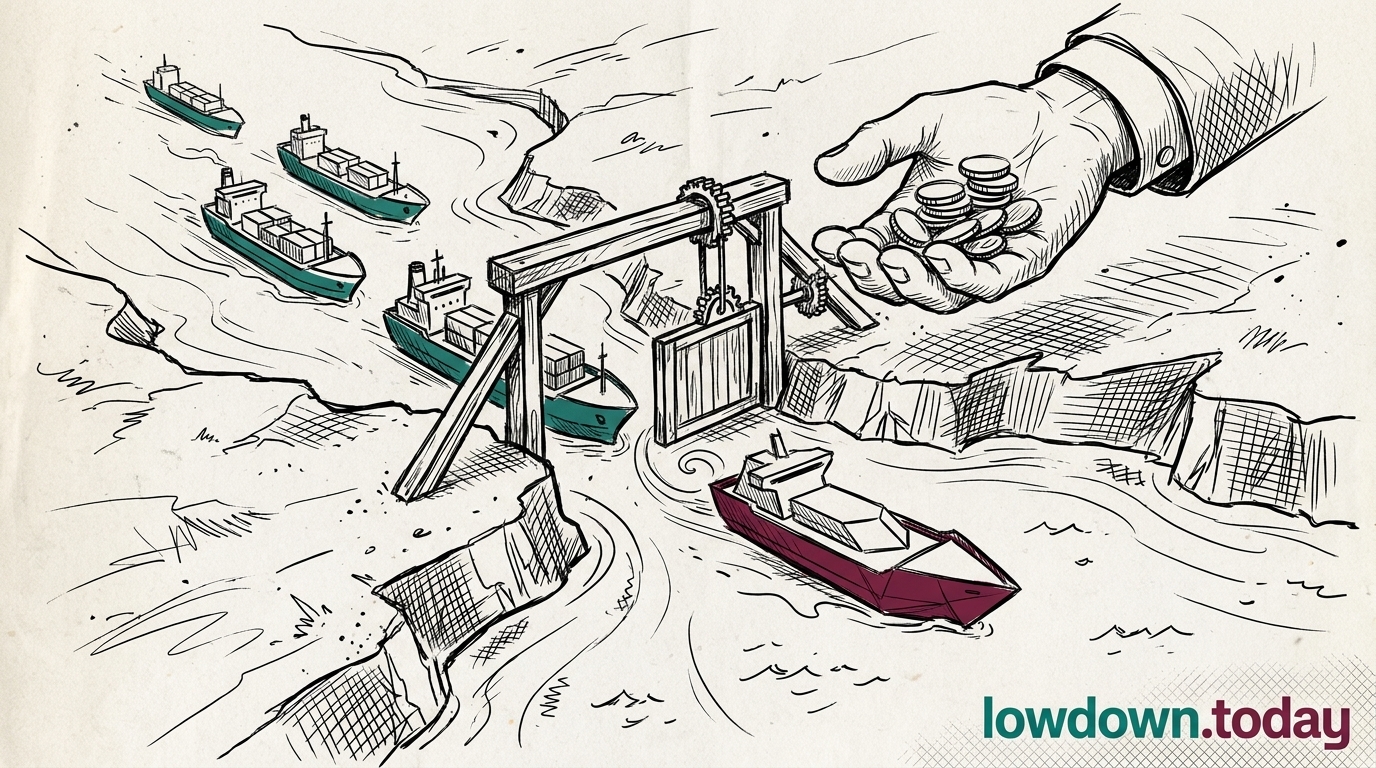
Qatar's LNG transit was the first blockade break since the Persian Gulf Strait Authority (PGSA, the Iranian body collecting roughly £180,000 per crossing) began enforcing tolls in early May . The retaliatory strike establishes the rule that any Gulf state whose tankers test the blockade draws a hit on its shipping. International maritime law treats coercion against a transit state differently from coercion against a flag state; Qatar is neither a US ally in any formal sense nor a sanctions enforcer, which puts Tehran on weaker UNCLOS (United Nations Convention on the Law of the Sea) ground than the broader blockade.

The last sustained period of Gulf shipping attacks ran from 1984 to 1988, when Iran and Iraq hit over 200 vessels and global insurance premiums tripled. Underwriters at Lloyd's and the International Group of P&I Clubs, who together cover most Gulf-flagged hulls, now face the same question the Northwood mission was designed to answer but has not deployed for. Iran had let the US-led MOU reply window lapse on Saturday ; the Doha strike is the operational answer to a verification offer Tehran has stopped pretending to consider.

Deep Analysis

In plain English

Qatar is both America's military landlord in the Gulf and a major supplier of liquefied natural gas to Europe. On 10 May, one of Qatar's LNG ships made the first transit through the Strait of Hormuz since the conflict began in February. Iran responded by striking a bulk carrier near the Qatari capital Doha. At exactly that moment, Qatar's prime minister was in Washington meeting senior US officials to discuss peace talks. Iran's message was clear: any Gulf state that lets its ships break the blockade will pay a price, regardless of how friendly that state appears to be in diplomatic channels.

Deep Analysis
Root Causes

Qatar occupies a structurally contradictory position: it hosts CENTCOM's Al Udeid Air Base with 10,000 US personnel, shares the North Field gas reservoir with Iran across the maritime boundary, and acts as Washington's primary Gulf diplomatic channel. Iran cannot apply military pressure to CENTCOM directly without risking full escalation; striking Qatari shipping applies the same political cost with less exposure.

The Hormuz blockade's enforcement architecture requires Iran to demonstrate consequences for any transit that bypasses PGSA clearance. Without a retaliatory strike after the first Qatari LNG tanker since 28 February tested that architecture, the PGSA toll and permit framework loses the credibility that its $2 million-per-ship fee structure depends on.

What could happen next?
  • Consequence

    Qatar faces a choice between continuing to host US forces and conduct diplomacy on one hand, and protecting its LNG export revenues on the other. Iran has made those two roles mutually incompatible.

    Short term · 0.82
  • Risk

    If Qatar suspends further LNG transits in response, European gas buyers lose their nearest alternative to Russian pipeline gas and face renewed price volatility heading into summer storage-fill season.

    Medium term · 0.74
  • Precedent

    The strike establishes a standing blockade-enforcement rule: any Gulf state whose tankers break the PGSA clearance framework draws a retaliatory hit on its commercial shipping, regardless of diplomatic neutrality.

    Immediate · 0.88
First Reported In

Update #93 · Tanker hits Doha while Qatar mediates

Al Jazeera· 10 May 2026
Read original
Different Perspectives
Gulf shipping and insurance markets
With Hormuz and Bab el-Mandeb both hostile at once, war-risk underwriters face their first dual-chokepoint pricing problem; the rerouting hedge that absorbed one closure is gone for Israeli-linked hulls. Any deal that reopens Hormuz without a Houthi stand-down clause delivers only partial shipping relief.
Russia and China
Russia and China
Russia and China met IAEA chief Grossi jointly in Geneva on 5 June to coordinate an advance blocking position against Washington's censure resolution, the first documented instance of proactive pre-session obstruction rather than reactive post-vote dissent. Beijing's move came four days after OFAC designated Shanghai Qianye Energy under Iran energy sanctions.
Saudi Arabia
Saudi Arabia
Saudi Arabia was left out of the emergency $4.01 billion Patriot waiver Qatar received on 2 May as its own PAC-3 stocks ran near-empty from intercepting Iranian salvoes over Aramco facilities. Riyadh is on a standard 18-month FMS queue behind a production line booked through 2030, with no equivalent priority to Qatar's Al Udeid basing role.
Houthis (Ansar Allah)
The Houthis declared a complete ban on Israeli Red Sea navigation on 8 June and struck Jaffa, their first attack on Israeli territory since April, seven days after the Tasnim authorisation to activate other fronts including Bab el-Mandeb. The declaration put both chokepoints under hostile authority simultaneously.
Iran
Iran
Iran agreed the 9 June mutual halt after the Mahshahr exchange and coordinated with Russia and China to block Washington's IAEA censure resolution, using the Board as a second front while the bilateral pause held on the military one. Tehran's acceptance of the Lebanon carve-out contradicts the linkage position it stated on 1 June.
Benjamin Netanyahu and the IDF
Israel struck the Karun Petrochemical plant at Mahshahr on 8 June over Trump's explicit objection, then agreed a halt with Iran the following day scoped on Israeli terms with Lebanon carved out. Netanyahu's posture is that the IDF will not accept Iranian missile factories as off-limits regardless of US diplomatic timelines.