Skip to content
You can now search across every topic, entity and event.What's new
European Oil Markets
23JUL

IRGC rejects the Oman Hormuz route

3 min read
19:27UTC

Iran's Revolutionary Guard declared the new Oman-IMO Hormuz corridor 'unacceptable and dangerous' on 25 June, ordering every vessel to coordinate on Channel 16 or face enforcement, the third authority to claim the same 33 kilometres of water.

EconomicDeveloping
Key takeaway

The IRGC claims the strait by declaration while ships transit it unhindered, a gap one boarding would close.

Iran's Islamic Revolutionary Guard Corps (IRGC), the country's ideological military force, declared the new Strait of Hormuz corridor backed by the International Maritime Organization (IMO) "unacceptable and dangerous" on Thursday 25 June, ordering every vessel to coordinate with the IRGC Navy on Channel 16 or face "enforcement measures" 1. The IMO is the United Nations agency that regulates international shipping; its coordination gave the toll-free Oman route procedural standing. The IRGC's rejection strips that standing in a single statement.

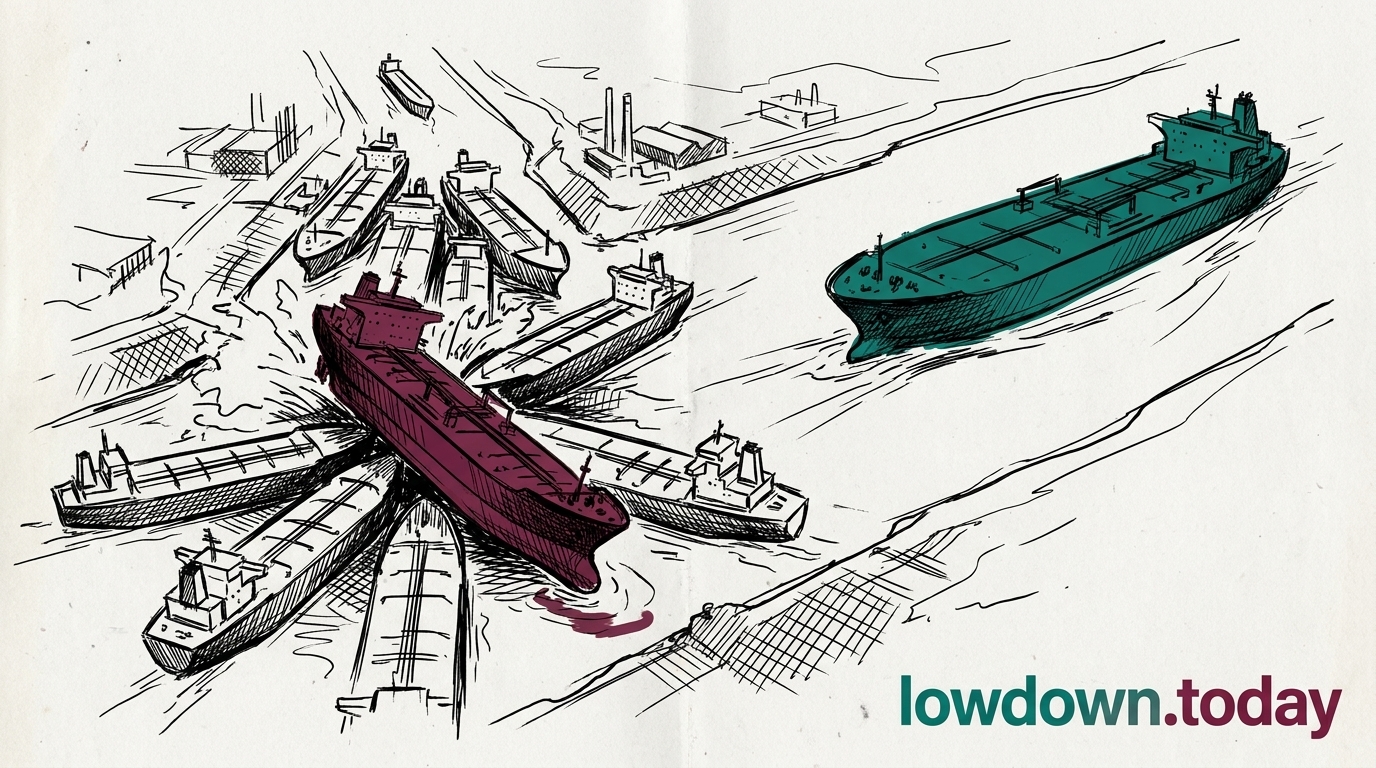
Hours earlier in Manama, US Secretary of State Marco Rubio told the six Gulf Cooperation Council (GCC) foreign ministers that the bloc backed free passage with no charges of any kind, a separate communique that rejects the IRGC scheme outright 2. The Iran-Oman fee committee signed in Muscat two days earlier is still negotiating its management mechanism with no published tariff. Three authorities now claim the same 33-kilometre chokepoint, through which a fifth of the world's oil passes, and each rules out the other two.

The Channel 16 demand rests on the corps's own prior declarations rather than any new capability. The IRGC formally closed Hormuz on 11 June citing Israeli strikes on Lebanon , then mandated insurance through its Persian Gulf Strait Authority and reserved fees from 17 August . Each step has been a press release, not an interdiction. The Korean masters sailed on Thursday; the corps issued a statement. One IRGC boarding of a foreign hull would collapse the divergence between word and act, and none has come.


Deep Analysis

In plain English

The Strait of Hormuz is a narrow waterway, only 33 kilometres wide at its narrowest, between Iran and Oman. About a fifth of the world's oil passes through it every day. Iran's military force, the Revolutionary Guards (IRGC), announced on 25 June that ships must contact them on radio Channel 16 before passing through, or face consequences. Earlier that same morning, international shipping body the IMO and neighbouring Oman had announced their own route for ships to use, toll-free. The IRGC declared that route unacceptable. Meanwhile, the Gulf Arab states and the United States said there should be no fees at all. On a single day, three different authorities announced three different rules for the same stretch of water. Ships from South Korea sailed through anyway, ignoring all three. Whichever authority ships choose to obey, they may be breaking the rules of one of the other two.

Deep Analysis
Root Causes

Iran never ratified the 1982 UN Convention on the Law of the Sea. Its domestic maritime law, updated in 2024, defines 'hostile-linked vessels' as those flagged to states that have imposed sanctions on Iran, a category covering most significant commercial flag states.

The IRGC's Channel 16 mandate derives legal authority from that domestic statute rather than from UNCLOS, which creates a foundational jurisdictional conflict: the international legal order says transit passage through international straits is non-suspendable; Iran's domestic law says the strait is under sovereign management for hostile-linked vessels.

The IRGC holds concurrent roles as Iran's military command, its domestic sanctions authority, and its de facto Hormuz toll operator. No other actor in Iran can countermand a Channel 16 declaration because no other Iranian institution has concurrent maritime jurisdiction.

The civilian Foreign Ministry can negotiate, but the IRGC retains unilateral enforcement authority, which means every diplomatic negotiation runs against a body that has not delegated its enforcement discretion to the parties at the table.

What could happen next?
  • Risk

    If the IRGC boards or detains a foreign-flag vessel that ignored the Channel 16 mandate, it would instantly collapse the price divergence between Brent and physical availability, repricing the war premium markets have fully discounted.

    Immediate · Assessed
  • Precedent

    The IRGC's simultaneous assertion of domestic jurisdiction alongside an Iranian-Omani fee committee and a GCC-US zero-fees position creates a three-body governance problem for Hormuz with no international arbitration mechanism; whichever body enforces first will set the de facto standard.

    Short term · Reported
  • Consequence

    London P&I clubs face a compliance paradox: complying with the IRGC's Channel 16 mandate to reinstate cover breaches OFAC obligations; not complying means no cover and no resumption of insured transits.

    Short term · Assessed
First Reported In

Update #138 · Three flags over Hormuz, none enforced

ANI· 25 Jun 2026
Read original
Causes and effects
This Event
IRGC rejects the Oman Hormuz route
Three incompatible governance claims now cover the Strait of Hormuz on the same day, and the IRGC's is the only one asserting enforcement it has not performed.
Different Perspectives
US money managers (CFTC-tracked)
US money managers had trimmed WTI net long positioning into July's rally, doubting the Hormuz premium would hold without freight or war-risk confirmation, and the crude stock build reported for the week to 17 July gives that scepticism a fundamentals basis. The 25 July CFTC data will show whether Brent's move above $100 changed their calculus.
Asian distillate buyers (Singapore)
Singapore's distillate holders kept retaining middle-distillate barrels as the East-West arbitrage window narrowed further this week, a pattern that sharpened as Fujairah light distillates hit a record low. Cargoes are being held rather than released west into the tightening Mediterranean market.
Bulgaria
Bulgaria
Bulgaria secured the removal of Lukoil founder Vagit Alekperov and Patriarch Kirill from the 21st package, with President Rumen Radev calling a personal listing 'shooting ourselves in the foot'. Sofia is protecting its position in Lukoil's EUR 3bn compensation claim over the 2023 Neftohim Burgas nationalisation.
Russia
Russia
Russia loses the roughly $14 a barrel of legal headroom the price-cap formula would have released toward $58, even as Urals continues trading below Moscow's $59 budget floor. The shadow-fleet insurance workaround that lets sanctioned crude clear above $44 in practice remains untouched by the freeze itself.
European Union
European Union
The EU adopted its 21st sanctions package on 23 July, freezing the $44 Russia oil cap for 12 months rather than letting the formula drift it toward $58, and listed shadow-fleet support vessels for the first time. The package cleared only after three failed Coreper votes.
Marine war-risk underwriters (Lloyd's-linked syndicates)
War-risk syndicates lifted southern Red Sea hull premiums 150% to about 0.75% of hull value after the 20 July blockade declaration, still a seventh of the roughly 5% Hormuz band. Underwriters reset on realised loss, not declared threat, so the 23 July Encelia and Layla strikes set up the next re-mark.