

Skip to content
You can now search across every topic, entity and event.What's new
European Oil Markets
22JUN

Hormuz opened on paper, freight said no

2 min read
09:55UTC

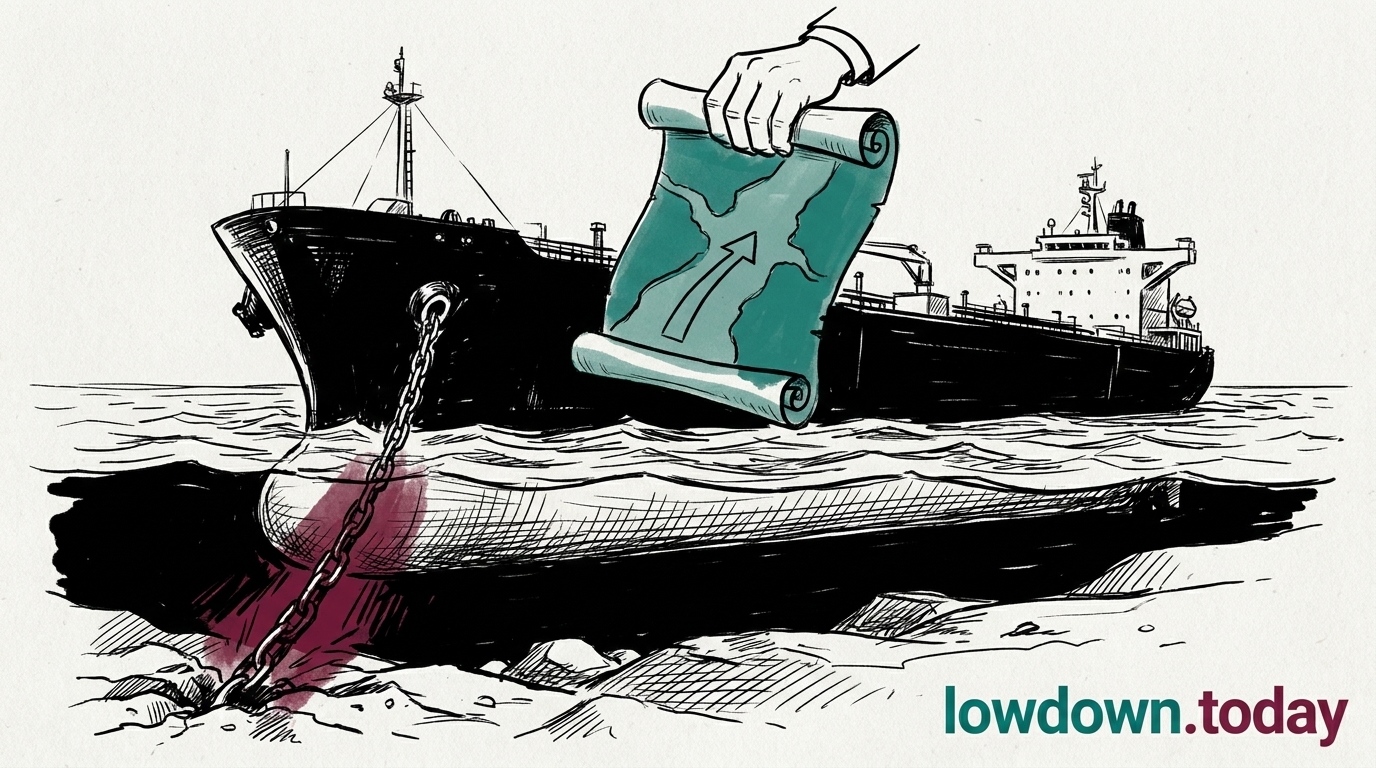
Hormuz opened on paper and the paper market did not buy it. The 18 June US-Iran framework briefly reopened the strait, Iran re-declared it shut on Saturday, and CENTCOM and Kpler still disagree on whether it is moving. Through all of it the freight curve, the Russian-crude enforcement vice and ARA product stocks barely flinched while the flat price whipsawed on diplomacy.

EconomicEIAOFAC
Key takeaway

Four durable market structures held as flat price whipsawed $2.84/bbl on two days of diplomacy.

This briefing mapped
Economic
Regulatory

The TD3C MEG-China VLCC spot held at $412,888/day on 16 June while the Q4 forward sat at $181,163/day, and neither the 18 June US-Iran framework nor Iran's re-closure moved the contango.

Sources profile:This story draws on neutral-leaning sources from United Kingdom and United States
United KingdomUnited States

The Q4 2026 tanker freight contract on The Gulf-to-China route stayed at $181,163 per day. It did not move on the US-Iran ceasefire of 18 June or Iran's re-closure on 20 June. A $231,000 per day gap with today's spot rate remains.

Insurance companies control the timeline. The Lloyd's Joint War Committee war-risk designation takes years to unwind. No mine clearance had started. Kuwait Petroleum said full recovery takes 10-12 weeks after reopening. 

OFAC confirmed on 18 June it would issue no GL 134D successor for Russian crude vessel cover, the EU listed 24 shadow-fleet operators, and Urals spiked to $66.58 against a frozen $44.10 cap.

Sources profile:This story draws on neutral-leaning sources

Three sanctions tools landed within 48 hours. The US Treasury's Russian vessel-services licence expired on 17 June. The EU listed 24 shadow-fleet operators. Europe froze Russia's oil price ceiling at $44.10 until January 2027. Urals at $55-66 per barrel puts Russia $11-22 above that cap.

Whether this bites depends on how much of Russia's fleet still uses Western insurance. The Urals spiked 8.81% to $66.58 on 19 June, reflecting tighter compliance pressure. 

Brent fell to $77.73 on 18 June as the US-Iran framework signed, bounced to $80.57 when the Switzerland talks collapsed, then eased near $80, while the structural spreads barely moved.

Sources profile:This story draws on centre-left-leaning sources from Qatar
Qatar

Brent fell to $77.73 on 18 June when the US-Iran deal was signed. It bounced to $80.57 on 19 June when peace talks collapsed, then settled near $80 by 22 June. The net five-day move was $1.60 per barrel.

The Brent-Dubai spread, which measures Asian versus Atlantic crude demand, stayed flat. Chinese imports hit a near-decade low in May, so Asian buyers were not competing for Gulf oil even when a ceasefire looked possible. 

Sources:Al Jazeera

ARA gasoil stocks fell to a fresh multi-year low of 13.56mb in June as Saudi Arabia's import share collapsed to 12% from 33-37% and the Atlantic basin backfilled the gap.

Sources profile:This story draws on neutral-leaning sources

European diesel reserves at the Rotterdam hub fell to a 25-year low of 13.56 million barrels in June. Saudi Arabia's import share collapsed from 33-37% to 12% because Hormuz closed Persian Gulf loadings, replaced by US (33%) and Brazilian (14%) cargoes.

Shipping from the US Gulf costs $1.50-2.00 per barrel more than the Saudi Suez route. That extra freight cost sits in European diesel prices, and Rotterdam bunker lead-times have stretched to 7-8 days. 

Fujairah middle-distillate stocks more than doubled week-on-week around 18 June while fuel oil held at its 2.05mb floor, and the hub flipped to net fuel-oil exporter at 228kbd.

Sources profile:This story draws on neutral-leaning sources

Fujairah's diesel-type stocks more than doubled in the week around 18 June while fuel-oil stocks stayed near a multi-year low. The United Arab Emirates hub outside Hormuz flipped to net fuel-oil exporter, shipping 228,000 barrels per day to Iraq and Pakistan.

If the Fujairah distillate build holds, it may ease pressure on European diesel by reducing Asian demand for Med barges. The fuel-oil export surge points the other way: regional power generation is drawing down available stocks. 

On 22 June CENTCOM counted 55 merchant ships transiting Hormuz while Kpler tracked only 12, a 43-ship gap analyst Behrouz Bakhtiari attributed to AIS-dark vessels hugging the Omani shore.

Sources profile:This story draws on centre-left-leaning sources from Qatar
Qatar

On 22 June, the US military counted 55 ships crossing Hormuz while tracking firm Kpler counted 12. Supply-chain analyst Behrouz Bakhtiari attributed the 43-ship gap to tankers running without transponders along the Omani coast.

If that dark corridor carries real volume, the $412,888-per-day insured-route freight rate overstates the supply loss. Oil barely moved when Iran re-closed the strait on 21 June: some barrels were already slipping through. 

Sources:Al Jazeera
Closing comments

Sideways with two discrete dated tip-points. The broad structure is in equilibrium at $80 Brent, structural spreads held, and neither MOU nor re-closure shifted the durable signals. First tip-point: GL 131F expires 27 June 2026 with no OFAC transaction licence yet issued for the Lukoil-ISAB sale of the 320kbd Priolo Gargallo refinery; if 27 June passes without a licence, the refinery faces stranding and a discrete Med and NWE diesel-supply shock that the current flat price does not embed. Second tip-point: the EU 15 July cap formula review, where Malta and Greece's block on the maritime-services ban determines whether the $44.10 Russian crude ceiling becomes enforceable or remains a revenue constraint without an insurance chokepoint. The CFTC COT due at approximately 15:30 ET today (22 June) carries the $94,725 WTI net-long position read that determines whether the position book is clean or still flushing going into those events.

AI-assisted, human-edited under the editorial responsibility of Bannermedia Ltd. Reviewed by Ed Woodcock on 22 June 2026. Editorial standards.

Different Perspectives
Saudi Arabia / OPEC+
Saudi Arabia's ARA gasoil import share fell to 12% from 33-37% as Hormuz loadings for Suez-routed European cargoes remain operationally unavailable at 5-10% of pre-war volume. Saudi Arabia holds the swing supply for European diesel but cannot deliver it while the loading leg is closed, embedding Atlantic-basin freight into NWE diesel costs at Saudi expense.
Russia
Russia
GL 134C's lapse on 17 June removed Western P&I cover while Urals printed $55-66/bbl against a $44.10 frozen cap, leaving Russia earning $11-22/bbl above the ceiling it legally cannot access on Western-serviced barrels. Moscow argues the shadow fleet covers the gap; the EU mini-package's 24 new entity designations raise the cost of that workaround.
European Commission
European Commission
The Commission froze the $44.10 Russia oil cap to January 2027, blocking the 15 July auto-lift toward $75/bbl, and adopted the 15 June mini-package listing 24 shadow-fleet operators. Malta and Greece's block on the maritime-services ban leaves the Commission holding a revenue constraint without an enforcement chokepoint at the insurance layer.
US Treasury / OFAC
US Treasury / OFAC
OFAC confirmed no GL 134D on 18 June, establishing a deliberate commodity-class split: gas and civil-nuclear services renewed under GL 55F on 11 June, crude vessel services allowed to lapse. Whether OFAC designates firms that stay in the Russian crude trade is the step that converts a legal lapse into an operational enforcement cliff.
China state refiners
Chinese seaborne crude imports ran at 6.78 mbd in May, the lowest May print in almost a decade, keeping the Brent-Dubai EFS compressed near $2-3. Chinese buyers did not bid up Middle Eastern grades on the 18 June MOU, confirming the EFS non-reaction reflects a demand hole from storage saturation, not a supply-driven re-pricing.
CFTC-tracked money managers
The $94,725 WTI managed-money net long from the week to 9 June sat on $15-18/bbl of mark-to-market losses as WTI fell toward $74.82. The 20 June COT, delayed by Juneteenth and expected at approximately 15:30 ET on 22 June, is the decisive read on whether that book was flushed before the 27 June GL 131F clock.




