ARA
Northwest European refining, storage and barge-pricing hub for oil products.
ARA is Northwest Europe's Amsterdam-Rotterdam-Antwerp refining and storage hub, where Independent gasoil stocks fell to a fresh 2.5-year low of about 13.48 million barrels in The Week to 15 July 2026.
Last refreshed: 3 August 2026 · Appears in 1 active topic
Why are ARA gasoil stocks at a 2.5-year low when imports are rising?
Timeline for ARA
Med diesel crack assessed at $91.67
European Oil MarketsMentioned in: Saudi Red Sea diesel loadings collapse
European Oil MarketsHeld independent gasoil inventories near a two-and-a-half-year low
European Oil Markets: Med refiners face a thinner backfillMentioned in: Fujairah light ends hit record low
European Oil MarketsBuilt fuel-oil stocks 9% higher on lower imports of 175,000 b/d
European Oil Markets: Singapore keeps barrels as ARA buildsBackground
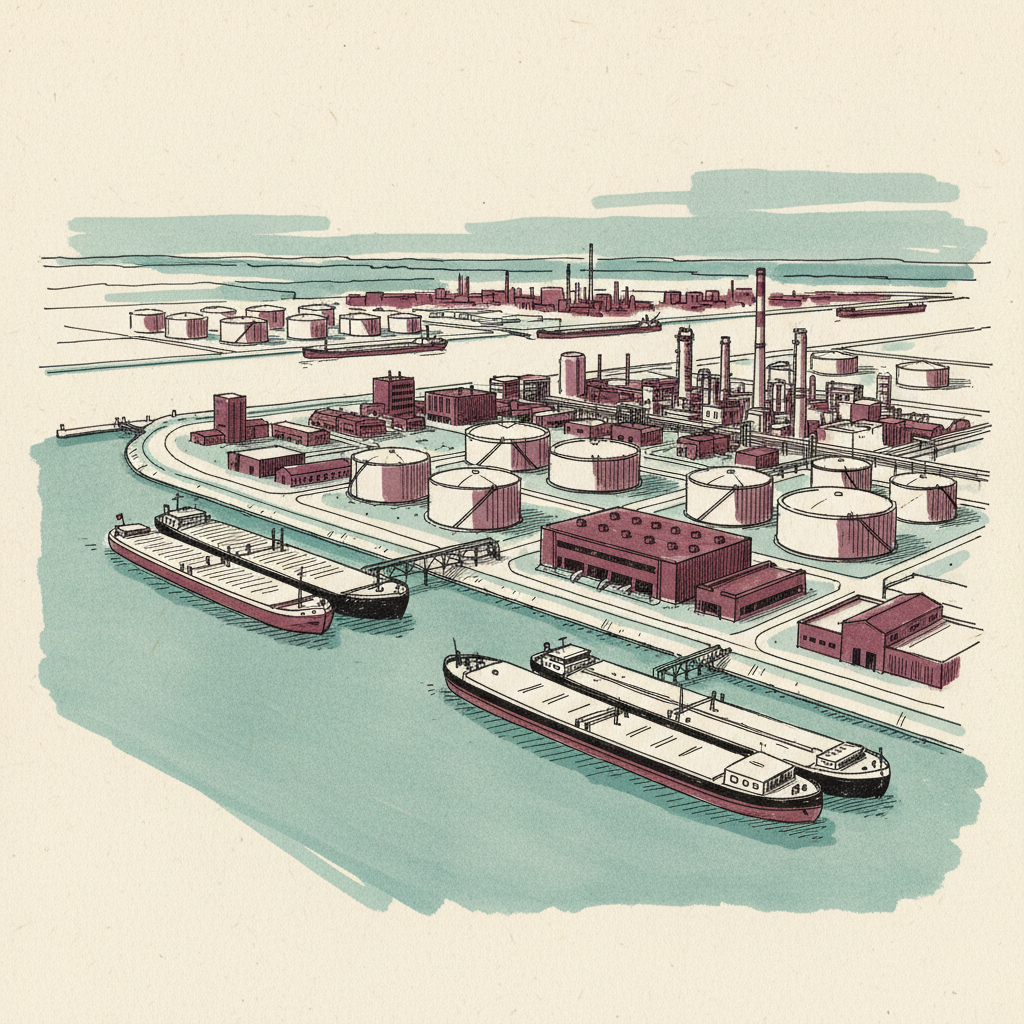
ARA (Amsterdam-Rotterdam-Antwerp) is Northwest Europe's dominant petroleum storage and distribution hub, spanning refineries, Independent tank terminals and inland waterway connections across the Netherlands and Belgium. Independent stocks measured by PJK International are the benchmark cited for European product inventory by the IEA, the European Commission and market participants, and the ICE Gasoil futures contract settles against ARA delivery, making the hub the mechanical reference point for European energy derivatives.
Rotterdam is the cluster's largest individual port, and refining capacity sited there feeds directly into the hub's own stock levels: when a major refinery cuts run rates, ARA's Independent tanks absorb the shortfall first. The hub's supplier mix shifts opportunistically between Middle Eastern, North American and Baltic cargoes depending on freight economics and sanctions exposure, rather than following any fixed sourcing pattern.
Because ARA sits at the pricing centre of the region's gasoil and diesel markets, movements in its Independent stock levels transmit quickly into airline hedging, heating-oil costs and agricultural fuel budgets across the continent, making the hub a leading indicator rather than merely a storage location.
ARA gasoil stocks keep hitting lows
ARA's gasoil stocks recorded their lowest level since November 2014 in The Week to 28 May 2026, a seasonal build month when inventories normally rise. The hub kept sliding rather than recovering: Independent stocks reached a fresh 2.5-year low of about 13.48 million barrels in The Week to 15 July, as imports halved to roughly 84,000 barrels a day from June's 188,000.
For a hub whose entire function is buffering northwest European product supply, that run of lows through a season built for restocking signals its cushion has thinned rather than merely dipped, leaving less spare barrel capacity to absorb the next disruption.
The diesel crack held through a selloff
ARA's own hub crack, the margin refiners earn turning crude into diesel, stood at $85.86 a barrel on 30 July 2026, even as the nearby West Mediterranean crack hit a three-month high of $91.67. That followed weeks in which the hub's own barge-market assessment held firm even as flat crude prices fell, a divergence ARA's pricing captured because the discounted Russian and Iranian barrels EU rules keep out of its market were never there to narrow the margin in the first place.
For ARA, a wide crack that survives a crude selloff is the clearest sign its own stock deficit, not the oil price, is setting northwest European diesel economics right now.
What is the ARA hub in oil markets?
Why do European diesel prices track ARA stocks?
What is PJK and why do oil traders watch it?
What does NWE mean in oil trading?
How much did ARA gasoil imports fall in July 2026?
Where does ARA now source its gasoil imports from?
Written with AI from Lowdown's published reporting. Not individually reviewed by an editor. Updated 3 August 2026. Editorial standards.