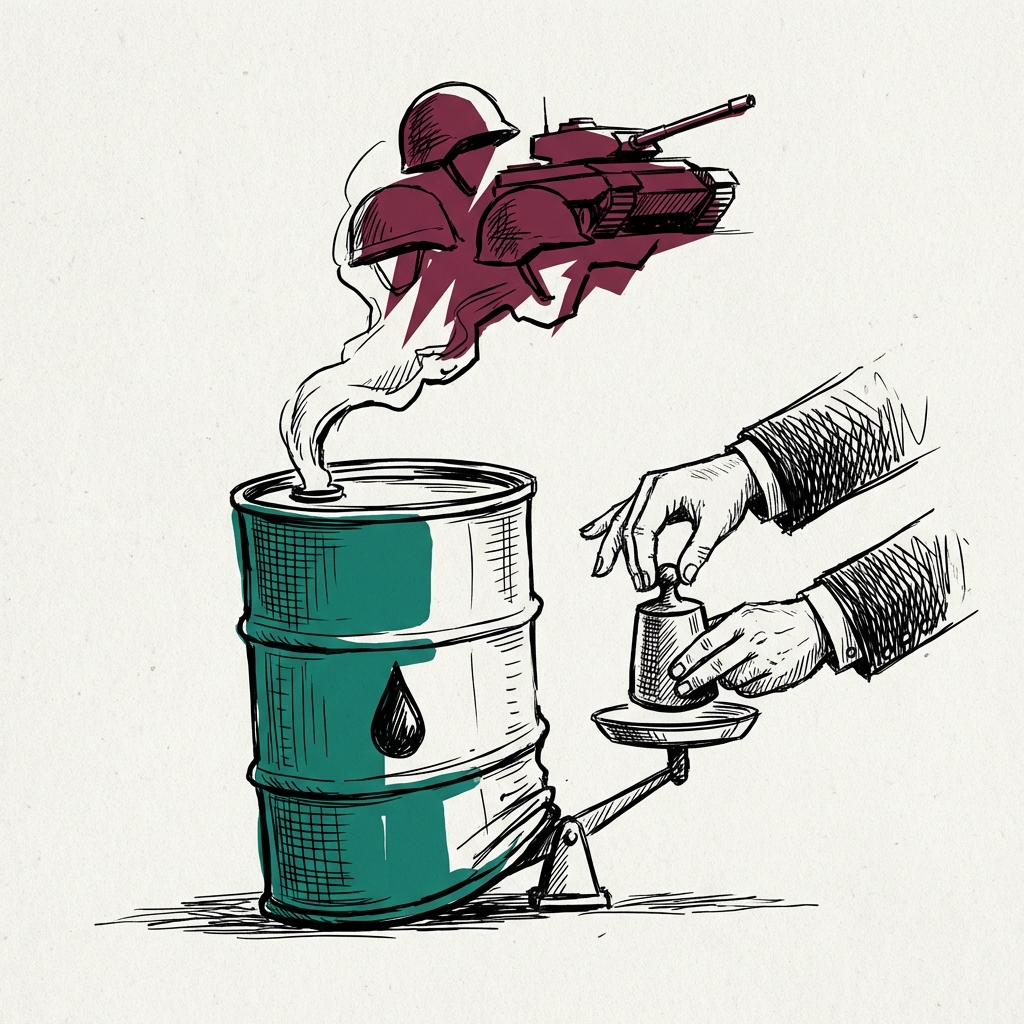
War Premium
Risk premium embedded in energy prices when conflict threatens supply routes or production.
The war premium is the gap between Brent and its $67.41 pre-war baseline; Washington enforced it by force on 14 July, blockading Hormuz, before the premium unwound 4.88% on 3 August as a threatened strike was called off.
Last refreshed: 3 August 2026
How much of the Brent price drop reflects geopolitics vs China demand collapse?
Timeline for war premium
Brent sheds 4.88% on called-off strike
European Oil MarketsUS crude drew 7.2mb as WTI round-tripped
European Oil MarketsStrike halt lands across two days
European Energy MarketsBlockade turns Hormuz threat to fact
Iran Conflict 2026Oil keeps its war premium near $78
Iran Conflict 2026Background
The war premium measures the gap between Brent Crude and the $67.41 a barrel it traded at on 28 February 2026, the day Iran's conflict with the United States began; through 2026 that gap has expanded and contracted with each round of diplomacy and each renewed strike rather than tracking the broader oil price.
It has two structural components that move independently. A permanent element reflects Iran's Hormuz toll system and the physical difficulty of clearing mines and restoring insurance cover once a closure is lifted; an escalation tail reflects the priced risk of a complete strait closure and expands or retires with each round of Ceasefire talk or renewed force. Goldman Sachs' geopolitical-risk pricing has tracked that lag, the gap between a headline and its verification, rather than the headlines themselves.
The record now spans a full unwind below the pre-war baseline while fighting continued, a run of strikes the price ignored entirely, and a blockade that had to be enforced with ships before the market believed it. That behaviour, not a stable additive percentage, is what the concept describes: a premium that can vanish, sit flat, or be forced back into existence depending on whether force has actually been used, not on how intense the conflict sounds.
The premium whipsaws on denial signals
Brent's break below $100 on 23 March, the war's steepest single-day drop, unwound by a third within a day: the rebound to $102-104 on 24 March came as Iran denied ceasefire talks and the Pentagon deployed the 82nd Airborne, leaving the premium at 52-54% above the $67.41 pre-war baseline.
The same pattern, a fall on a de-escalation signal followed by a Snap-back on denial or renewed strikes, is the premium's defining mechanism rather than any single level it reaches. It recurs each time a diplomatic headline meets a market still waiting to see whether the fighting has actually stopped.
The blockade forced the premium back
On 14 July at 20:00 GMT, CENTCOM enforced a naval blockade on Iranian ports, reversing its own claim two days earlier that the strait of Hormuz stayed open; Brent jumped to $87 and daily transits fell to about six ships, after two prior closure declarations had failed to move the market at all.
The premium built by force then proved just as unstable as the one built on rhetoric: a strike halt eased it on 25 July, WTI round-tripped inside three sessions on 29 July, and Brent shed 4.88% on 3 August when a planned strike was called off.
How much has the Iran war added to oil prices?
Why are oil prices still high after the ceasefire?
What is a war premium on oil?
Why did Brent oil drop $14 in May 2026?
What is the Brent-Dubai EFS and why did it spike?
Did the Iran war premium on oil come back in July 2026?
Did the war premium unwind the same way in gas and power in July 2026?

