Skip to content
You can now search across every topic, entity and event.What's new
European Energy Markets
31JUL

Hezbollah kills senior IDF tank officer

3 min read
09:44UTC

Hezbollah killed Lt. Col. Dor Ben Simhon and three crew at Kfar Tebnit hours after the Lebanon talks meant to halt the fighting collapsed in Washington.

EconomicAssessed
Key takeaway

The deal's most senior casualty fell on Lebanon, the very front it was meant to silence.

Hezbollah struck an IDF (Israel Defense Forces) tank at Kfar Tebnit in south Lebanon shortly after midnight on Friday 26 June 1. The strike killed Lt. Col. Dor Gedalia Ben Simhon, 32, commander of the 52nd Battalion, along with three crew. The IDF named them as Staff Sgt. Yoav Klein, 21, Staff Sgt. Liav Kababia, 20, and Staff Sgt. Nave Habshoosh, 20. Ben Simhon, who took command on 20 April, is the most senior Israeli officer killed since the Islamabad Memorandum of Understanding (MoU) was signed on 16 June.

Hezbollah is the Iran-backed Lebanese movement that has fought Israeli forces along the border throughout the war. The crew had been clearing a fortified Hezbollah position on the Ali Taher Ridge, a hilltop south of the Litani River that the IDF now holds. An IDF drone killed a Hezbollah anti-tank commander in retaliation hours later. The loss moves the toll up the chain of command from the Givati Brigade soldier a Hezbollah drone killed two days earlier .

The deal both sides signed required a ceasefire on every front, yet its most senior casualty fell on Lebanon, the one front Iran set as its precondition for nuclear talks . Lebanon's Round 5 talks in Washington had ended on Thursday 25 June with no joint statement and no map for an Israeli withdrawal to the Litani . Lebanese President Joseph Aoun will accept nothing short of a full withdrawal, while Benjamin Netanyahu has ordered his forces to hold their lines south of the Litani . A dead battalion commander on this front keeps the nuclear gate shut.

United Nations monitors have recorded an average of 12 children killed or maimed in Lebanon each day during the fighting, the civilian cost of a process both governments insist is still running 2.


Deep Analysis

In plain English

Hezbollah is a Lebanese armed group that has been fighting Israeli forces in southern Lebanon throughout this conflict. An Israeli army unit was moving at night to capture a fortified Hezbollah position on a hilltop called Ali Taher Ridge when Hezbollah hit their tank with an anti-tank weapon, killing the commander and three of his crew. This matters for the Iran nuclear negotiations because Iran told the United States it would not continue peace talks unless Israel stops its military operations in Lebanon. A senior Israeli officer dying in Lebanon keeps that condition unmet. Israel's Prime Minister Netanyahu has told his forces to stay put in southern Lebanon regardless of the ceasefire deal, so fighting continues even while diplomats meet in Washington.

Deep Analysis
Root Causes

Three structural conditions produced this strike. First, Netanyahu's hold-in-place directive blocks any IDF withdrawal south of the Litani that Lebanon demands and Iran has set as its nuclear precondition. Hezbollah retains doctrinal authority to attack IDF forces on Lebanese territory it considers occupied.

Second, Lebanon-Israel Round 5 collapsed on 25 June without a joint statement or an agreed Litani model-zone map. A failed round clears the diplomatic constraint on Hezbollah operations that a live negotiating window would otherwise impose.

Third, Hezbollah did not sign the Islamabad MOU. The IRGC and Iran's Foreign Ministry signed; Hezbollah did not. Its field commanders retain independent operational authority, which means Tehran cannot unilaterally freeze south Lebanon even when the nuclear track requires it.

Escalation

The killing of an IDF battalion commander raises the casualty threshold on the Lebanon front beyond any exchange since the Islamabad MOU was signed. The prior benchmark was a Givati Brigade soldier killed by drone on 23 June. The IDF's drone retaliation against a Hezbollah anti-tank commander hours later establishes tit-for-tat at the officer level. One step of escalation in grade, not yet in scale.

What could happen next?
  • Consequence

    Iran's nuclear precondition on Lebanon remains unmet. Each IDF officer killed on this front gives Hezbollah's hardliners grounds to argue the war continues, blocking the diplomatic track Tehran needs for sanctions relief.

    Short term · Assessed
  • Risk

    Netanyahu faces domestic pressure to respond to a battalion commander's death with larger-scale operations in south Lebanon, which could widen the front and destabilise the MOU framework.

    Immediate · Suggested
  • Precedent

    Hezbollah has demonstrated it can kill an IDF battalion commander days after Lebanon talks collapsed, establishing that a failed round provides operational cover rather than a restraint on further attacks.

    Medium term · Assessed
First Reported In

Update #139 · A commander dies, the deal binds no one

Times of Israel· 26 Jun 2026
Read original
Different Perspectives
Spain's LNG terminal operators
Spain's 9,145 GWh terminal inventory is the largest single stock in the EU LNG network, an option value that can reroute cargoes wherever the winter strip pays best rather than a cavern gas obligation tied to a fixed date. That flexibility matters more as Germany's cavern shortfall pushes more of the winter security question onto import infrastructure.
European Commission
European Commission
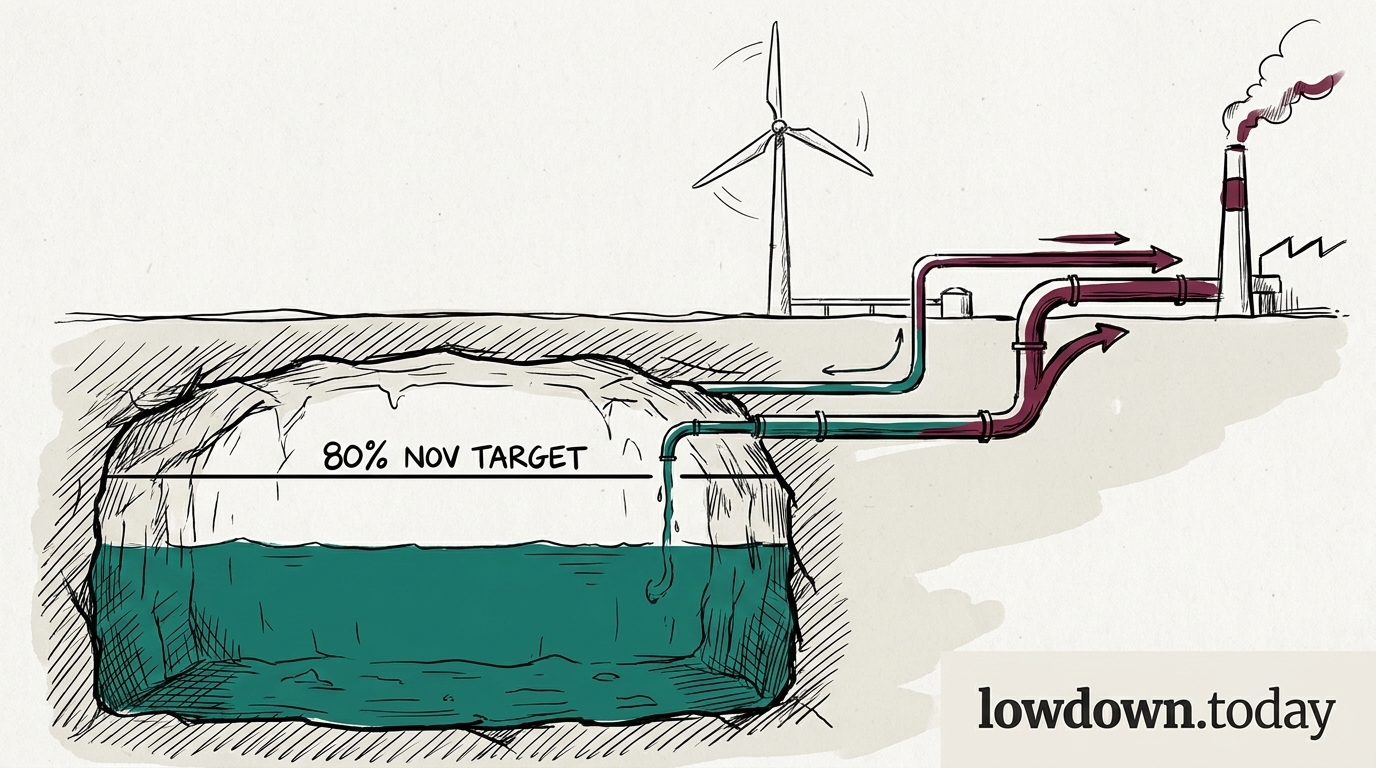
Brussels holds the bloc to 90% on a flexible window while Germany, holding roughly a quarter of EU storage capacity, tracks toward missing its own lower 80% figure by 21 points. A national shortfall this size in the anchor market matters more to bloc security than the flexible timetable alone can absorb.
French power exporters and CRE
French day-ahead rose in step with Germany but by less, reopening a EUR 7-17 premium that makes northward export flows commercially attractive again after the EUR 43.09 discount evaporated in days. CRE separately authorised RTE and Enedis to buy flexibility locally, betting the coming winter's binding constraint is grid congestion rather than a shortage of firm capacity.
TTF trading desk
TTF trading desk
A visible national shortfall like Germany's 21-point gap is a directional signal, not noise, for a desk holding the summer-winter spread. TTF's flat EUR 58-60 range through this week's German price swings says the market has not yet chosen to reprice refill risk into the front of the curve.
German cavern and CCGT operators
German caverns kept buying prompt gas at TTF near EUR 58-60 through the inversion; the wind collapse to 2.4 GW then flipped the spark spread to plus EUR 29 and put turbines back in the same queue. Every day turbines win that bid, injection at a third of the 877 GWh/day pace needed falls further behind.
Slovakia
Slovakia
Slovakia says it dropped its hold-out on the 21st sanctions package only after Ursula von der Leyen personally signed written gas-price and supply guarantees. The Council of the European Union's own 17,238-character release on the package names neither Slovakia nor any guarantee, leaving Bratislava's account unconfirmed by the institutional record.



