Skip to content
Briefings are running a touch slower this week while we rebuild the foundations.See roadmap
European Energy Markets
4JUN

Russian LNG ban lands 25 April, no replacement named

3 min read
10:45UTC

The EU Council's short-term contract ban removes roughly 17 bcm/yr of Russian LNG in ten days and no importer has publicly said where the volume will come from.

EconomicDeveloping
Key takeaway

The hardest EU energy-security cut of 2026 takes effect in ten days with no named substitute supply.

The EU Council's short-term contract ban on Russian LNG enters force on 25 April 2026, ten days from the 15 April print, removing approximately 17 bcm per year, around 13% of EU LNG imports across the first eleven months of 2025 1. Long-term contracts follow on 1 January 2027. Importers must operate under a prior-authorisation system requiring proof of non-Russian origin for every cargo, and member states must notify the Commission of remaining Russian gas contracts within one month of entry-into-force.

The distinction against the 27 March transshipment measure matters. That instrument covered re-export to non-EU destinations, not inbound volumes; Bruegel's dataset confirms it did not materially reduce Russian LNG arrivals at EU terminals . The new instrument is the first that actually blocks Russian LNG at the European border, and the supply arithmetic changes on day one rather than across a transition.

What is missing from every source reviewed is a named replacement. Ras Laffan force majeure remains in force , Atlantic cargo diversions to Asia are now close to a dozen , and record March 2026 volumes read as front-loading rather than a durable bridge 2. At March import patterns the cut displaces roughly 1.3 to 1.6 bcm each month; replacing that from US flexible supply requires winning cargoes on a JKM-TTF spread that has not widened.

For procurement desks the compliance load lands on the 25th and the origin-proof paperwork applies to every non-Russian cargo from the first day. Bruegel's refill estimate did not assume another 17 bcm/yr would be removed on top of an already difficult supply picture. Implementation is certain; the open question is which importer breaks cover first on where the volume will come from.


Deep Analysis

In plain English

Russia has been one of Europe's biggest suppliers of liquefied natural gas, even after the 2022 Ukraine invasion. By early 2026, Russian LNG still made up about 13% of what Europe imported by ship. From 25 April 2026 the EU bans short-term and spot contracts for Russian LNG. Before a tanker can dock, importers will need to provide paperwork proving the cargo is not Russian. The problem is that no EU buyer has publicly announced a replacement supply source. The volume being cut, about 17 billion cubic metres per year, is roughly equivalent to all the gas Norway ships to Germany in a year. It is not a minor adjustment; it requires new suppliers, new ships, and new contracts, none of which have been signed.

Deep Analysis
Root Causes

The EU took three years after the February 2022 invasion to move from voluntary Russian LNG reduction targets to a binding short-term contract ban.

The delay reflects two structural constraints: first, several member states (Belgium, Spain, France) had signed long-term LNG offtake agreements directly with Novatek that were not expiring before 2026, creating legal exposure if the ban was applied retroactively to long-term contracts. The ban's scope is therefore limited to short-term and spot contracts.

Second, no replacement supply was contractually arranged before the ban was passed. Bruegel's estimate that Europe needs 180 additional cargoes versus last summer is based on aggregate volumes; it does not address the specific contract structure (FOB versus DES, US terminal slots, regasification capacity bookings) needed to operationalise that volume. The ban passed the political test; it did not pass the supply-chain test.

What could happen next?
  • Risk

    Russian LNG re-labelling through Turkish or Indian intermediaries could make the ban largely symbolic for 3-6 months, as documented in the 2023 crude oil ban precedent.

  • Precedent

    If ACER's new REMIT reporting instruments (ID:2359) successfully close the origin-certification gap, the combination represents the first genuinely enforceable EU energy sanctions regime, with implications for future sanctions design.

First Reported In

Update #2 · TTF EUR 42 as Russian LNG ban enters range

Council of the European Union· 15 Apr 2026
Read original
Different Perspectives
TTF traders / Amsterdam hub desks
TTF broke its 38-session EUR 46-47 band on 2 June to EUR 48.9 on stalled Iran diplomacy and an unconfirmed Troll A restart; Dutch EBN mandates carry storage trajectory while commercial injection books nothing. The 17 June pipeline expiry is the next binary level: Central European hub premium above EUR 2/MWh widens sharply on any physical step-down.
Red Electrica / Spanish grid operators
Spain logged 397 negative-price hours in Q1 2026, eight times the 48 hours of Q1 2025, documenting midday solar surplus now embedding structurally into Continental pricing. Spain is four to six quarters ahead of France and Germany on the solar-penetration curve, making it the clearest forward indicator of where Continental midday clearing is heading.
Equinor
Equinor
Equinor issued no Troll A restart notice through 4 June despite extending the combined outage to 31 May, keeping up to 51 mcm/day of Norwegian supply offline alongside Hammerfest LNG dark since 22 April. The company's silence follows its 2025 Hammerfest pattern, which ran 24 days past target, and each day without a notice sustains the TTF supply premium.
European Commission / GMTF
SWD(2026)147 found EU gas spot and derivatives markets functioning well on 2 June, recommending MiFID-REMIT legislative alignment rather than emergency intervention. The GMTF verdict addressed derivatives-market integrity, not the physical injection mechanism FNB Gas declared broken five days earlier: the Commission's immediate next step is a legislative proposal, not an emergency storage order.
FNB Gas / Bundesnetzagentur
FNB Gas declared the storage-refill mechanism broken on 27 May after zero bookings in January 2026 auctions, and German day-ahead cleared EUR 102.64 on 3 June on a CCGT stack set by TTF near EUR 49 plus EUA near EUR 78. Winter storage fill now depends on state mandates with no commercial self-correction.
EDF / French government
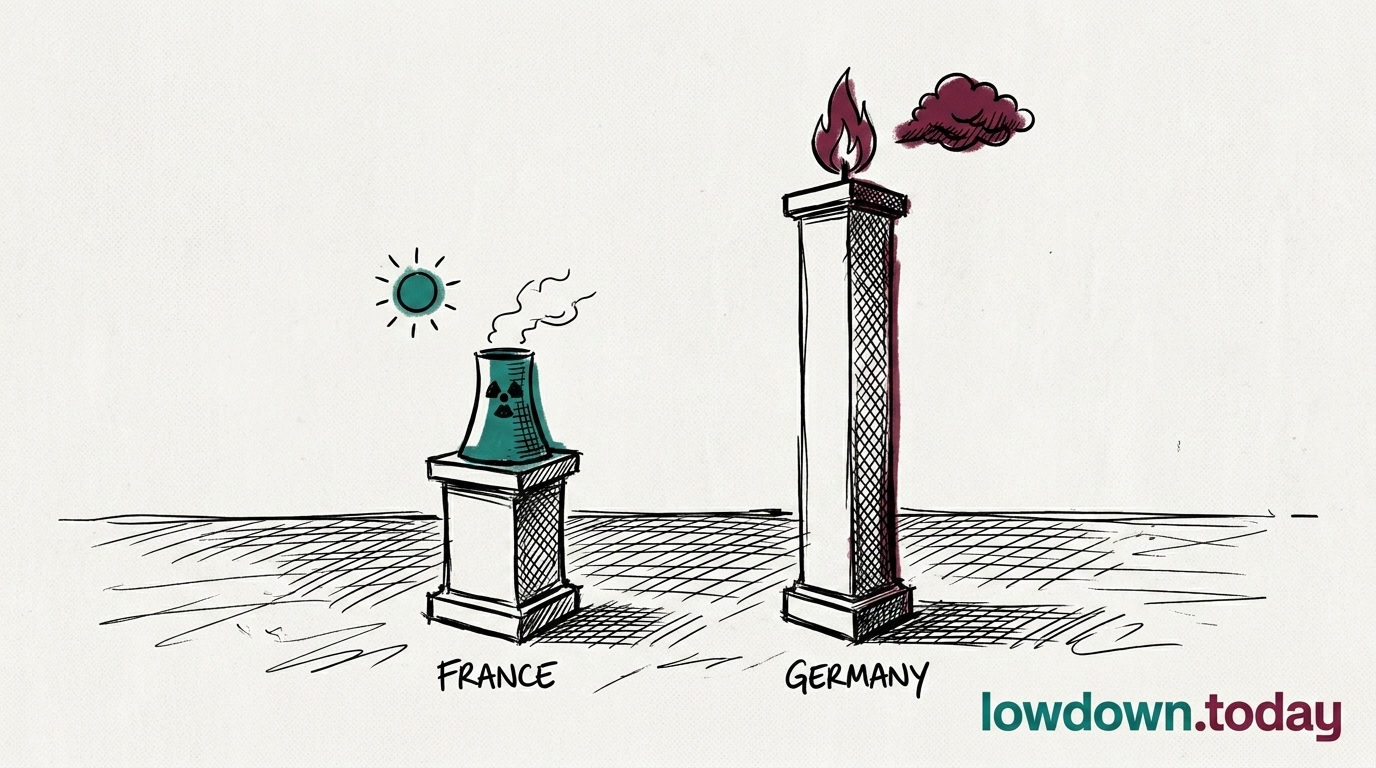
EDF held full-year nuclear guidance at 350-370 TWh after April output of 29.3 TWh, anchoring the surplus that collapsed French day-ahead to EUR 8.96 on 3 June and passed that price to VNU industrials. Flamanville-3's September overhaul removes 1.6 GW at heating-season onset, reversing the nuclear surplus that made VNU pricing competitive.
