Skip to content
Briefings are running a touch slower this week while we rebuild the foundations.See roadmap
European Energy Markets
4JUN

Qatar force majeure hits EU buyers

3 min read
10:45UTC

Strike damage at Ras Laffan knocked 17% of global LNG export capacity offline, and QatarEnergy has told Belgium, Italy, and Poland it cannot deliver.

EconomicDeveloping
Key takeaway

Ras Laffan damage removed 17% of global LNG export capacity with repairs estimated at five years.

QatarEnergy declared force majeure to buyers in Belgium, Italy, and Poland after strikes in early March damaged the Ras Laffan LNG complex. The facility handles 77 million tonnes per annum, roughly 17% of global LNG export capacity. Repairs are estimated at up to five years. 1

The direct EU exposure to Qatari gas is modest: Bruegel puts it at only 4% of total EU gas imports, below one in ten of LNG. But direct exposure understates the mechanism. Qatar's absence tightens the global LNG spot market, where Asian and European buyers compete for the same flexible cargoes. Kpler estimates the monthly supply shortfall from the Qatar and UAE disruption at nearly 6 million tonnes, with alternative sources covering under 2 million tonnes.

Bruegel distinguishes this shock from the Russia crisis. There is no equivalent of the Russian pipeline cut, no bilateral supply relationship severed. The transmission is indirect: global spot market tightening via Asian competition for Atlantic cargoes. Policy tools that worked against a single-supplier disruption (demand reduction mandates, solidarity mechanisms) are less effective because the constraint is global competition, not a bilateral decision.


Deep Analysis

In plain English

Qatar is one of the world's largest exporters of liquefied natural gas (LNG), which is natural gas chilled to liquid form so it can be shipped by tanker. The Ras Laffan industrial complex in Qatar is where most of this gas is processed and loaded onto ships. In March, that facility was damaged in military strikes. Qatar's state energy company, QatarEnergy, has told its customers in Belgium, Italy, and Poland that it cannot fulfil its delivery commitments, a legal declaration called 'force majeure.' This means those countries must find replacement gas supplies elsewhere, at whatever the market price currently is.

Deep Analysis
Root Causes

Ras Laffan's concentration of 77 million tonnes per annum of LNG capacity in a single geographic complex reflects QatarEnergy's deliberate strategy of capital efficiency through co-location.

The North Field expansion project, which is adding a further 49 million tonnes per annum of capacity through 2030, uses the same concentrated onshore processing architecture. This maximises output per dollar invested but creates a single-site vulnerability that no insurance or contract structure can fully hedge.

The force majeure to European buyers specifically (Belgium, Italy, Poland) rather than globally reflects the contractual structure: European buyers purchased under delivered ex-ship terms with destination clauses, giving QatarEnergy discretion over which buyers receive cargo when overall volume is constrained.

Asian buyers under the same Ras Laffan source often have FOB (free on board) contracts, meaning they bear the shipping risk and QatarEnergy's obligation is fulfilled at the Qatari loading terminal.

Escalation

Force majeure duration is the pivotal variable. Ras Laffan repair estimates of up to five years (if structural damage is severe) would make this a multi-year supply disruption rather than a one-season event. Independent engineering assessments of the damage have not been published; current market pricing implies traders expect a six to eighteen month disruption.

What could happen next?
  • Risk

    If Ras Laffan repairs extend beyond 12 months, European LNG contract structures will face systematic repricing at renewal, eliminating the Brent-indexed cost advantage that European buyers have relied on since 2015.

  • Consequence

    European buyers receiving force majeure declarations face spot replacement premiums of EUR 300-500 million per cargo at current spread, materially affecting national gas company balance sheets in Belgium, Italy, and Poland.

First Reported In

Update #1 · Europe's thinnest gas cushion since 2018

Kpler· 13 Apr 2026
Read original
Causes and effects
This Event
Qatar force majeure hits EU buyers
The force majeure removes the single largest source of flexible LNG from the global market at the start of the European injection season, when competition for cargoes is most intense.
Different Perspectives
TTF traders / Amsterdam hub desks
TTF broke its 38-session EUR 46-47 band on 2 June to EUR 48.9 on stalled Iran diplomacy and an unconfirmed Troll A restart; Dutch EBN mandates carry storage trajectory while commercial injection books nothing. The 17 June pipeline expiry is the next binary level: Central European hub premium above EUR 2/MWh widens sharply on any physical step-down.
Red Electrica / Spanish grid operators
Spain logged 397 negative-price hours in Q1 2026, eight times the 48 hours of Q1 2025, documenting midday solar surplus now embedding structurally into Continental pricing. Spain is four to six quarters ahead of France and Germany on the solar-penetration curve, making it the clearest forward indicator of where Continental midday clearing is heading.
Equinor
Equinor
Equinor issued no Troll A restart notice through 4 June despite extending the combined outage to 31 May, keeping up to 51 mcm/day of Norwegian supply offline alongside Hammerfest LNG dark since 22 April. The company's silence follows its 2025 Hammerfest pattern, which ran 24 days past target, and each day without a notice sustains the TTF supply premium.
European Commission / GMTF
SWD(2026)147 found EU gas spot and derivatives markets functioning well on 2 June, recommending MiFID-REMIT legislative alignment rather than emergency intervention. The GMTF verdict addressed derivatives-market integrity, not the physical injection mechanism FNB Gas declared broken five days earlier: the Commission's immediate next step is a legislative proposal, not an emergency storage order.
FNB Gas / Bundesnetzagentur
FNB Gas declared the storage-refill mechanism broken on 27 May after zero bookings in January 2026 auctions, and German day-ahead cleared EUR 102.64 on 3 June on a CCGT stack set by TTF near EUR 49 plus EUA near EUR 78. Winter storage fill now depends on state mandates with no commercial self-correction.
EDF / French government
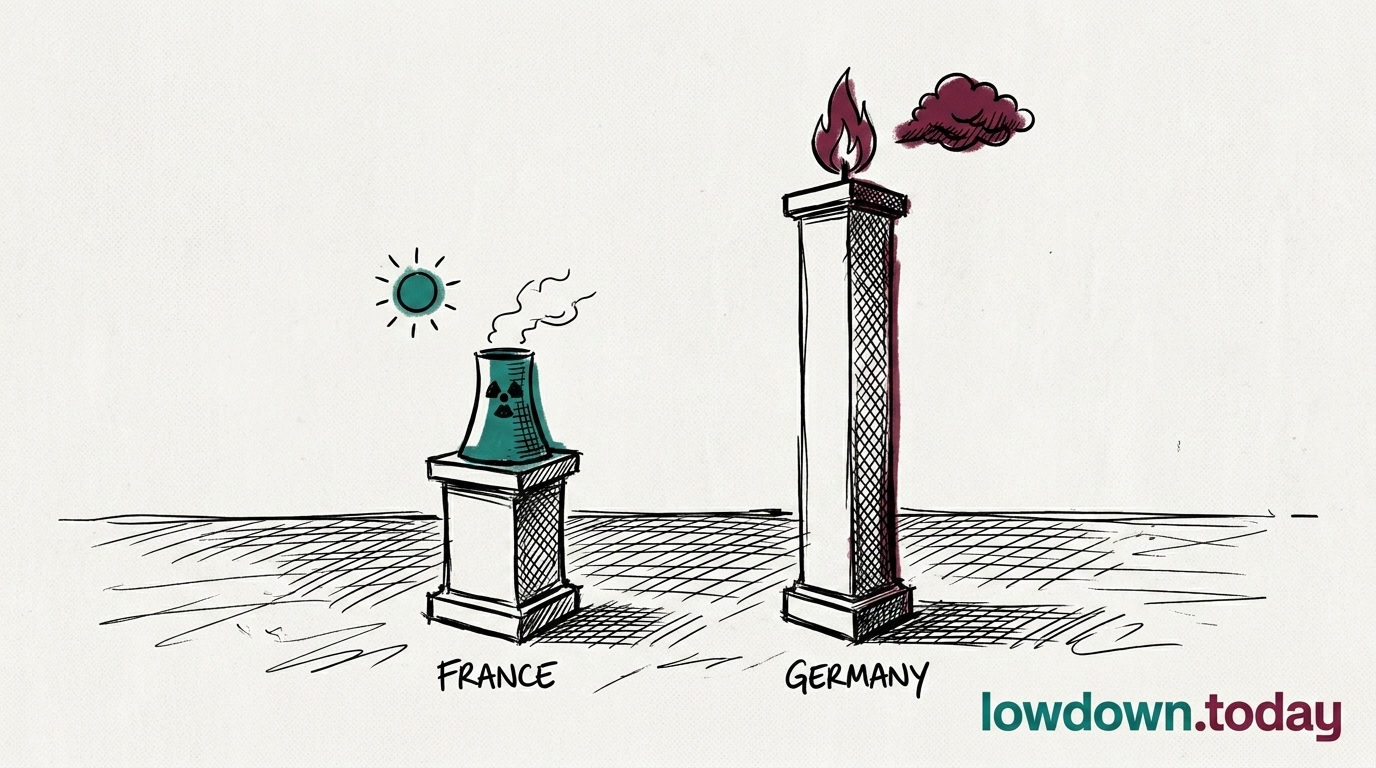
EDF held full-year nuclear guidance at 350-370 TWh after April output of 29.3 TWh, anchoring the surplus that collapsed French day-ahead to EUR 8.96 on 3 June and passed that price to VNU industrials. Flamanville-3's September overhaul removes 1.6 GW at heating-season onset, reversing the nuclear surplus that made VNU pricing competitive.
