Skip to content
Briefings are running a touch slower this week while we rebuild the foundations.See roadmap
European Energy Markets
4JUN

Kunpeng rejected at Dahej, LNG sanctions hold

3 min read
10:45UTC

The LNG vessel Kunpeng was rejected by India's Dahej terminal in early May over US Treasury sanctions on its Portovaya cargo. AIS satellite tracking made the Russian origin traceable despite reported documentation obfuscation.

EconomicDeveloping
Key takeaway

Kunpeng is the first public test of an LNG sanctions architecture the Russian oil sanctions framework never matched.

The Kunpeng (138,200 cubic metres of LNG capacity), carrying cargo from Russia's Portovaya Baltic LNG facility, was rejected by India's Dahej LNG Terminal in early May 2026 over US Treasury sanctions designations. Shipping documentation reportedly attempted to obscure Russian cargo origin; AIS satellite tracking made the route traceable. As of Tuesday 12 May the vessel was stranded near Singapore with no declared destination.

The case is the first public test of the LNG sanctions enforcement architecture built under the EU's 20th package . LNG cryogenic constraints prevent ship-to-ship transfer at scale, the structural feature dark-fleet operators in the Russian oil trade exploited; the AIS chain from Portovaya loading to Dahej rejection is unbreakable, and any falsified bill of lading is contradicted by the satellite track. Separately, the Arc7 dry-dock carve-out under April's EU ban remains unresolved: six Yamal LNG carriers (Rudolf Samoylovich, Georgiy Brusilov, Boris Davydov, Vladimir Vize, Nikolay Zubov, Nikolay Yevgenov) are due summer 2026 dry-dock servicing, and EU yards are prohibited under the ban.


Deep Analysis

In plain English

Russia exports some of its gas in liquid form, loaded onto specialist tankers called LNG vessels. One of these tankers, the Kunpeng, was turned away from a port in India because it was carrying Russian gas under Western sanctions. It is now floating near Singapore with nowhere to go. Unlike Russian oil tankers, which can transfer their cargo to other ships at sea to hide its origin, LNG tankers cannot do this because the gas has to be kept at extreme cold temperatures, making the tracking system much harder to beat.

Deep Analysis
Root Causes

LNG's physical properties, specifically the requirement for specialised cryogenic storage at minus 162 degrees Celsius, prevent the ship-to-ship cargo transfer that has been the primary evasion mechanism for Russian oil sanctions since 2022.

The 25 April 2026 EU ban on Russian LNG short-term contracts, combined with pre-existing US Treasury secondary sanctions on Portovaya-origin cargo, created overlapping enforcement jurisdictions that Indian terminal operators could not ignore without risking their own dollar-clearing access.

Russian LNG operators' reliance on documentation obfuscation (false bills of lading) as the primary evasion tactic was already defeated by the 2022-24 expansion of AIS satellite constellation coverage, which reduced gaps in the tracking chain to under two hours in most ocean basins.

What could happen next?
  • Meaning

    Asian terminal operators from Dahej to South Korea now face reputational and secondary-sanctions pressure on any cargo with origin obfuscation, effectively extending US Treasury enforcement reach to every major LNG import terminal without a formal bilateral agreement.

    Short term · Assessed
  • Meaning

    The Arc7 dry-dock carve-out for six Yamal LNG carriers due summer 2026 servicing remains unresolved; if no EU yards accept the vessels, the carve-out becomes the next structural test of the sanctions architecture.

    Short term · Assessed
  • Meaning

    Russia's LNG export infrastructure depends on Western Arctic technology for liquefaction train maintenance; the Kunpeng enforcement precedent accelerates the timeline on which Novatek must find non-Western service providers.

    Short term · Assessed
First Reported In

Update #10 · TTF breaks EUR 50; US LNG hits 58% of imports

Discovery Alert· 18 May 2026
Read original
Different Perspectives
TTF traders / Amsterdam hub desks
TTF broke its 38-session EUR 46-47 band on 2 June to EUR 48.9 on stalled Iran diplomacy and an unconfirmed Troll A restart; Dutch EBN mandates carry storage trajectory while commercial injection books nothing. The 17 June pipeline expiry is the next binary level: Central European hub premium above EUR 2/MWh widens sharply on any physical step-down.
Red Electrica / Spanish grid operators
Spain logged 397 negative-price hours in Q1 2026, eight times the 48 hours of Q1 2025, documenting midday solar surplus now embedding structurally into Continental pricing. Spain is four to six quarters ahead of France and Germany on the solar-penetration curve, making it the clearest forward indicator of where Continental midday clearing is heading.
Equinor
Equinor
Equinor issued no Troll A restart notice through 4 June despite extending the combined outage to 31 May, keeping up to 51 mcm/day of Norwegian supply offline alongside Hammerfest LNG dark since 22 April. The company's silence follows its 2025 Hammerfest pattern, which ran 24 days past target, and each day without a notice sustains the TTF supply premium.
European Commission / GMTF
SWD(2026)147 found EU gas spot and derivatives markets functioning well on 2 June, recommending MiFID-REMIT legislative alignment rather than emergency intervention. The GMTF verdict addressed derivatives-market integrity, not the physical injection mechanism FNB Gas declared broken five days earlier: the Commission's immediate next step is a legislative proposal, not an emergency storage order.
FNB Gas / Bundesnetzagentur
FNB Gas declared the storage-refill mechanism broken on 27 May after zero bookings in January 2026 auctions, and German day-ahead cleared EUR 102.64 on 3 June on a CCGT stack set by TTF near EUR 49 plus EUA near EUR 78. Winter storage fill now depends on state mandates with no commercial self-correction.
EDF / French government
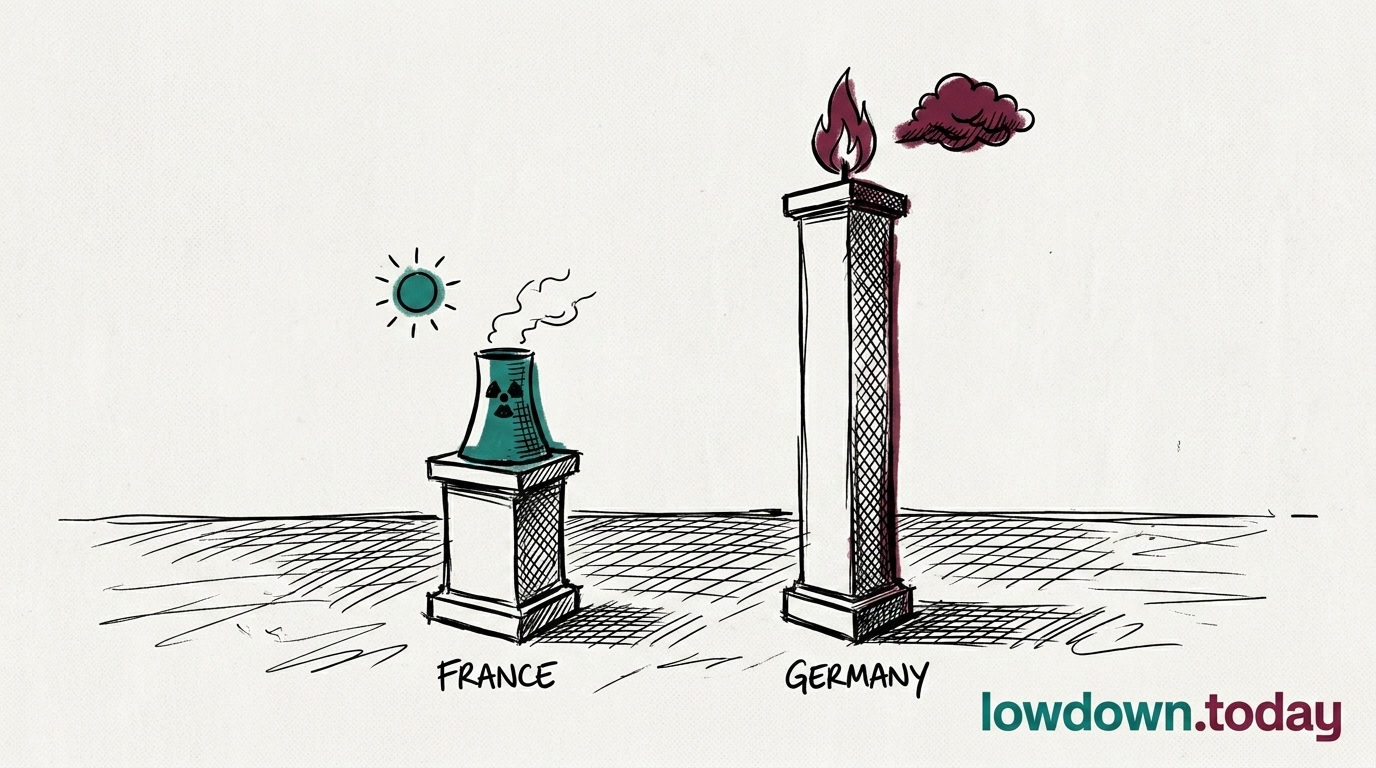
EDF held full-year nuclear guidance at 350-370 TWh after April output of 29.3 TWh, anchoring the surplus that collapsed French day-ahead to EUR 8.96 on 3 June and passed that price to VNU industrials. Flamanville-3's September overhaul removes 1.6 GW at heating-season onset, reversing the nuclear surplus that made VNU pricing competitive.
