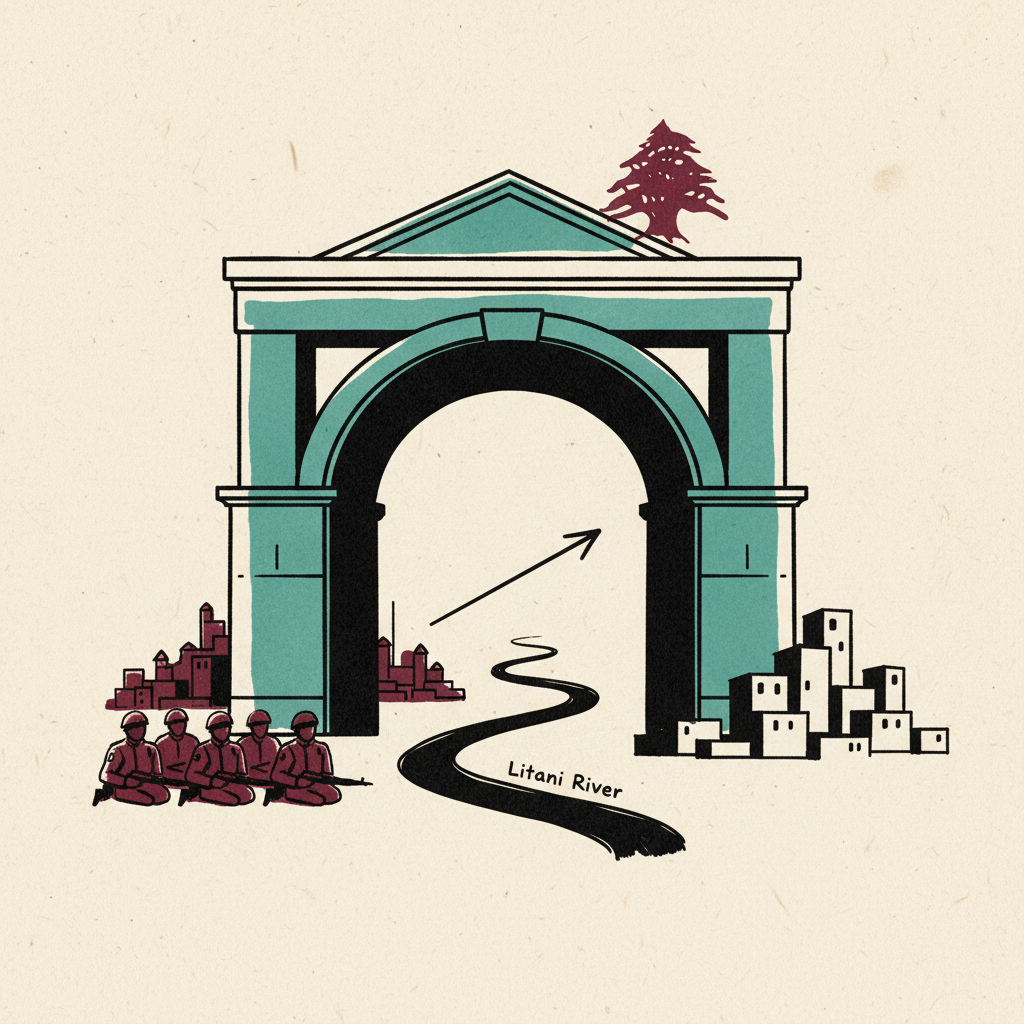
Washington Lebanon framework
US-brokered Israel-Lebanon ceasefire framework announced 4 June 2026, requiring Hezbollah to withdraw north of the Litani before any Israeli withdrawal.
Last refreshed: 23 July 2026 · Appears in 1 active topic
Will Hezbollah actually withdraw north of the Litani under the Washington framework?
Timeline for Washington Lebanon framework
Mentioned in: IDF kills a Lebanese army colonel
Iran Conflict 2026Mentioned in: IDF kills engineer, warns three villages
Iran Conflict 2026Mentioned in: Aoun tells CNN Iran uses Lebanon
Iran Conflict 2026Announced between Israel and Lebanon, requiring Hezbollah withdrawal north of the Litani before Israeli withdrawal
Iran Conflict 2026: Hezbollah veto stalls the Iran-US dealBackground
The Washington Lebanon framework is a conditional Ceasefire instrument announced on 4 June 2026, brokered by the United States following a month of parallel military escalation and diplomatic manoeuvring over the Lebanon front. Its core terms require Hezbollah to cease fire immediately, withdraw operatives and fighters north of the Litani River, and allow Lebanese Armed Forces to assume exclusive control of pilot zones in southern Lebanon; Israeli military withdrawal follows compliance rather than running concurrently. Lebanon-Israel political talks were scheduled to resume in The Week of 22 June 2026. The framework was agreed between Beirut and Jerusalem; Hezbollah was not party to the negotiations in Washington.
The framework emerged from a sequence that began on 1 June 2026 when Donald Trump phoned Benjamin Netanyahu in an expletive-laden call halting planned Israeli strikes on Beirut, and Lebanon announced a partial Ceasefire under which Hezbollah pledged to stop attacking Israel — the first documented Israeli military reversal under US pressure in 95 days of conflict. That halt was Beirut-only; IDF ground operations in the south continued, with Israeli forces capturing Beaufort Castle and advancing toward the Zaharani river through the same period. On 4 June, the full framework was announced; the same day a UNIFIL peacekeeper was killed near Marjayoun by mortar fire, and IDF Chief Zamir stated publicly that 'there is no ceasefire for our forces'.
The framework's diplomatic weight was immediately contested. Hezbollah Secretary-General Naim Qassem rejected it in a televised address on 4 June, calling it 'absurd, humiliating and insulting'. Iran's Foreign Minister Abbas Araghchi simultaneously refused to decouple the Lebanon ceasefire track from the broader Iran-US Memorandum of Understanding, warning that any Israeli attack on Beirut would trigger a full-scale resumption of the war. Donald Trump told reporters he had spoken to Hezbollah and they 'did not reject' the offer, directly contradicting Qassem's broadcast. Iran's linkage of the Lebanon track to the Iran-US MoU means the framework cannot be treated as a self-contained bilateral instrument; its viability depends on the wider Iran-US negotiation finding a text that Khamenei, communicating only through written couriers on a three-to-five-day lag, will endorse.
As a diplomatic instrument the Washington Lebanon framework sits between the November 2006 UNSCR 1701 architecture — which established the Litani line as the withdrawal boundary after the 2006 Lebanon War — and the practical reality of the 2026 campaign. Its terms reproduce the UNSCR 1701 withdrawal logic, but Hezbollah retains veto power over implementation while Iran retains linkage leverage through the MOU track. The framework may prove a foundation for a durable arrangement or a transitional posture; as of 5 June 2026 it has been announced but not ratified, rejected by the principal armed party, and overtaken militarily by continued IDF operations south of the Litani.
What is the Washington Lebanon framework?
Did Hezbollah accept the Washington Lebanon ceasefire deal?
Why is the Litani River the ceasefire line in the Lebanon deal?
How is the Lebanon ceasefire connected to the Iran nuclear deal?
Is Israel still fighting in Lebanon while the Washington framework is being discussed?


Written with AI from Lowdown's published reporting. Not individually reviewed by an editor. Updated 23 July 2026. Editorial standards.